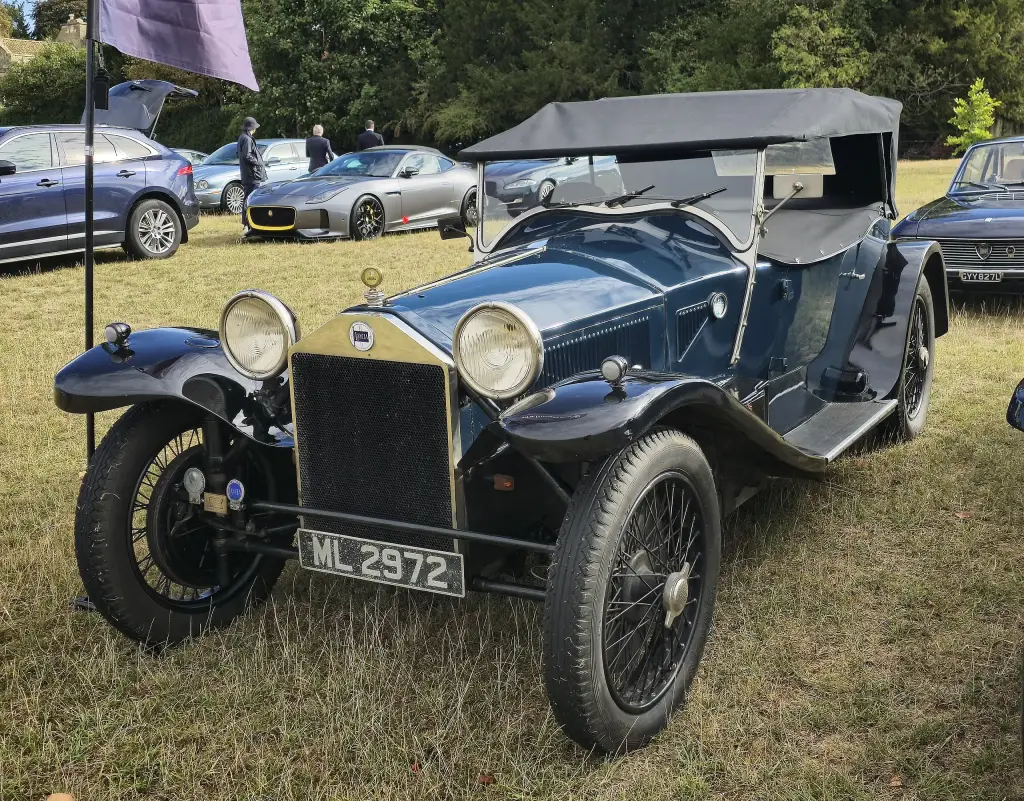
The Lancia Lambda was produced from 1922 to 1931 and was one of the most influential cars of its era. It was the first car with a load-bearing unitary body, without a stressed roof, and it pioneered independent front suspension of the sliding pillar type with coil springs. Vincenzo Lancia even invented a shock absorber for it, and it had excellent four-wheel brakes. About 13,000 were built in nine series.
Lancia Lambda at a glance
| Maker | Lancia, Turin |
|---|---|
| Production | 1922–1931 |
| Shown | Paris and London shows, autumn 1922 |
| Construction | load-bearing unitary body |
| Engine | narrow-angle V4, single overhead camshaft |
| V angle | 13 degrees, 14, then 13 degrees 40 minutes |
| Stroke | 120 mm in all three displacements |
| Front suspension | sliding pillar with coil springs |
| Brakes | four-wheel brakes |
| Series | nine |
| Total built | about 13,000 |
| Replaced by | Lancia Artena and Astura |
History of the Lancia Lambda
A patent drawn in 1918
Vincenzo Lancia filed a patent application on 7 December 1918, granted on 28 March 1919 as number 171,922, for a new kind of car. Its sketches showed a spindle-shaped body with a circular radiator and semi-independent front suspension on a transverse leaf spring, but the revolutionary element was the abandonment of the conventional chassis with side members in favour of a load-bearing shell of pressed sheet steel. Lancia worked with the Stola works to build it. The floor sat much lower than usual because the propeller shaft ran in a tunnel inside the cabin, so passengers sat beside it rather than above it. According to Pinin Farina, the idea came to Lancia from the structure of a ship, while the independent front suspension followed a broken front leaf spring on his own Kappa.
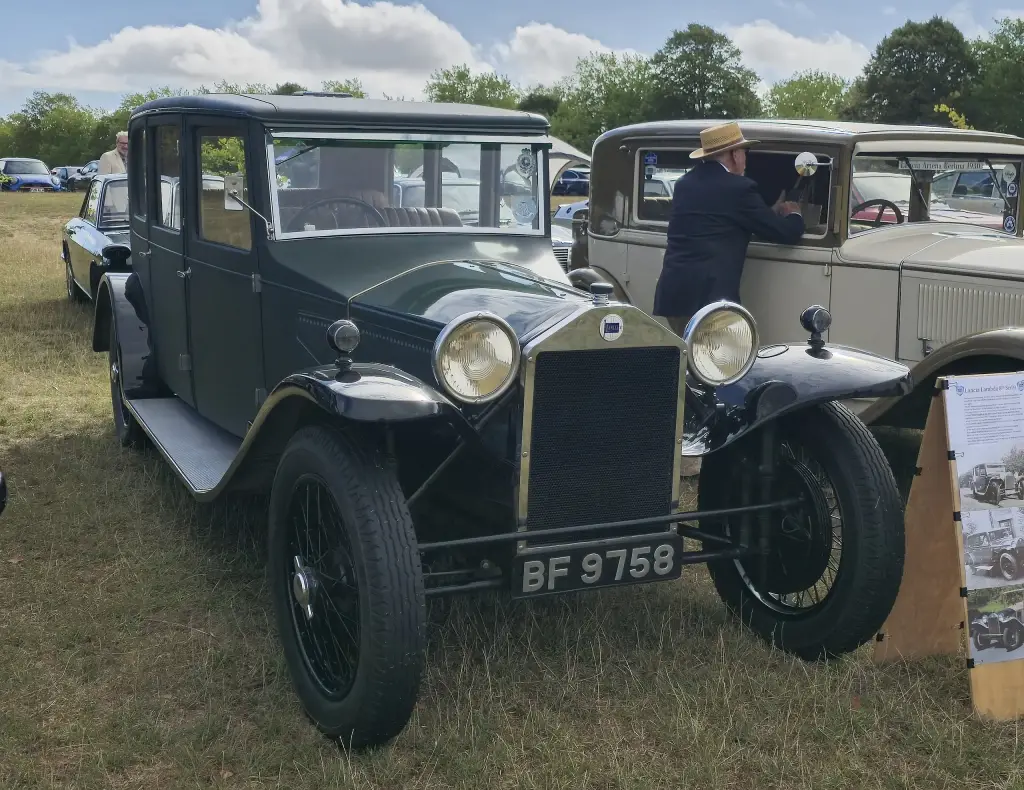
Development and production
A first prototype was ready on 1 September 1921, and Vincenzo himself began testing it with Luigi Gismondi on the road to the Moncenisio pass. The definitive car added front brakes, which the prototype lacked because Lancia had long distrusted them. The sliding pillar suspension needed a new hydraulic damper concentric with the spring, since friction dampers could not be used. The Lambda was shown at the Paris and London shows in the autumn of 1922, with production and deliveries starting in mid-1923. Its roadholding, thanks to independent suspension and a rigid shell, was far better than that of contemporary cars, especially on the rough roads of the period, and top speed rose from under 115 km/h in the early series to more than 120 km/h later.
Nine series
The first series of 1923 accounted for 400 cars, the second of 1923–1924 for 1,100 with minor engine changes, the third of 1924 for 800 with a modified engine and the fourth of 1924–1925 for 850 with a modified windscreen. The fifth series of 1925 (1,050 cars) brought a four-speed gearbox, and the sixth of 1925–1926 (1,300 cars) was sold as a bare chassis with two wheelbases. The seventh series of 1926–1928 (3,100 cars) introduced a new, larger engine and the eighth of 1928–1930 (3,903 cars) a larger one again, while the ninth of 1931 (500 cars) was sold only as a bare chassis. All three engine sizes shared the same long 120 mm stroke, and the narrow-angle aluminium V4 had a single camshaft serving both banks.
Reputation and successors
Many Lambdas were used in competition and from the second half of the 1920s distinguished themselves in the three-litre touring and sports classes. The car was sold in Italy for more than eight years and was also successful abroad: in the five years from 1926 to 1930 exports took more than 40 per cent of production. A first-series torpedo cost 43,000 lire. The Lambda was replaced at the 1931 Paris show by the more conventional and cheaper Artena, with which Lancia returned to a separate chassis, and by the larger Astura.
Design and features
- Unitary body: the first car with a load-bearing shell instead of a separate chassis.
- Independent front suspension: sliding pillars with coil springs and concentric hydraulic dampers.
- Low floor: the propeller shaft ran in a tunnel inside the cabin.
- Strong roadholding: far better than rivals on the rough roads of the 1920s.
Lancia Lambda versions
- Series 1–4: the early cars of 1923–1925 with the original body and engine.
- Series 5: four-speed gearbox.
- Series 6: bare chassis and two wheelbases.
- Series 7–9: larger engines and the final chassis-only series of 1931.
The Lambda was the technical ancestor of the Lancia Augusta and Lancia Aprilia, and it was replaced by the Lancia Artena and Lancia Astura. More cars are in the Lancia collection.
Sources
- Lancia Lambda, English Wikipedia: series and production numbers, engine
- Lancia Lambda, Italian Wikipedia: patent, development, testing, sales and exports