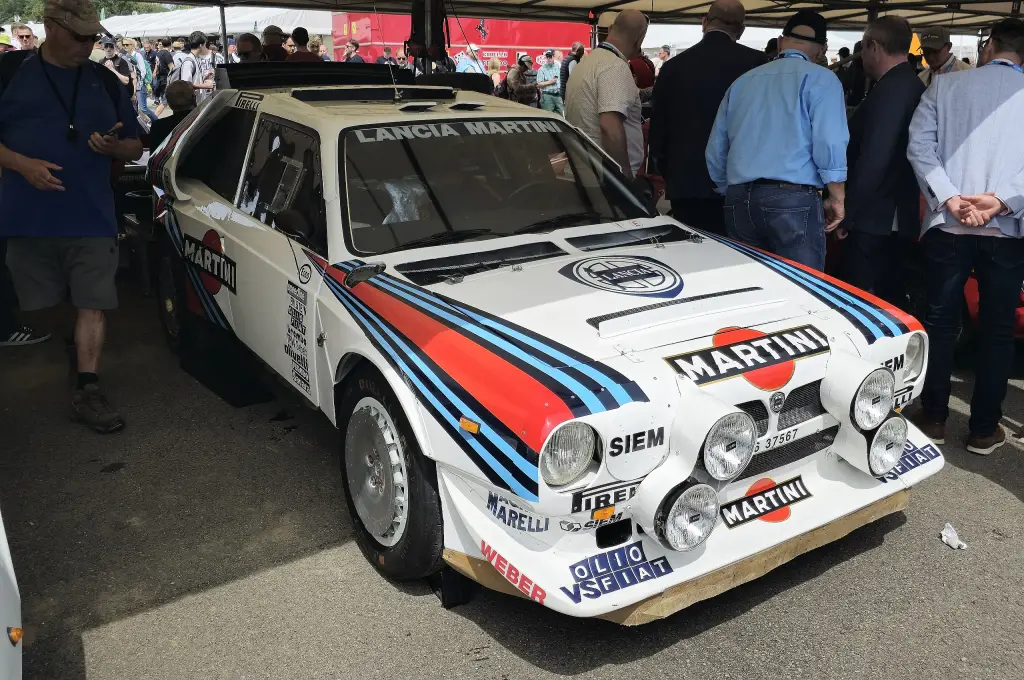
The Lancia Delta S4, known by its Abarth project code SE038, is a Group B rally car manufactured by Lancia. It competed in the World Rally Championship in 1985 and 1986, until the Group B class was disbanded and the cars were banned by the FIA. It replaced the 037 and used a mid-mounted engine and four-wheel drive for traction on loose surfaces.
Lancia Delta S4 at a glance
| Competed | World Rally Championship, 1985 and 1986 |
|---|---|
| Complete chassis built | 28 |
| Engine | 1,759 cc inline-four, supercharged and turbocharged (twincharged) |
| Race output | 490 PS (360 kW); some sources say 500 PS |
| Minimum weight | 890 kg (1,962 lb), in the under-2,500 cc class |
| Drive | four-wheel drive with a centre differential sending 60–75% of torque to the rear |
| Gearbox | 5-speed by Hewland |
| Body | carbon-fibre composite, detachable front and rear sections |
| Road car (Stradale) | 250 PS, 225 km/h (140 mph), 0–100 km/h in 6.0 seconds; planned 200, fewer than 100 built |
| Price of the Stradale | about 100 million lire |
This page is based on English Wikipedia only (a trusted source), so the facts were not cross-checked against a second source.
History of the Lancia Delta S4
The Delta S4 took full advantage of the Group B rules. Like Peugeot’s 205 T16 before it, the mid-engined S4 was a “silhouette” race car, a rally car dressed as the production Delta for marketing; it shared practically nothing in construction with the front-engined road Delta. The chassis was a tubular space frame, like the 037’s, with long-travel double-wishbone suspension front and rear. The bodywork was a carbon-fibre composite with front and rear sections that could be removed quickly for repairs, and carried aerodynamic aids including a front splitter, winglets in the bumper and a rear deck-lid wing.
Twincharging
The 1,759 cc engine combined supercharging and turbocharging. The FIA applied a multiplier of 1.4 to forced-induction engines, so this capacity put the S4 in the under-2,500 cc class, which allowed a minimum weight of 890 kg. The turbocharger had a boost threshold of about 4,500 rpm, below which it gave little help; an Abarth Volumex supercharger, driven by the crankshaft, provided low- and mid-range boost and improved response, at the price of a parasitic power loss. The Delta S4 was the first example of this twincharged technology, and it produced up to 490 PS.
Motorsport
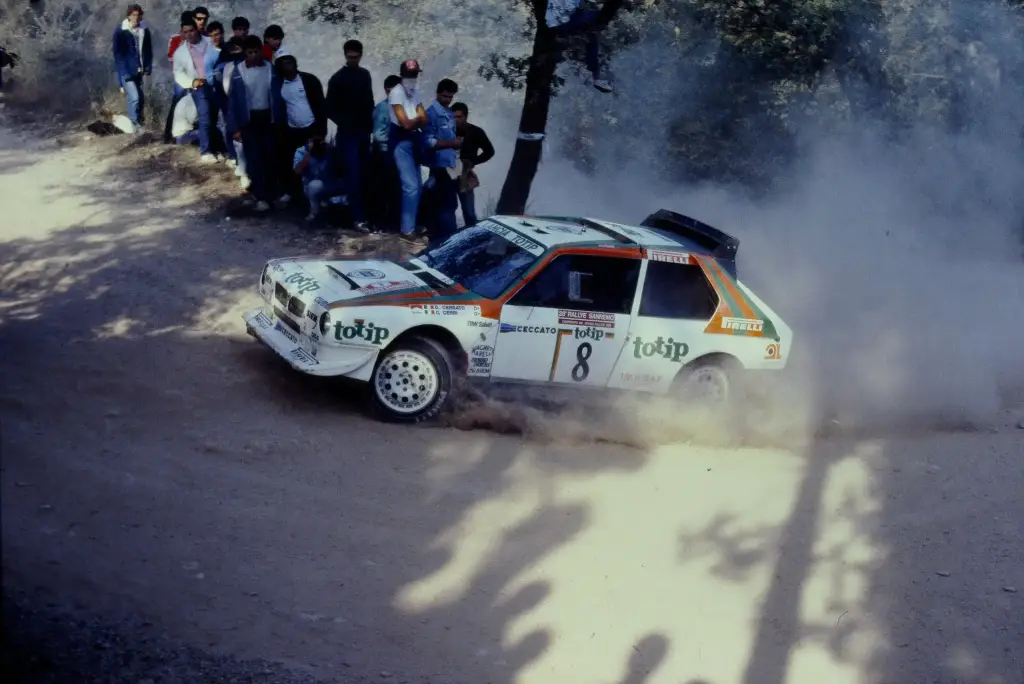
The car won its first event, the 1985 RAC Rally, in the hands of Henri Toivonen. In 1986 it had three wins outside San Remo: the Monte Carlo Rally with Toivonen, Rally Argentina with Massimo Biasion and the Olympus Rally with Markku Alén. For two weeks after the end of the 1986 season Alén was champion, until the FIA annulled the results of the Sanremo Rally for irregular technical scrutineering; Alén had won that event, and the lost points gave the title to Peugeot’s Juha Kankkunen. The S4 also won the 1986 European Rally Championship with Fabrizio Tabaton.
The car’s legacy was tainted by the fatal crash of Toivonen and his co-driver Sergio Cresto on the 1986 Tour de Corse, where the car left a tight hairpin, plunged into a ravine and burst into flames. The accident led directly to the abolition of Group B. A Group S Lancia ECV was to replace the S4 in 1987, but Group S was scrapped as well.
The road car
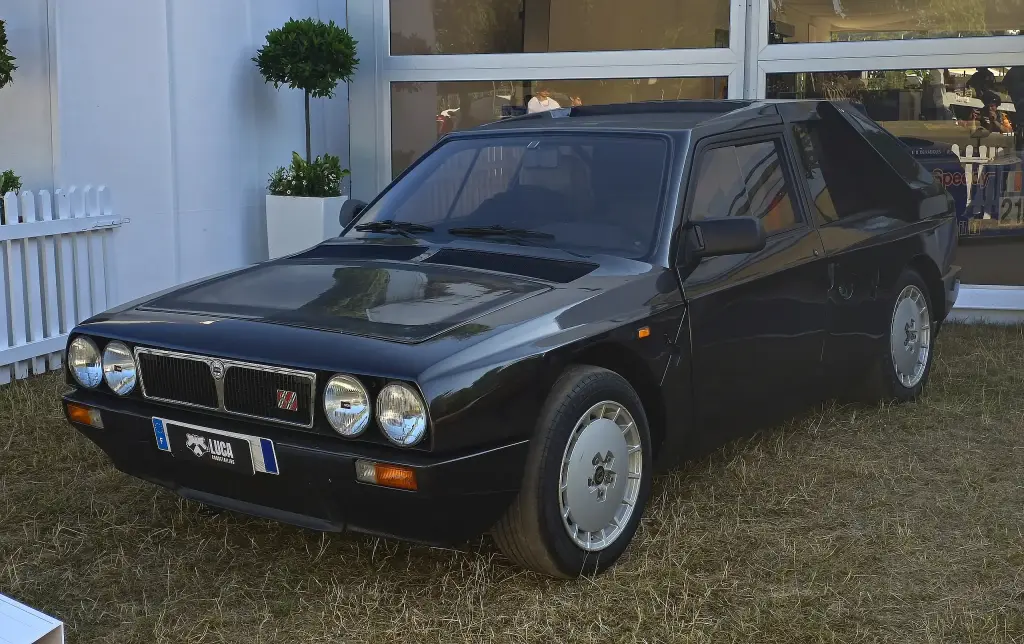
To homologate the car for Group B, Lancia was to build 200 road versions between October 1985 and 1986, officially the Lancia Delta S4 but widely called the “Stradale”; it is more likely that fewer than 100 were made. In Italy it cost about 100 million lire, five times the price of the most expensive Delta of the time, the HF Turbo. It had a space-frame chassis like the rally car’s, a mid-mounted longitudinal engine with supercharger, turbocharger and two intercoolers making 250 PS, and the rally car’s three-differential four-wheel-drive layout. Unlike the bare racer it had an Alcantara interior, sound deadening, power steering, a trip computer and air conditioning. The racing cars were built by Abarth, the Stradales by the Turin coachbuilder Savio.
Design and features
- Engine: the first twincharged engine, with a supercharger and a turbo.
- Construction: a space frame with carbon-fibre bodywork.
- Drive: four-wheel drive developed with Hewland.
Lancia Delta S4 versions
- Rally car: 28 complete chassis; 490 PS.
- S4 Stradale (1985–1986): the road version, 250 PS; fewer than 100 made.
- Lancia ECV: the planned Group S successor, scrapped.
The S4 followed the rear-drive Lancia 037 and the Lancia Delta road cars; its Group B contemporary was the Ford RS200. More Lancias are in our Lancia collection.
Sources
- Lancia Delta S4, English Wikipedia: specifications, Stradale, motorsport