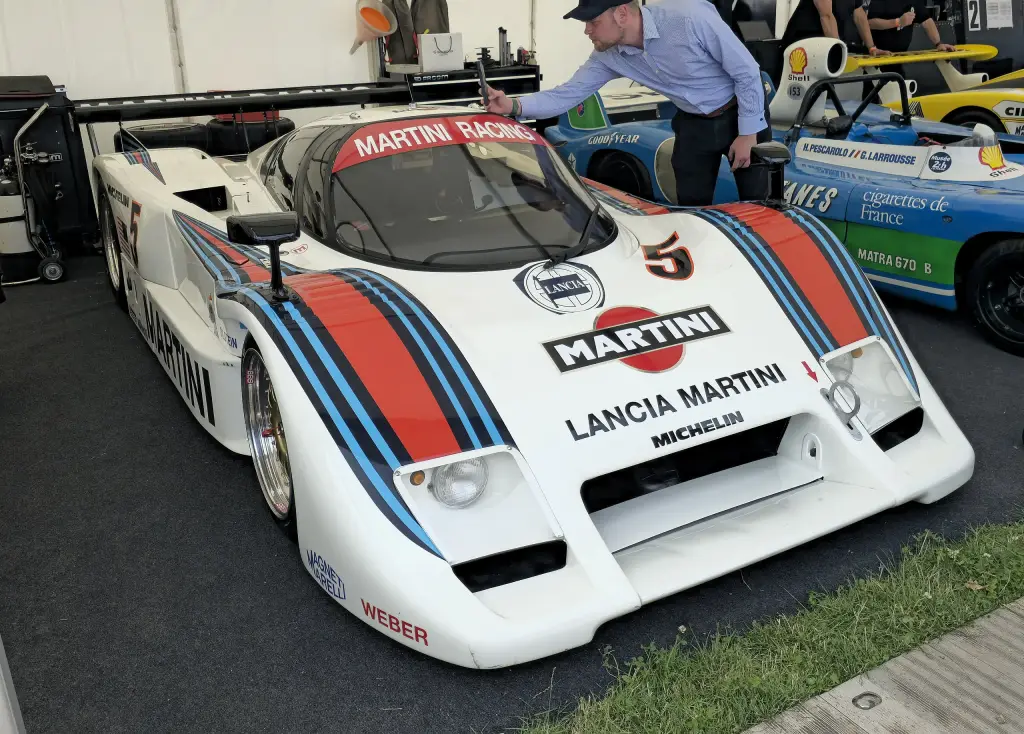
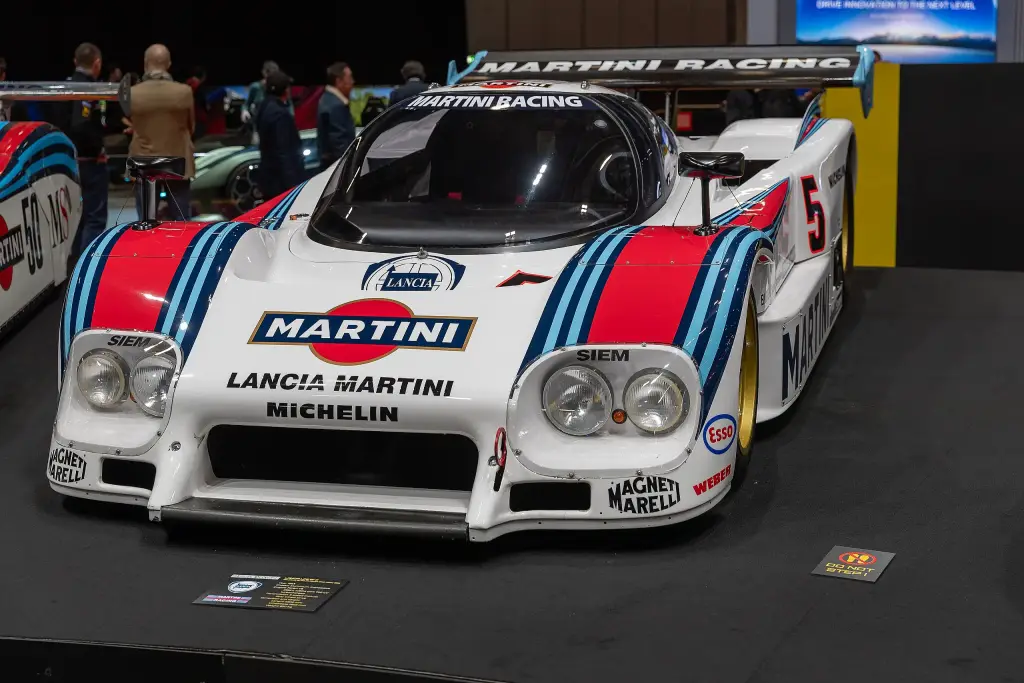
The Lancia LC2 was a Group C sports prototype built by Lancia and powered by engines from its sister company Ferrari. It represented Lancia’s works effort in the World Sportscar Championship from 1983 to 1986, although private teams kept racing the cars until 1991. Faster in qualifying than the Porsche 956s it fought, the LC2 was held back by reliability and fuel consumption, and it won three world championship races.
Lancia LC2 at a glance
| Maker | Lancia, with Abarth and Dallara |
|---|---|
| Seasons | 1983–1986 works, privateers to 1991 |
| Category | Group C sports prototype |
| Project code | Abarth SE036 |
| Engine | Ferrari-derived 90-degree V8, 2,599 cc then 3,014 cc |
| Induction | two KKK turbochargers |
| Race power | about 680 hp, 850–1,000 hp on overboost |
| Chassis | Dallara aluminium honeycomb monocoque |
| Body | Kevlar and carbon fibre |
| Weight | about 850 kg |
| Gearbox | five-speed manual |
| Wins | three world championship races |
History of the Lancia LC2
Why Lancia needed a new car
Group C rules arrived in 1982 and required closed coupé prototypes able to cover 100 km on no more than 60 litres of fuel. Lancia’s Group 6 LC1 was an open car with a 1.4-litre turbocharged four, too thirsty and no longer eligible for constructors’ points once the championship was open to Group C cars only in 1983. Under Cesare Fiorio the company began work on a replacement.
Ferrari power
Lancia had no production engine big enough for a racing programme, but as part of the Fiat group it could turn to Ferrari, which allowed it to adapt the new 3.0-litre four-valve V8 introduced in the 308 GTBi QV. Enzo Ferrari gave the development to Nicola Materazzi, then chief engineer in the racing department, and the work ran in parallel with the F114B engine of the GTO. For racing the architecture was heavily redesigned, capacity was reduced to 2,599 cc — a size chosen with the North American CART series in mind — and two KKK turbochargers were added. Initially there was a Hewland five-speed gearbox, replaced in 1984 by an Abarth-cased unit.
Chassis and aerodynamics
Design was split between Abarth and Dallara, the latter building the aluminium honeycomb monocoque and the Kevlar and carbon fibre bodywork. Like the LC1, the LC2 had a large radiator intake in the centre of the nose, unlike the Porsche 956, which drew air from behind and beside the cockpit; that air also fed the intercoolers through the side bodywork. Rear brake cooling inlets sat just behind the doors, and the tail used a pontoon-style arrangement with a large wing bridging the two pontoons. The car was about 850 kg, with independent double-wishbone suspension and rear-wheel drive. Italian sources put race power at around 680 hp because of the fuel formula, with an adjustable overboost allowing 850 to 1,000 hp in qualifying or when overtaking.
Racing record
For 1984 the V8 returned to 3.0 litres to improve reliability and power, with Magneti Marelli electronics letting the larger engine use the same fuel; it produced just under 840 hp at 9,000 rpm with 800 lb-ft at 4,800 rpm and 3.0 bar of boost. Seven LC2s were built by Lancia and two more for Gianni Mussato after the programme ended. The cars were run in Martini Racing colours by the works team and in Totip colours by the Jolly Club, with drivers including Teo Fabi, Riccardo Patrese, Alessandro Nannini, Mauro Baldi, Michele Alboreto and Bob Wollek. At Le Mans in 1983 they were as quick as the Porsches in practice but retired after 13 hours; in 1984, with the works Porsches absent, two LC2s started on the front row but gearbox trouble left them eighth; 1985 brought sixth and seventh places. Lancia withdrew after two races of 1986 to concentrate on rallying, leaving three world championship wins for Italy’s only Group C car. Abarth later fitted an LC2 with the 3.5-litre Alfa Romeo V10 as the SE047 project.
Design and features
- Ferrari V8: a racing V8 derived from the 308 GTBi QV engine, developed by Nicola Materazzi.
- Twin turbos: two KKK turbochargers with adjustable overboost for qualifying.
- Dallara monocoque: an aluminium honeycomb chassis with Kevlar and carbon bodywork.
- Narrow body: only 1.80 m wide, 20 cm under the limit, to cut drag and fuel use.
Lancia LC2 versions
- LC2 1983: 2,599 cc engine, Pirelli then Dunlop tyres.
- LC2 1984: 3,014 cc engine, Abarth gearbox.
- LC2/84 and later: wider tracks and revised aerodynamics.
- SE047: Abarth test car with an Alfa Romeo V10.
The LC2 followed the Lancia 037 in the company’s racing programme, and its chassis thinking came from the Lancia Montecarlo era of Group 5 racing. More racing Lancias are in the Lancia collection.
Sources
- Lancia LC2, English Wikipedia: development, engine, chassis, racing history
- Lancia LC2, Italian Wikipedia: technical data, power figures, Le Mans results