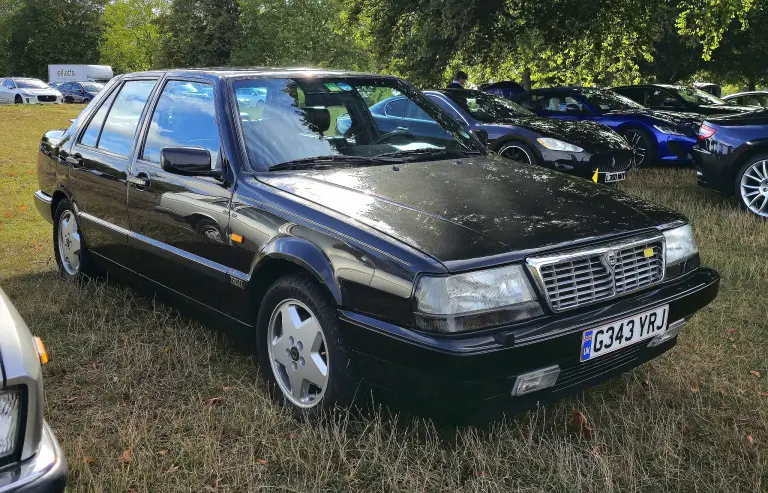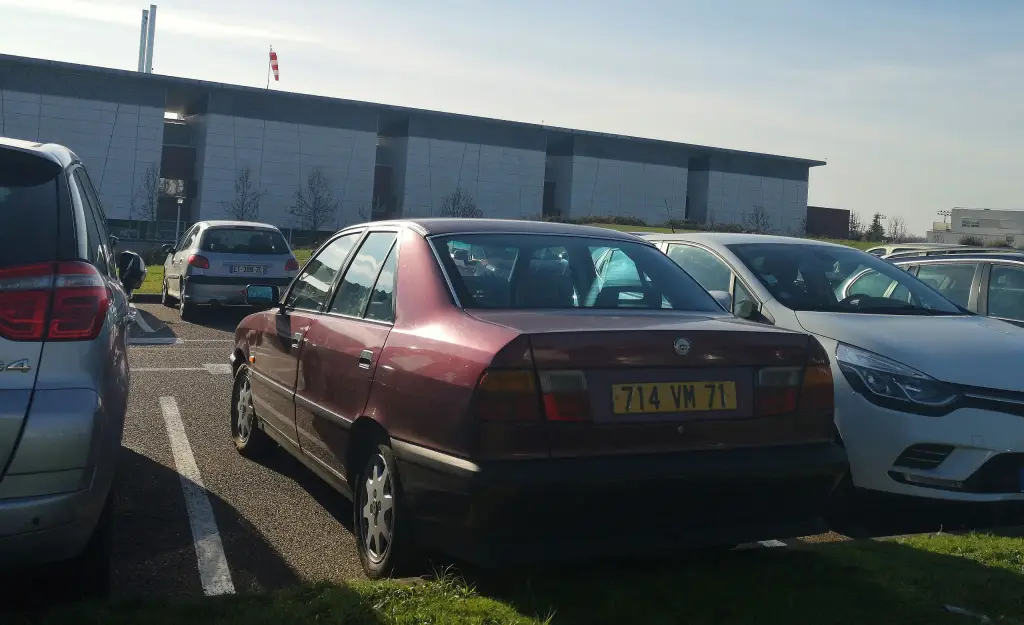
The Lancia Dedra, type 835, was a compact executive car produced from 1989 to 1999 to support and then replace the Prisma. It used a stretched version of the platform that later underpinned the second-generation Delta, and it is often described as the four-door saloon version of that car. Its shape, drawn by Ercole Spada at the I.DE.A Institute, achieved a drag coefficient of 0.29.
Lancia Dedra at a glance
| Maker | Lancia, Chivasso and Rivalta |
|---|---|
| Production | 1989–1999 |
| Class | compact executive car |
| Bodies | four-door saloon, station wagon from 1994 |
| Platform | Fiat Tipo Tre, shared with the Fiat Tempra and Alfa Romeo 155 |
| Engines | 1.6, 1.8 and 2.0 petrol, 1.9 turbodiesel |
| Power | from 76 to 169 PS |
| Drive | front-wheel drive, four-wheel drive on the Integrale |
| Gearbox | five-speed manual, four-speed automatic from 1992 |
| Drag coefficient | 0.29 |
| Designer | Ercole Spada, I.DE.A Institute |
| Built | 418,150 saloons and 44,488 estates |
History of the Lancia Dedra
One platform, four characters
The Dedra was part of a Fiat Group plan to spread development costs: a single floorpan served four medium cars with different characters. The Fiat Tipo offered value, the Tempra space and a large boot, the Alfa Romeo 155 sportiness, and the Dedra elegance. The second-generation Lancia Delta of 1993 used the same platform. The idea made commercial sense, but electrical faults reported by owners damaged the group’s reputation for solid, reliable cars.
A quiet, well-equipped saloon
The Dedra was meant to embody prestige, exclusivity, personality and comfort. The equipment list ran to Alcantara trim, a choice of paints and alloy wheels, attention to soundproofing and ventilation, height-adjustable seats, a power steering system and electrically adjustable and folding mirrors, and an optional fully automatic digital air conditioning. Safety was part of the brief, with a structure designed to reduce injury and active aids such as ABS and, later, an airbag. The car was 4.34 m long, 1.70 m wide, 1.43 m high with a 2.54 m wheelbase.
Launch and updates
Production started in January 1989 and the car was launched in Italy in April 1989 with three petrol engines of 1.6, 1.8 and 2.0 litres and a 1.9 turbodiesel. A 1.9 naturally aspirated diesel of 65 PS was homologated but never listed, as it was thought too slow for the class. In May 1991 came the four-wheel-drive Dedra Integrale and the front-wheel-drive 2000 turbo; an automatic gearbox followed in 1992, along with trim levels such as LE, LS and LX. A major facelift in 1993 brought Solarcontrol glass, ten colours and revised seats and did little to lift sales.
The Integrale and the estate
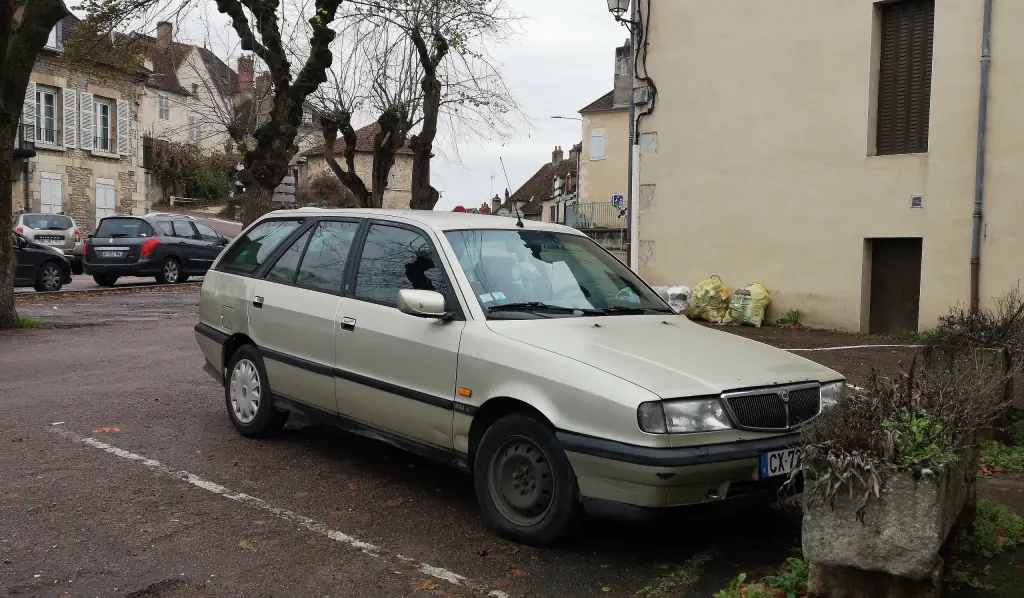
The Dedra Integrale used an engine and transmission similar to those of the Delta Integrale 8v: a 2-litre twin-cam four with contra-rotating balancer shafts, a Garrett T3 turbocharger and an intercooler, giving 169 PS in catalysed form. It had the Visco Drive 2000 traction system, electronically controlled suspension as an option on 2.0 models, more heavily bolstered seats, a sports steering wheel and a standard rear spoiler. Power went to all four wheels with a 56 per cent front bias. The 2000 turbo was a front-wheel-drive alternative with slightly less power, also using Visco Drive. From 1994 a station wagon developed by the French coachbuilder Heuliez joined the range. The Dedra was withdrawn from right-hand-drive markets in 1994 and replaced by the Lybra in 1999 after 418,150 saloons and 44,488 estates.
Design and features
- Aerodynamic body: a drag coefficient of 0.29 from Ercole Spada’s design.
- Comfort first: Alcantara trim, extensive soundproofing and optional digital climate control.
- Integrale version: turbocharged 169 PS with four-wheel drive and Visco Drive traction control.
- Estate body: a Heuliez-developed station wagon from 1994.
Lancia Dedra versions
- Saloon: 1.6, 1.8 and 2.0 petrol, 1.9 turbodiesel.
- 2000 turbo: front-wheel drive with turbocharging and Visco Drive.
- Integrale: four-wheel drive, 169 PS, sports trim.
- Station wagon: estate body from 1994, built with Heuliez.
- Automatic: four-speed automatic offered from 1992.
The Dedra replaced the Lancia Prisma and sat below the Lancia Thema, using the same platform family as the Lancia Delta. It was replaced by the Lancia Lybra. More cars are in the Lancia collection.
Sources
- Lancia Dedra, English Wikipedia: development, range, Integrale, production
- Lancia Dedra, Italian Wikipedia: platform sharing, equipment, dimensions, engines