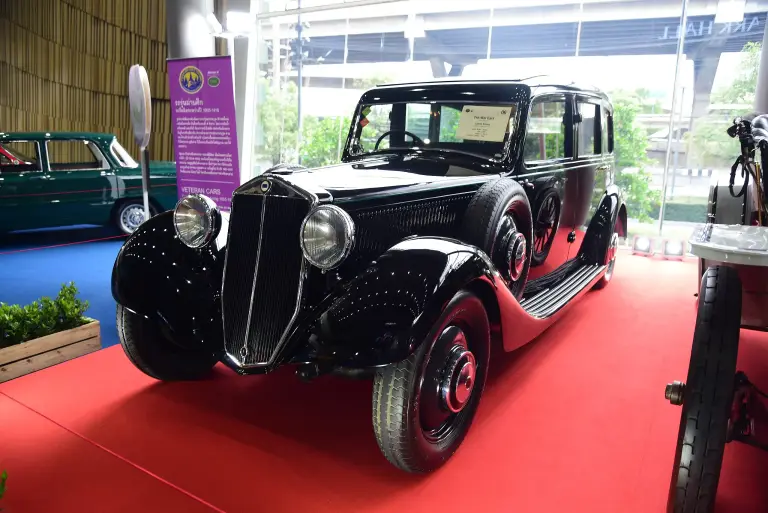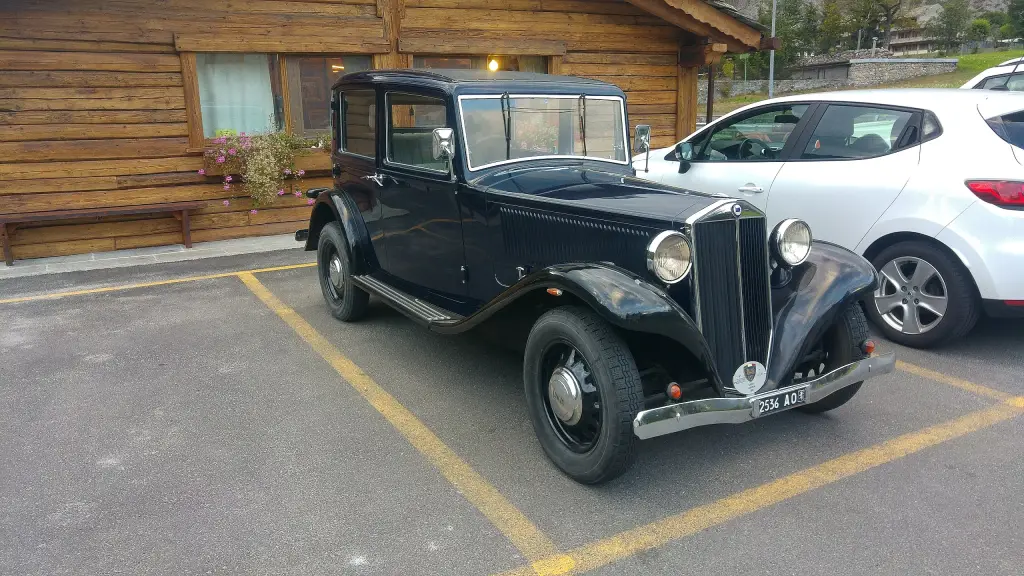
The Lancia Augusta was a small passenger car produced from 1933 to 1936 and shown at the Paris Motor Show in 1932. It was powered by a 1,196 cc V4 and its unitary body made it, according to Lancia’s own account, the first closed car built around a load-bearing shell.
Lancia Augusta at a glance
| Maker | Lancia, Turin; also Bonneuil-sur-Marne, France |
|---|---|
| Production | 1933–1936 in Italy, 1934–1938 as Belna |
| Class | small family car |
| Engine | 1,196 cc Lancia V4 |
| Body | four-door saloon with pillarless doors |
| Construction | unitary body and floor |
| Suspension | independent front, live axle rear |
| Steering | right-hand drive as standard |
| French version | Lancia Belna, about 3,000 built |
| Successor | Lancia Aprilia |
History of the Lancia Augusta
A car for hard times
The Wall Street crash of October 1929 ended the golden age of Lancia’s exports: at the end of the 1920s about 75 per cent of Lancia production went abroad, and tariff barriers were closing fast. The Augusta was designed for that new climate: a small, light, economical car that still had to offer the comfort, quietness and speed of a Lancia. It had to be narrow enough for medieval Italian streets, tall enough inside to feel roomy and able to cruise at about 80 km/h and run for hours near 100 km/h, as it did in the 6,000 km Coppa d’Oro event.
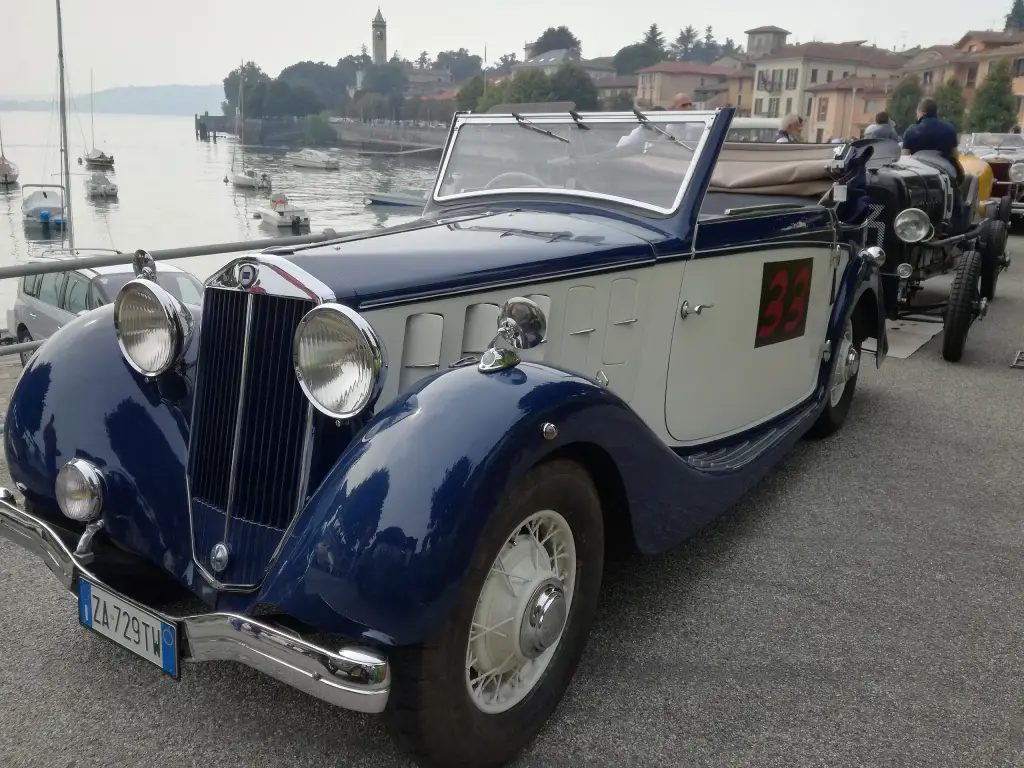
Unit body and pillarless doors
The answer was a radical one: a unitary body-and-floor structure instead of a separate chassis, which allowed a closed four-seater of almost four metres to weigh a little over 800 kg. The doors were hinged at the back and there was no centre pillar, so almost the whole side of the car opened for access. The masses — engine and occupants — were placed between the axles, and the wheelbase was long for the size of the car. The 1,196 cc V4 was the familiar Lancia narrow-angle unit, and the car kept the sliding pillar front suspension used since the Lambda.
Selling the Augusta
The Augusta made its debut at the Paris Motor Show in 1932 and dominated the European shows of 1932 and 1933. It brought many new buyers to Lancia and accounted for nearly 85 per cent of the company’s output and turnover in 1934, 1935 and 1936. Even so, in sheer volume it was overwhelmed by the far cheaper Fiat 508 Balilla, which sold in far greater numbers. Production in Turin ran from 1933 to 1936, after which the Aprilia took over.
The French Belna
Lancia began French operations on 1 October 1931, and at its first plant outside Italy, at Bonneuil-sur-Marne, it built the Augusta under the name Belna, later building the Aprilia as the Ardennes. About 3,000 Augusta and Belna cars and 1,500 Aprilia and Ardennes cars were made in France. Of the roughly 3,000 Belnas built between 1934 and 1938, 2,500 were saloons and 500 bare chassis. Georges Paulin, the inventor of the retractable hardtop, showed his designs to Marcel Pourtout, and Carrosserie Pourtout built several bodies on French-built Belna chassis.
Design and features
- Unitary construction: a load-bearing body and floor in place of a separate chassis.
- Pillarless doors: aft-hinged doors without a centre pillar opened up the whole side.
- Light for its size: a little over 800 kg for a closed four-seater of almost four metres.
- French twin: built at Bonneuil-sur-Marne as the Lancia Belna.
Lancia Augusta versions
- Augusta saloon: the standard Italian car, 1933–1936.
- Lancia Belna: French-built version, 2,500 saloons and 500 chassis.
- Pourtout-bodied Belnas: special bodies by the French coachbuilder.
- Cabriolet conversions: open bodies by Italian coachbuilders.
The Augusta was replaced by the Lancia Aprilia, which developed its unitary body and aerodynamics, and the later Lancia Ardea scaled the idea down again. More cars are in the Lancia collection.
Sources
- Lancia Augusta, English Wikipedia: dates, engine, Belna production
- Lancia Augusta, Italian Wikipedia: design context, body construction, sales