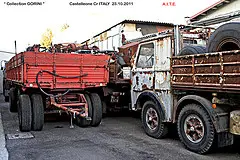
The Lancia Esadelta was a truck produced by Lancia Veicoli Industriali from 1959 to 1970 at the Bolzano plant. It was designed as a middle-weight model between the smaller Lancia trucks and the Esatau B, and stayed in production through three main stages until the Fiat takeover ended Lancia’s industrial vehicle programme.
Lancia Esadelta at a glance
| Maker | Lancia Veicoli Industriali, Bolzano |
|---|---|
| Production | 1959–1970 |
| Type | medium-weight truck |
| Engine | 8,245 cc straight-six diesel, 9,469 cc in the last version |
| Power | 115, 126, 132 and 176 hp |
| Gearbox | four speeds with preselected two-speed reduction |
| Configurations | 4×2 and 6×2 tractor and rigid, later 8×2 |
| Cab | fibreglass engine tunnel |
| Towing weight | from 120 to 190 quintals, 18 tonnes in the 402 C |
| First version | 1959, 115 hp |
| Last version | 1967, 402 C, 176 hp |
| End of production | 1970 |
based on one source: the article is written from the Italian Wikipedia page on the Esadelta, as English Wikipedia has no separate page for this truck.
History of the Lancia Esadelta
A truck to earn money
After the Pesenti family took control of Lancia in 1958, the management decided to increase profits by widening its investment in industrial vehicles. The new motorways of the period made road haulage far more competitive than before, and demand for trucks was growing. The Esadelta was designed in that climate as a truck of intermediate size between the company’s existing models and the Esatau B.
The first Esadelta
Presented in 1959, the first Esadelta used a Lancia six-cylinder engine derived from the first version of the Esatau 864: 8,245 cc, with output held to 115 CV at 1,850 rpm. The truck was robust and livelier than its rivals and had a good reputation for driver comfort, helped by an engine tunnel made of fibreglass instead of metal. The gearbox had four speeds and a preselected reduction unit under the dashboard, and the cab borrowed styling from other models already on the list; a radio with speakers could be fitted inside.
Development through the 1960s
At first the Esadelta was offered only as a 4×2 or 6×2 tractor and rigid, with towing weights of 120 and 190 quintals. The A version of 1962 raised power to 126 CV at the same engine speed. In 1963 the revised 401 B series extended the range to other layouts, including an 8×2 on four axles, using the 401.080 engine of 8,245 cc and 132 CV at 2,000 rpm, with a top speed of 64 to 70 km/h depending on the final drive and a maximum combination weight of 267 quintals, of which 140 could be towed. No bus chassis was ever developed, although a small series of armoured 401 truck chassis was bodied as buses and sold abroad.
The 402 C and the end
The last version of 1967 was an entirely new design called the 402 C: 9,469 cc, 176 CV at 2,300 rpm and 18 tonnes of towing capacity, with the same cab as the Esagamma. Like earlier versions it was widely used on building sites, as a tanker and as a fire engine. Production of the last Esadelta models ended in 1970, shortly after Lancia became part of Fiat, which preferred to concentrate on its own Fiat and OM commercial vehicle brands. Over eleven years the Esadelta sold well in Italy and much of Europe, with some examples exported to the East and to the Americas.
Design and features
- Straight-six diesels: 8,245 cc units of 115 to 132 hp and a 9,469 cc engine of 176 hp.
- Driver comfort: a fibreglass engine tunnel and a quiet, well-finished cab for the period.
- Many layouts: 4×2, 6×2 and 8×2 tractors and rigids for road and site work.
- Versatile: used as a tipper, tanker, crane carrier and fire engine.
Lancia Esadelta versions
- Esadelta 1959: 115 CV, 4×2 and 6×2 tractor and rigid.
- Esadelta A (1962): 126 CV.
- 401 B (1963): 132 CV, including the 8×2 four-axle version.
- 402 C (1967): 9,469 cc, 176 CV, Esagamma cab.
The Esadelta sat between the earlier Lancia commercials and the Lancia Esagamma, which replaced the larger Lancia Esatau. More vehicles are in the Lancia collection.
Sources
- Lancia Esadelta, Italian Wikipedia: history, versions, engines, production