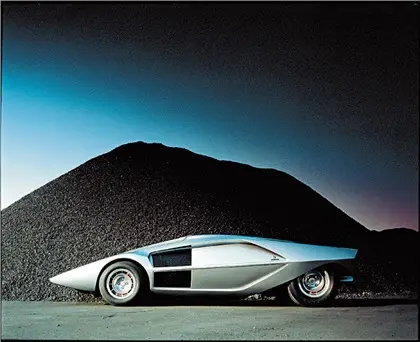
The Lancia Stratos Zero, also called the Stratos HF Zero, was a concept sports car built by Bertone and shown at the 1970 Turin Motor Show. It came a year before the Stratos HF prototype and three years before the production Lancia Stratos. An ultra-low wedge of only 84 cm, it was designed by Marcello Gandini and built on the running gear of a Fulvia rally car.
Stratos Zero at a glance
| Maker | Bertone for Lancia |
|---|---|
| Shown | Turin Motor Show, 1970 |
| Designer | Marcello Gandini, Bertone |
| Type | concept sports car |
| Height | 84 cm |
| Body | fibreglass, copper colour, fastback |
| Chassis | crashed Lancia Fulvia HF1600 rally car |
| Engine | 1.6-litre Lancia V4 from the Fulvia HF1600 |
| Power | 115 PS |
| Access | flip-open windscreen door, retractable steering wheel |
| Instruments | digital control screen |
| Production | one car |
based on one source
History of the Stratos Zero
A door called Stratos 0
Gandini, chief designer at Bertone, designed the car and the studio called it Stratos 0 after the space-age stratosphere then in fashion. It was built on the chassis of a crashed Lancia Fulvia HF1600 rally car, keeping that car’s mid-rear mounted 1.6-litre V4 of 115 PS. There were no doors: access was through a flip-open front windscreen, and the steering wheel retracted to help the driver climb in over the column. The rear deck carried an arrow motif, the tail lights were a simple luminous outline of the rear volume and the nose held ten lamps side by side. The original colour was metallic bronze, described elsewhere as copper.
Shape and influence
The body was an angular, trapezoidal shape unlike anything on the road in 1970, only 84 cm high and shaped for aerodynamics, with a fastback rear and integrated bucket seats. Its aeronautical design was inspired by the supersonic aircraft of the time and by rival concept cars, and the idea of a digital instrument screen was visionary for the period. The Zero itself did not reach production, but it prompted Cesare Fiorio, then running the Lancia HF racing team and looking for a replacement for the ageing Fulvia Coupé 1600 HF, to see in a mid-engined design the novelty the company needed. Lancia and Bertone then developed the Stratos HF, which shared the Zero’s ideas but none of its mechanical parts.
Later life
The Stratos Zero was for many years exhibited at the Bertone museum near Turin. It has since been sold at auction, including at the 2011 Concorso d’Eleganza Villa d’Este, and has appeared at concours events and museums around the world, including Sankt Moritz in 2023. In August 2024 it was entered at the Pebble Beach Concours d’Elegance in the wedge-shaped concept cars class, where it won first place in its class, was one of four contenders for Best in Show, and received the Gran Turismo Special Award from Kazunori Yamauchi. Since July 2025 it has been displayed at the Petersen Automotive Museum in Los Angeles as part of an exhibition on wedge-shaped cars. The car appears in Michael Jackson’s 1988 film Moonwalker, where it turns into a bulletproof Stratos Zero to make an escape, and in 2025 Hot Wheels released a 1/64 scale model.
Design and features
- Only 84 cm tall: one of the lowest cars ever shown, shaped by aerodynamics.
- Flip-open windscreen: there were no doors; the screen lifted for access.
- Fulvia mechanicals: a 1.6-litre V4 of 115 PS from a crashed HF1600 rally car.
- Digital instruments: a screen instead of dials, visionary in 1970.
Stratos Zero versions
- Stratos Zero: the single 1970 show car, still in existence.
The Zero inspired the Lancia Stratos rally car and used the mechanics of the Lancia Fulvia. More Lancias are in the Lancia collection.
Sources
- Lancia Stratos Zero, English Wikipedia: design, chassis, engine, display history