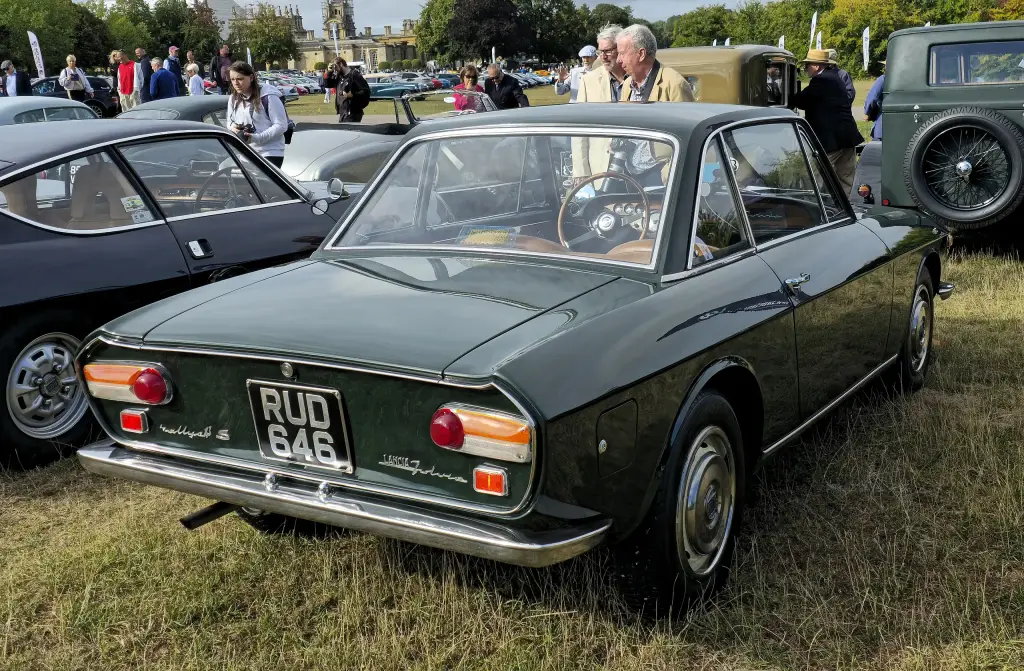
The Lancia Fulvia, type 818, was produced from 1963 to 1976 and replaced the Appia. Named after the Via Fulvia, it was shown at the Geneva Motor Show in 1963 and came in three bodies: the four-door Berlina saloon, the two-door Coupé and a fastback Sport designed and built by Zagato on the coupé floorpan. Front-wheel drive and a narrow-angle V4 made it one of the most advanced small cars of its day, and the HF versions won the 1972 International Rally Championship.
Lancia Fulvia at a glance
| Maker | Lancia, Chivasso |
|---|---|
| Production | 1963–1976 |
| Bodies | Berlina saloon, Coupé, Sport by Zagato |
| Engine | narrow-angle V4, 1,091 to 1,584 cc |
| Power | 58 CV at launch, up to 132 CV in the 1.6 HF |
| Layout | front engine, front-wheel drive |
| Gearbox | four-speed, five-speed from 1970 |
| Suspension | wishbones and transverse leaf front, live axle rear |
| Brakes | Dunlop discs, Girling with servo from 1970 |
| Berlina built | 192,097 |
| Coupé built | 139,797 |
| Sport built | 7,102 |
History of the Lancia Fulvia
Fessia’s small front-wheel-drive Lancia
The Fulvia was designed by Antonio Fessia to replace the Appia, with which it shared almost nothing: the Appia was rear-wheel drive, the Fulvia followed the Flavia into front-wheel drive. The general engineering matched the Flavia except for the engine, which was a narrow-angle V4 in the tradition of most Lancias since the Lambda. Designed by Zaccone Mina, its V was only 12 degrees wide, allowing a single cylinder head to cover all four cylinders with one camshaft for the inlet and one for the exhaust valves. The engine sat well forward, tilted at 45 degrees, ahead of the gearbox. The front suspension used wishbones and a single transverse leaf spring, the rear a beam axle with a Panhard rod and leaf springs.
The Berlina
The four-door saloon arrived in 1963, built at Lancia’s new Chivasso plant, with a 1,091 cc engine of 58 CV and a top speed of 138 km/h. Its square three-box body by Piero Castagnero was not universally admired, but comfort, build quality and roadholding made it a success. In 1964 the 2C added twin twin-choke Solex carburettors and 71 CV, with 145 km/h and a mechanical rev counter. A GT with the 1,216 cc coupé engine and 80 CV came in 1967 and grew to 1,231 cc later that year, a 1,199 cc version was built for Greece where cars over 1,200 cc were taxed heavily, and the 1,298 cc GTE of 1968 gave 87 CV and 162 km/h.
Second series and the coupé
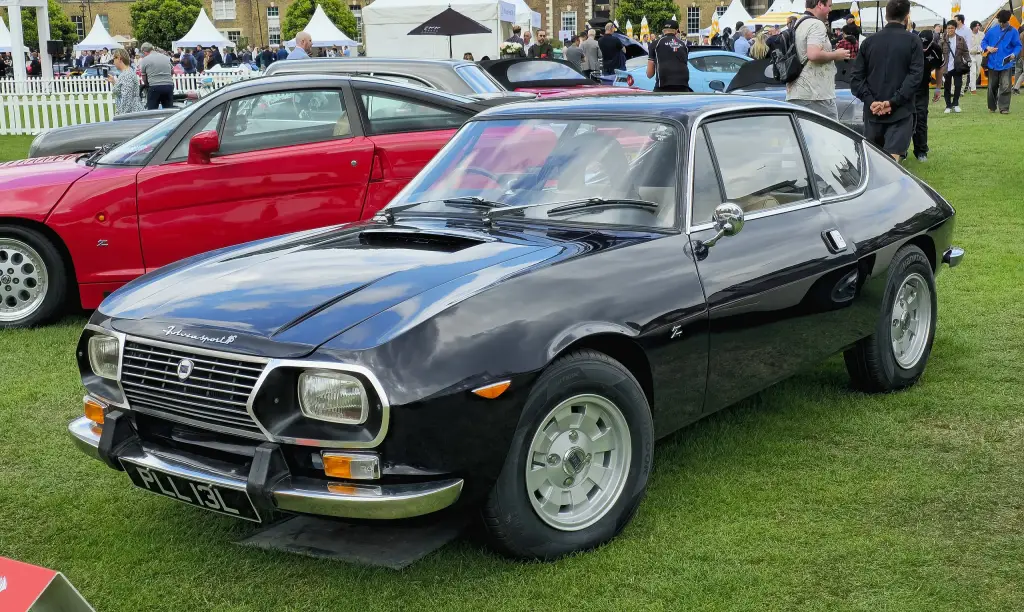
A 1969 restyling created the second series, with a redesigned tail, a new grille with iodine lamps, a completely new interior, a short floor-mounted gear lever, an alternator and, from 1970, a five-speed gearbox, a collapsible steering column, Superduplex brakes and a 20 mm longer wheelbase. The only engine was the 1,298 cc unit with 87 CV, later reduced to 85 CV to meet early emission rules. Some details, such as a plastic Lancia badge and rubber mats, led purists to say that Fiat had arrived, although the badge was shared with the Rallye 1.6 HF and made of plastic to save weight. The Coupé of 1965 was a compact three-box two-door with a wheelbase 150 mm shorter than the saloon’s, also by Castagnero, and the Sport was Zagato’s fastback version on the coupé floorpan.
Racing and reputation
The Fulvia is remembered for motorsport, including a win in the 1972 International Rally Championship, and Road & Track called it a precision motorcar and an engineering tour de force. The 1.6 HF engine was reworked with an even narrower V of 11 degrees 20 minutes, a 75 mm stroke and an 82 mm bore for 1,584 cc and 115 to 132 CV depending on tune. Production ended after 192,097 Berlinas, 139,797 Coupés and 7,102 Sports had been built; the coupé, the last model to be withdrawn, was replaced in 1977 by the 1.3-litre Beta Coupé. The Fulvia sold fewer cars than expected because it was expensive: in 1971 it cost 1,745,000 lire, more than an Alfa Romeo Giulia 1300, a BMW 1600 or a Fiat 125 S.
Design and features
- Narrow-angle V4: a 12-degree engine with a single cylinder head, designed by Zaccone Mina.
- Front-wheel drive: the same approach as the Flavia, with an auxiliary subframe for the front suspension.
- Three bodies: saloon, coupé and the Zagato-built Sport fastback.
- Rally record: HF versions took the 1972 International Rally Championship.
Lancia Fulvia versions
- Berlina: 1,091 cc 58 CV, later 2C, GT and GTE.
- Coupé: 1,216 and 1,298 cc, Rallye and HF versions.
- Sport: Zagato fastback coupé, 7,102 built.
- HF 1.6: 1,584 cc, 115 to 132 CV, rally homologation.
- Second series: five-speed gearbox, Superduplex brakes, 1970–1972.
The Fulvia replaced the Lancia Appia and shared its engineering approach with the Lancia Flavia. Its successor in the range was the Lancia Beta. More cars are in the Lancia collection.
Sources
- Lancia Fulvia, English Wikipedia: engineering, models, engine development
- Lancia Fulvia, Italian Wikipedia: saloon history, prices, restyling, sales