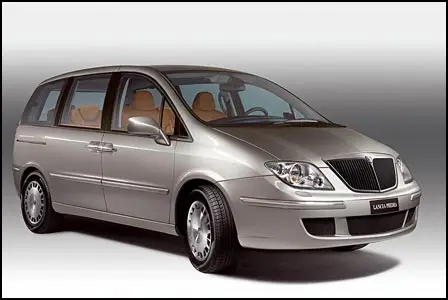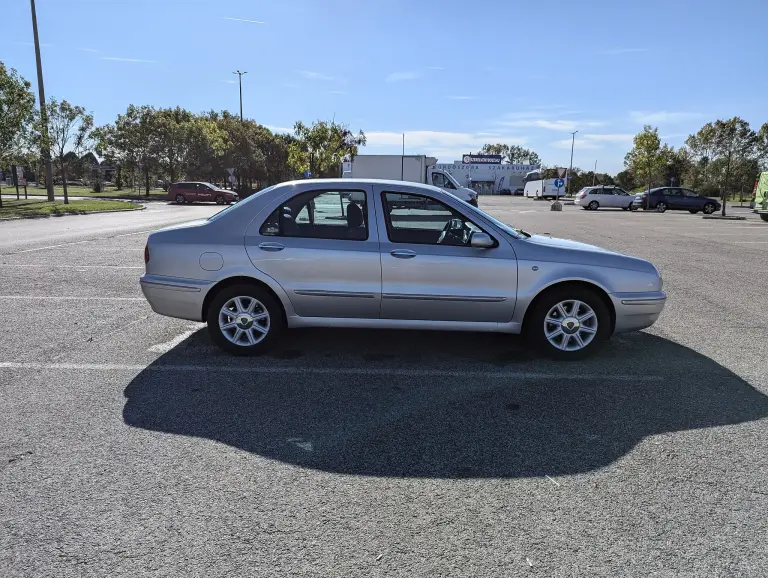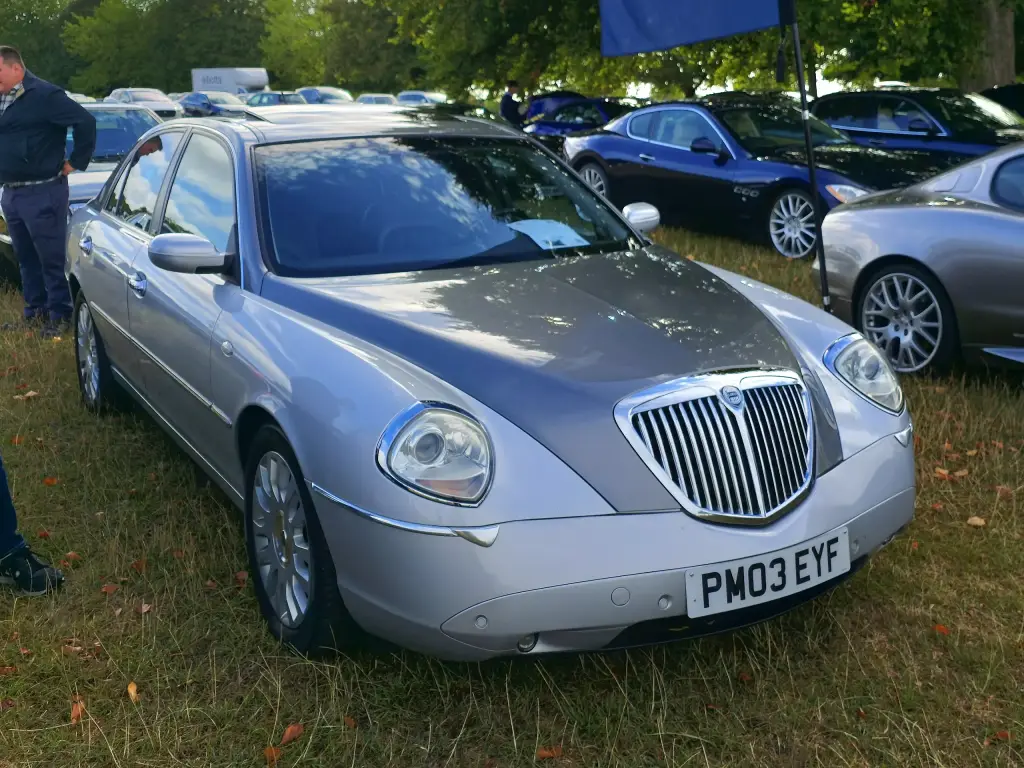
The Lancia Thesis, type 841, was a full-size car produced from 2001 to 2009 and the flagship of the range. Its design was based on the Diàlogos concept car of 1998, and it was built on a chassis of its own rather than sharing one with Alfa Romeo as the Kappa had. It was offered with five-cylinder and V6 engines between 2.0 and 3.2 litres, and fewer than 16,000 were built.
Lancia Thesis at a glance
| Maker | Lancia, Rivalta then Mirafiori |
|---|---|
| Production | 2001–2009 |
| Shown | Geneva Motor Show, March 2001 |
| Engine | 2.0 turbo, 2.4 and 3.0 V6, 3.2 V6, 2.4 JTD |
| Power | up to 230 PS |
| Layout | front engine, front-wheel drive |
| Gearbox | six-speed manual, five-speed Comfortronic automatic |
| Suspension | multi-arm aluminium-intensive, Mannesmann Sachs Skyhook dampers |
| Length | 4.89 m |
| Safety firsts | radar adaptive cruise control, electric parking brake |
| Built | about 16,000 |
| Replaced by | Lancia Thema (2011) |
History of the Lancia Thesis
From Diàlogos to production
The Thesis came from project 841 of 1997, discussed repeatedly by management and chief designer Mike Robinson. At the Mirafiori style centre three concepts were prepared, Tikal, Agorà and Arca, and the staff chose one by internal vote. Agorà won and was changed in appearance, having started as a large two-box car inspired by the saloons of the 1930s, and became the Diàlogos, the semi-definitive three-box prototype with rear-hinged doors and advanced technology. Fiat’s leadership liked it enough to derive a version for Pope John Paul II in 2000, called Giubileo. The production car kept the shape but returned to conventional doors, softened the lower part of the grille so the plate could sit in the bumper, and made the bonnet creases less prominent. The name Thesis was chosen to echo the Thema, one of the brand’s most successful flagships.
Struggling to sell
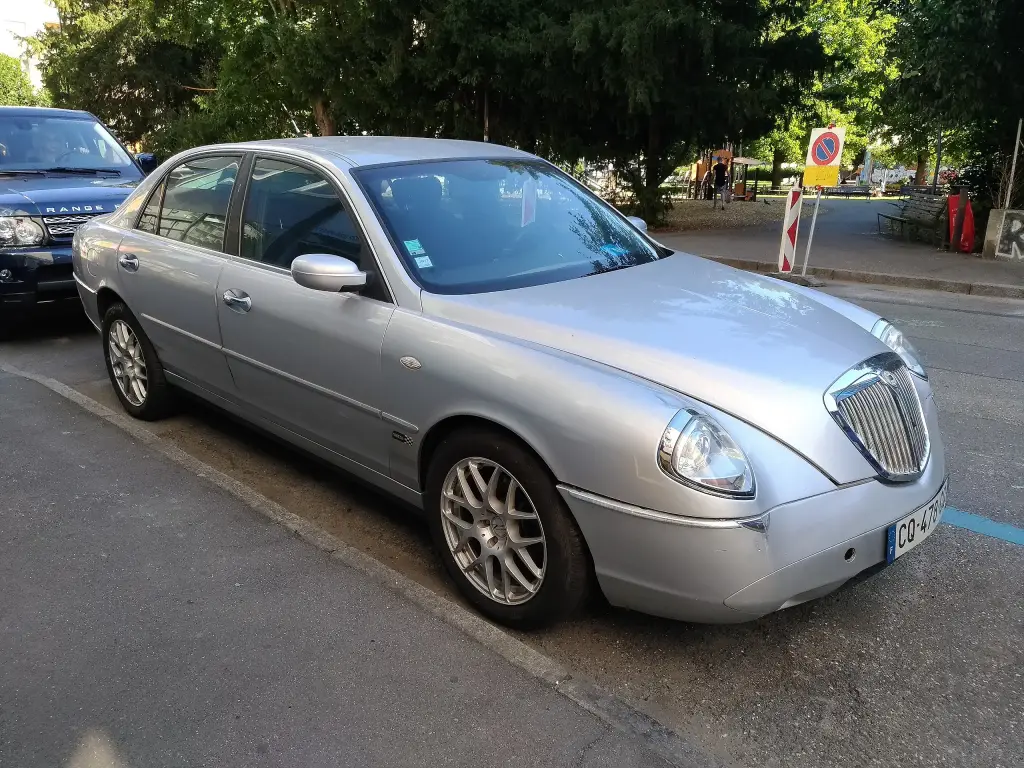
The car was officially presented at the Geneva Motor Show in March 2001, with its interior revealed in November at Frankfurt. For the Italian press Lancia provided 30 cars to 85 journalists for a 122 km route around Lake Maggiore. Production began in 2002 at Rivalta before the plant was converted to aviation components and sold, then moved to Mirafiori, where the Thema had been assembled. Lancia expected 13,000 cars a year, rising to 25,000 at full capacity, but sales were weak from the start, hurt by the brand’s damaged image, by a very unconventional shape and by prices that put the car against the BMW 5 Series, Mercedes-Benz E-Class and Jaguar S-Type. No right-hand-drive version was made for the British market, where Lancia had been absent since the early 1990s.
Engineering and comfort
Unlike the Kappa, the Thesis had its own chassis. The British magazine Car tested it with the V6 and praised the multi-arm aluminium-intensive suspension with Mannesmann Sachs Skyhook adaptive dampers, the same kind used on the Maserati Spyder, for absorbing large bumps without letting body movement get out of hand. It was the first Lancia with Bosch radar adaptive cruise control and one of the first production cars with an electric parking brake, although the new BMW 7 Series arrived in the same year with one. Inside there were lightly varnished wood, cast magnesium for the centre console, engraved glass instruments and leather or Alcantara trim; Car called it rich and expensive-feeling but criticised steering that was too light and a tendency to understeer that brought in the ESP.
The end and one-offs
Most Thesis cars stayed in Italy, where they sold reasonably as company cars and with the Italian government, including armoured Protecta versions for state use, and the model served as a presidential car. The programme had cost more than 405 million euros in industrial investment, and with only about 16,000 cars built Lancia could not recover it. Production ended at the beginning of 2009, and the Thesis was replaced in 2011 by a new flagship based on the Chrysler 300 and sold in continental Europe as the Lancia Thema. A stretched limousine prototype, the Stola S85, was shown at Geneva in 2004: 60 cm longer, 5.49 m in total, with beige leather, electrically adjustable rear seats, a minibar, navigation, internet and a fax machine, a 230 PS V6 and a weight of 2,030 kg.
Design and features
- Own chassis: unlike the Kappa, the Thesis was designed on a dedicated platform.
- Skyhook dampers: adaptive suspension shared in concept with the Maserati Spyder.
- Technology firsts: Bosch radar cruise control and an electric parking brake.
- Rich interior: wood, cast magnesium, engraved glass instruments and Alcantara or leather.
Lancia Thesis versions
- 2.0 turbo: four-cylinder entry model, manual gearbox only.
- 2.4 and 3.0 V6: five- and six-cylinder petrol engines.
- 3.2 V6: the most powerful version, 230 PS.
- 2.4 JTD: the turbodiesel, popular in Italy.
- Protecta: armoured version for government use.
- Stola S85: 2004 stretched limousine prototype, 5.49 m long.
The Thesis replaced the Lancia Kappa and was developed from the Diàlogos concept; its name recalled the Lancia Thema. More cars are in the Lancia collection.
Sources
- Lancia Thesis, English Wikipedia: design, engineering, press verdict, production
- Lancia Thesis, Italian Wikipedia: project history, launch, prices, Stola S85