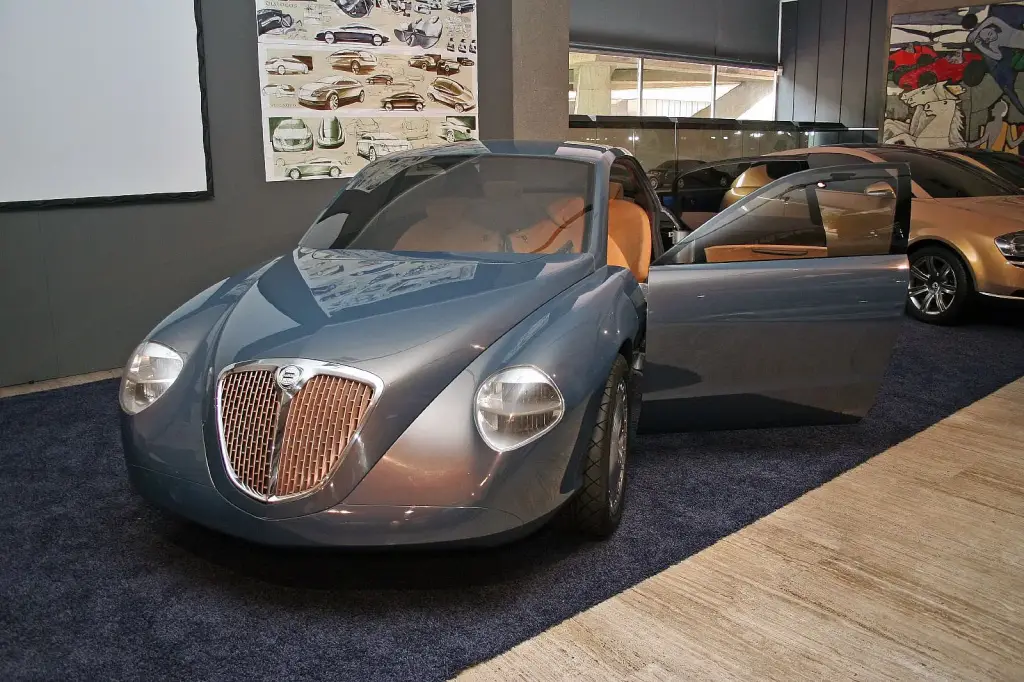
The Lancia Diàlogos was a luxury concept car presented in saloon form at the 1998 Turin Motor Show. Developed since August 1996 by Lancia’s own Centro Stile under Mike Robinson, it was described as a futuristic, next-generation car with a flavour of the past. Many of its ideas and its exterior styling later went into the Lancia Thesis of 2001.
Lancia Diàlogos at a glance
| Maker | Lancia Centro Stile, Turin |
|---|---|
| Shown | 1998 Turin Motor Show |
| Type | luxury concept saloon |
| Development | from August 1996 |
| Chief designer | Mike Robinson |
| Dimensions | 1.95 m wide, 1.49 m high |
| Wheelbase | 3.05 m |
| Engine | none fitted |
| Rear doors | rear-hinged, no central pillar |
| Key innovation | Ego Card personal settings |
| Influence | styling and technology of the Lancia Thesis (2001) |
| One-off | Giubileo built for Pope John Paul II in 2000 |
History of the Lancia Diàlogos
Designing a room on wheels
The Diàlogos was meant to combine an ideal atmosphere, a living room and stress-free driving. Its large dimensions — 1.95 m wide, 1.49 m high and a 3.05 m wheelbase — served that interior. Design work ran through several stages: a free research phase produced five quarter-scale clay models in the summer of 1996, and three proposals survived, called Agorà, Arca and Tikal. Agorà and Arca were then merged under Pietro Camardella into the prototype shown at Turin in 1998, with Mike Robinson directing the Centro Stile and Flavio Manzoni following the interior. The final car was a three-box saloon, as the then Lancia chief executive Paolo Cantarella wanted.
Style with a flavour of the past
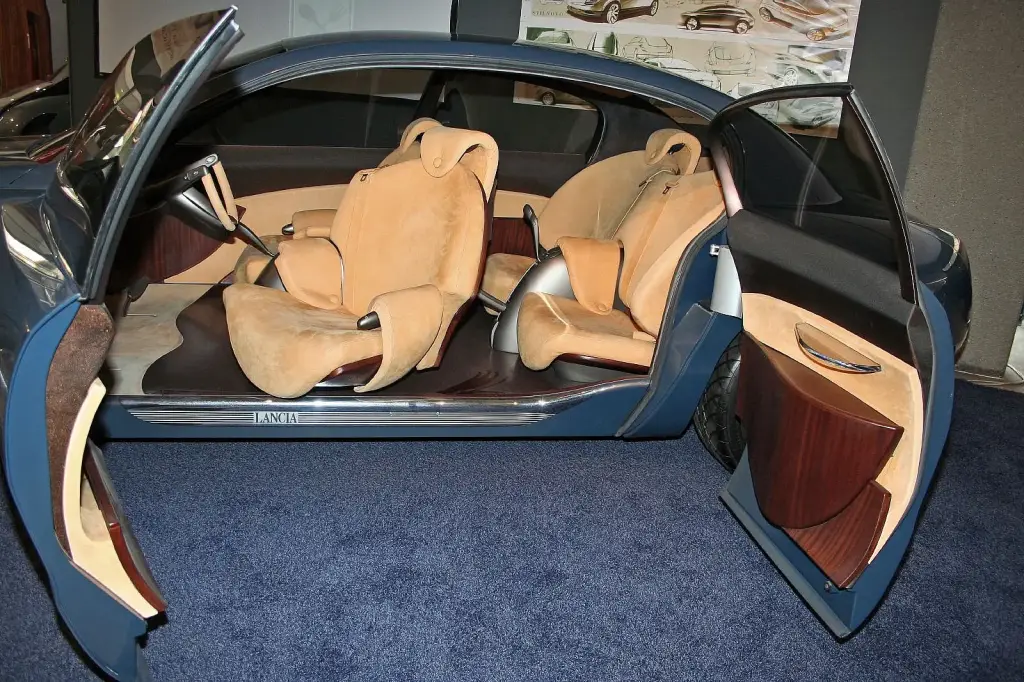
The exterior was dominated by a large grille, and the side had no central pillars: the rear doors opened backwards to make the whole side of the cabin open, a direct reference to the Lancia Aurelia saloon of the 1950s. That retro element sat alongside distinctly futuristic details, which Robinson summed up as a futuristic design with a flavour of the past.
Inside the Diàlogos
The interior was trimmed in nabuk, a suede-like leather, with body-moulding seats. The front seats swivelled through 90 degrees to help access and through 180 degrees to form a sofa facing the rear passengers. The steering wheel and instrument panel sat centrally and could slide to either side depending on the direction of travel, and two screens were fitted in the backs of the front seats. A tactile thin film of softwood bonded to resin and foam covered the dashboard and other areas. A personal electronic key, the Ego Card, let the car adapt seat position, multi-zone climate settings and steering wheel and pedal positions to an individual, and the driver’s door opened automatically as the driver approached.
Technology and the Giubileo
Although it had no engine, the concept was described with an active differential, adjustable torque distribution to both axles and multilink suspension, including a front layout with a virtual steering axis passing through the centre of the wheels and a rear layout with a virtual pitch centre so that a wheel moved back over an obstacle. Driving aids included adaptive headlights, adaptive cruise control, a semi-automatic transmission, anti-collision and lane departure systems, voice control and exterior cameras. In 2000 a one-off version called Giubileo was built and given to Pope John Paul II for the Great Jubilee: 5.50 m long, with a stretched wheelbase, armoured body, a five-ratio Comfortronic automatic, leather trim with a seat for the pontiff and a 3.0-litre Alfa Romeo V6. It was valued at 1.5 million dollars. A station wagon concept was designed but never built at full scale.
Design and features
- Lounge interior: nabuk-trimmed swivelling seats that turn into a sofa facing the rear.
- Ego Card: a personal key that sets seat, climate, steering and pedal positions.
- Rear-hinged doors: no central pillar, a nod to the 1950s Aurelia saloon.
- Driver aids: adaptive cruise control, lane departure warning and voice control in 1998.
Lancia Diàlogos versions
- Diàlogos saloon: the 1998 Turin show car.
- Giubileo: 2000 one-off limousine for Pope John Paul II, 5.50 m long.
- Wagon concept: designed but never built at full scale.
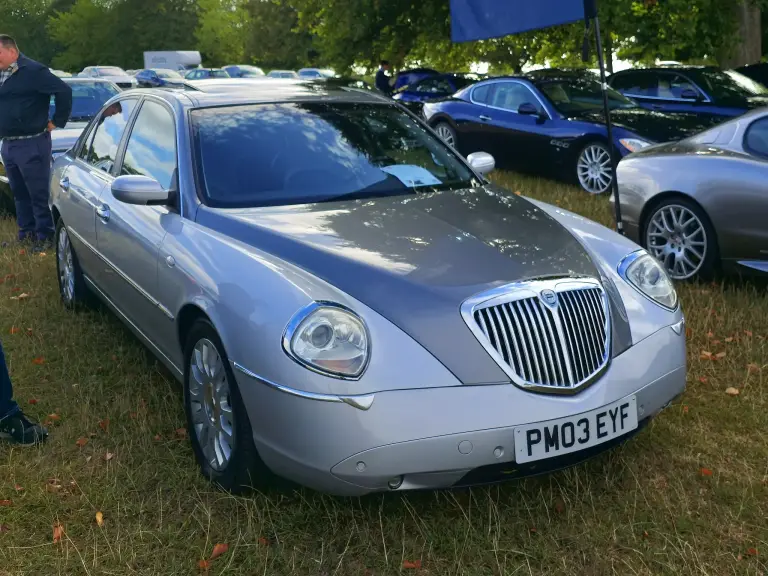
The Diàlogos previewed the Lancia Thesis, which took its exterior styling, and echoed the Lancia Aurelia in its rear-hinged doors. More cars are in the Lancia collection.
Sources
- Lancia Dialogos, English Wikipedia: design, interior, technology, Giubileo
- Lancia Dialogos, Italian Wikipedia: design process, designers, Giubileo details