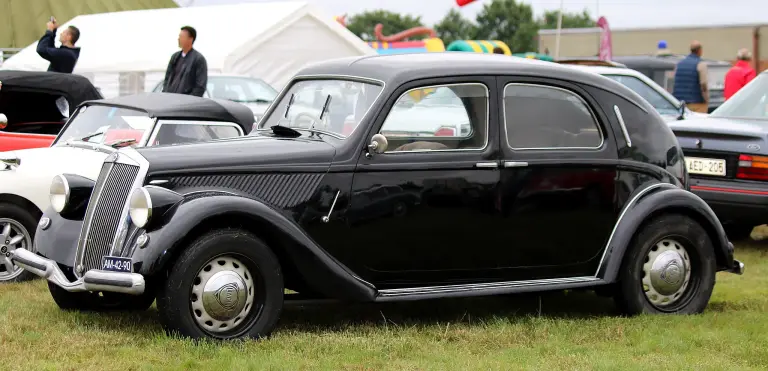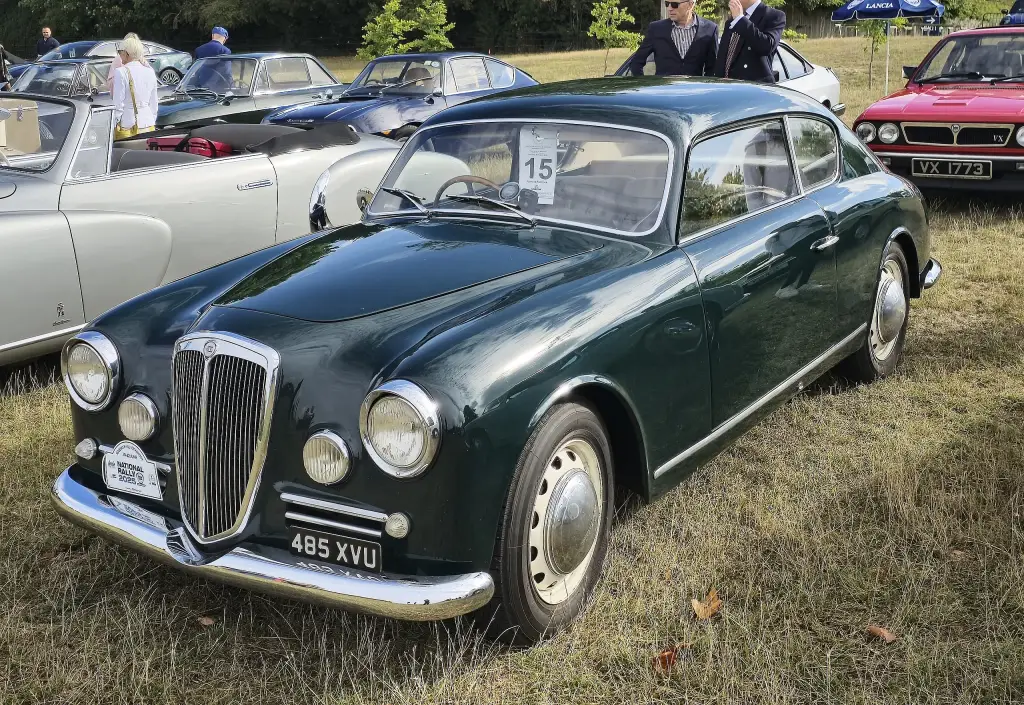
The Lancia Aurelia was built from 1950 to 1958 in six series, as a four-door saloon, a cabriolet, the B20 GT coupé, the B24 spider and convertible, and as a rolling chassis for coachbuilders. Designed under Vittorio Jano, it used one of the first series-production V6 engines and was the first car to be fitted with radial tyres as standard equipment. Like the Aprilia before it, it was named after a Roman road, the Via Aurelia.
Lancia Aurelia at a glance
| Maker | Lancia, Turin |
|---|---|
| Production | 1950–1958, six series |
| Bodies | saloon, cabriolet, B20 GT coupé, B24 spider and convertible |
| Engine | 60-degree V6, 1,754 to 2,451 cc |
| Power | 56 hp in the first B10, over 110 hp in later 2.5-litre cars |
| Layout | front engine, rear-wheel drive |
| Transmission | transaxle with gearbox, clutch and differential at the rear |
| Rear brakes | inboard, on the transaxle |
| Front suspension | sliding pillar; de Dion rear from the fourth series |
| Tyres | radial, the first car with them as standard |
| Designer | Vittorio Jano, with Francesco De Virgilio |
| Named after | the Via Aurelia |
History of the Lancia Aurelia
From the A10 prototype to the Aurelia
During the war Gianni Lancia began planning the company’s future. A 1948 prototype called the A10 used a 2-litre 90-degree V8 in a tubular chassis with a Ghia coupé body, three seats in front with the driver in the middle and a preselector gearbox, but the project was judged too revolutionary and too expensive. Instead the technical direction, led by Vittorio Jano and Giuseppe Vaccarino with the young Francesco De Virgilio, went back to the classic Lancia layout, and the V6 idea came from De Virgilio’s work on balance, which pointed to an angle between 40 and 80 degrees.
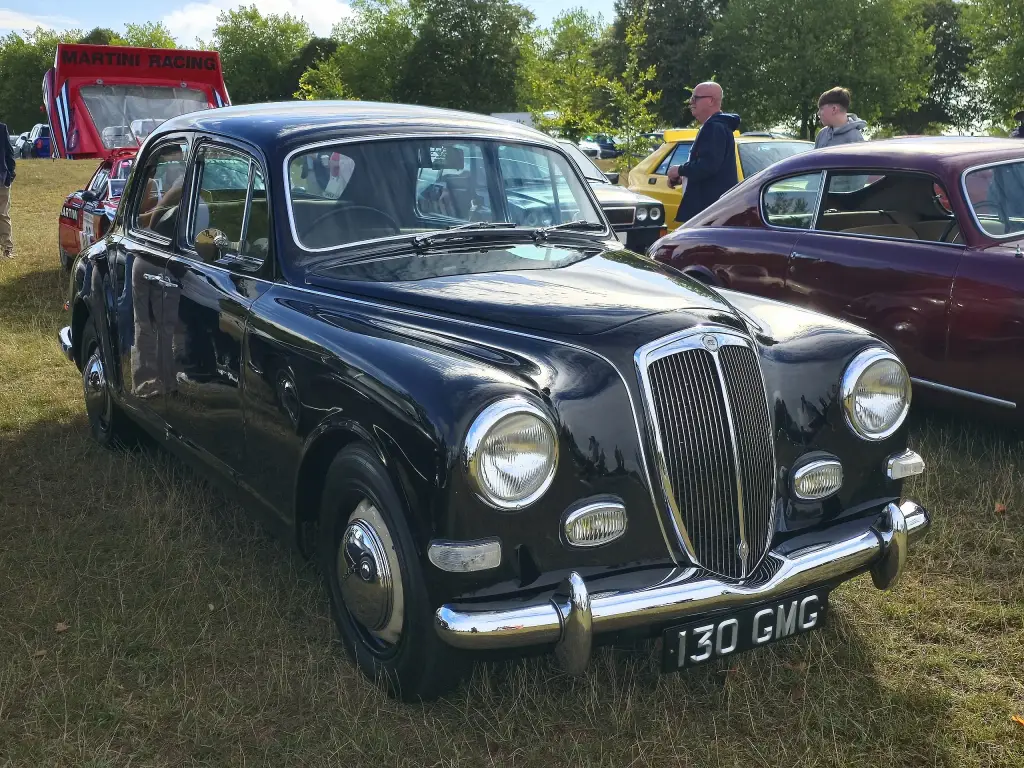
The V6 and the transaxle
The production engine had a 60-degree V6 with an all-alloy block and a single camshaft between the banks, hemispherical combustion chambers and in-line valves. Capacity grew from 1,754 cc in the B10 of 1950, with 56 hp, to 1,991 cc in the B21 and B20, and 2,451 cc in the third series. At the rear was an innovative transaxle combining gearbox, clutch and differential, with inboard drum brakes. The front suspension was the Lancia sliding pillar type; the fourth series replaced the rear semi-trailing arms with a de Dion tube.
Six series
The first series consisted of the B10 saloon and, from 1951, the B21 with the larger engine and the B20 GT coupé, which had a shorter wheelbase and a Ghia design built by Pinin Farina; 500 first-series cars were made. The second series of 1952 raised coupé power to 80 hp with a higher compression ratio and repositioned valves, added chromed bumpers, and brought the B22 saloon with twin Weber carburettors and 90 hp. The third series of 1953 used the 2,451 cc engine and lost the earlier tail fins. The fourth series introduced the de Dion rear suspension, shell bearings, the B24 Spider and left-hand drive availability, and was the first to be imported to the United States in any number.
The later cars
The fifth series coupé of 1956 was more luxurious, with a stronger split-case transaxle and a revised driveshaft; alongside it came the B24 convertible with roll-up windows and a better seating position. Dino Risi’s 1962 film Il Sorpasso made the car famous. The sixth series of 1957 had 112 hp with more torque to offset its greater weight and was the most touring-oriented B20. Coachbuilt versions included the Pinin Farina B50 and B52 cabriolets, of which about 265 B50s and 98 B52 chassis were built, and the PF200 show car of 1952 with its circular jet-inspired air intake.
Design and features
- Production V6: a 60-degree all-alloy engine designed by Francesco De Virgilio under Vittorio Jano.
- Transaxle: gearbox, clutch and differential together at the rear, with inboard brakes.
- Radial tyres as standard: the Aurelia was the first car so equipped.
- Coupé legend: the short-wheelbase B20 GT with Ghia styling and Pinin Farina bodywork.
Lancia Aurelia versions
- B10 and B21 saloons: 1,754 and 1,991 cc, from 1950.
- B20 GT coupé: short wheelbase, up to 112 hp in the sixth series.
- B22 saloon: twin carburettors, 90 hp, 1952.
- B24 Spider and convertible: open cars of the fourth and fifth series.
- B50 and B52 cabriolets: Pinin Farina four-seaters.
- PF200: Pinin Farina show car of 1952, seven built.
The Aurelia replaced the Lancia Aprilia, and the smaller Lancia Appia followed its styling. The Lancia Flaminia succeeded it as flagship. More cars are in the Lancia collection.
Sources
- Lancia Aurelia, English Wikipedia: series, engines, body styles
- Lancia Aurelia, Italian Wikipedia: A10 prototype, engine development, B10 details