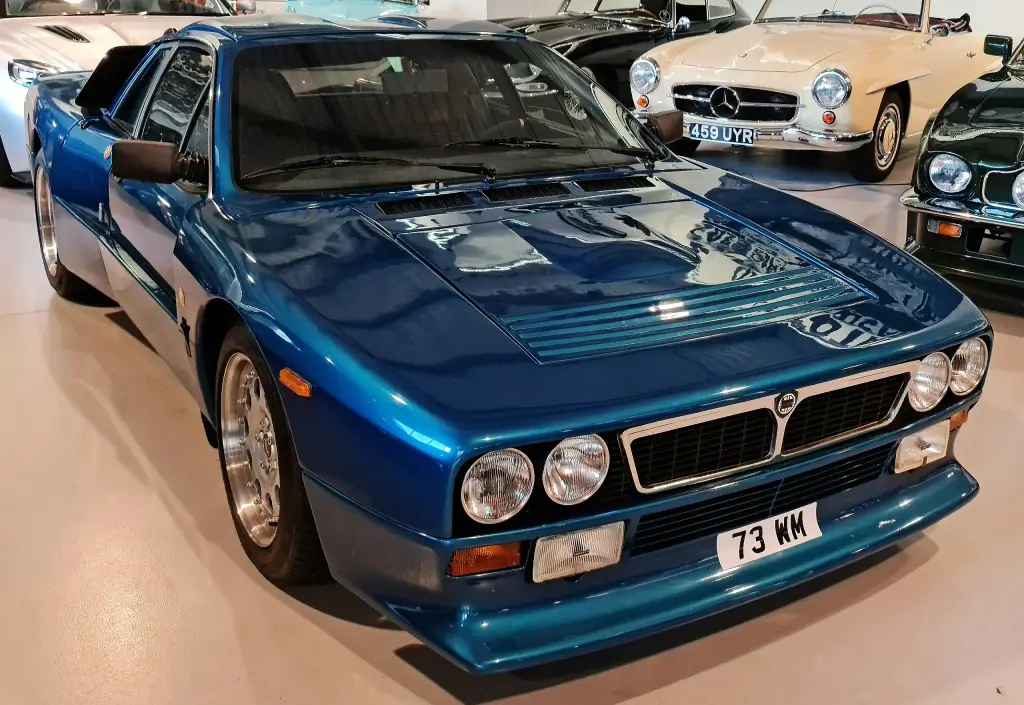
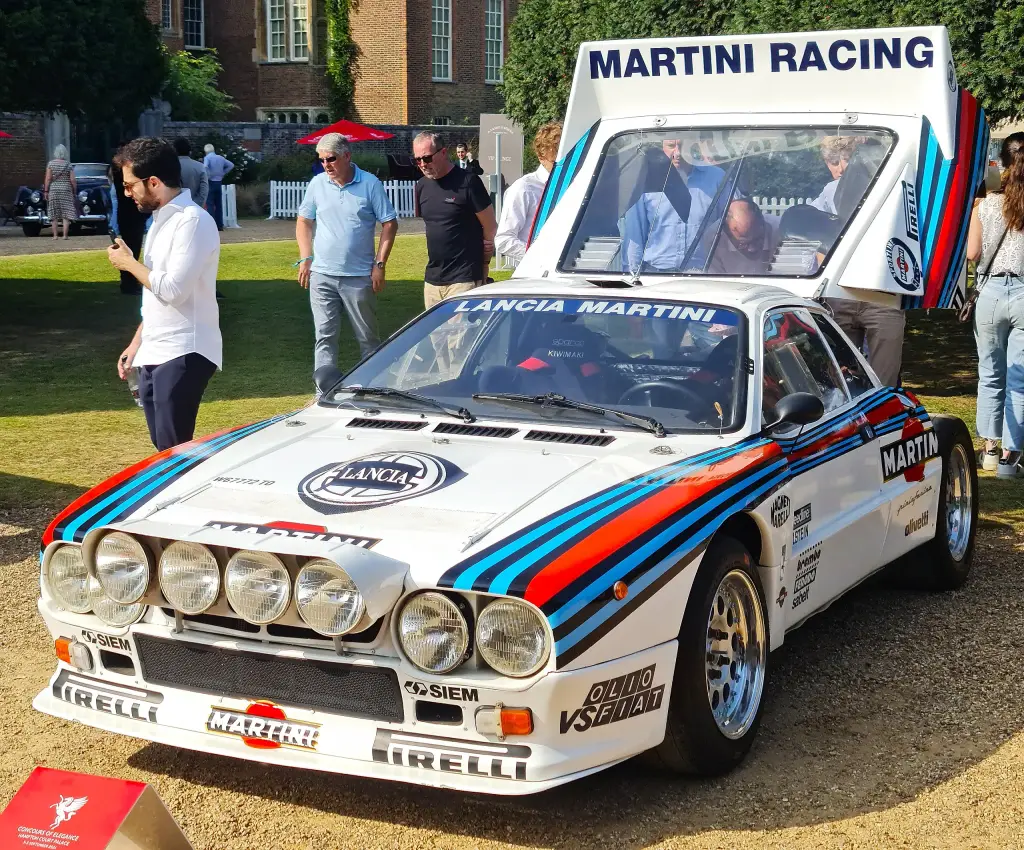
The Lancia Rally, homologated as the 151 ARO and better known as the 037 from its Abarth project code SE 037, was a mid-engined rally car built for the new Group B category. It was the first car designed specifically for Group B and, in 1983, won the manufacturers’ world championship for Lancia. It was also the last rear-wheel-drive car to win the World Rally Championship.
Lancia 037 at a glance
| Maker | Lancia, developed by Abarth |
|---|---|
| Production | 1982–1984 |
| Class | Group B rally car, with 200 road cars for homologation |
| Layout | mid engine, rear-wheel drive |
| Engine | 1995 cc four-cylinder, 16 valves, volumetric supercharger |
| Road-car power | 205 CV |
| Top speed | over 220 km/h |
| Acceleration | 0–100 km/h in under 7 seconds |
| Transmission | five-speed ZF gearbox modified by Abarth |
| Chassis | Beta Montecarlo-based, developed by Dallara |
| Bodywork | Pininfarina, glass-fibre reinforced polyester |
| Competition weight | about 960 kg dry |
| Major win | 1983 World Rally Championship for Makes |
History of the Lancia 037
From Fiat prototypes to Abarth
The story begins with the Pininfarina X1/8 study of the late 1960s, a mid-engined coupé proposal for Fiat. It was renamed X1/20 when Fiat switched to the 2-litre Lampredi twin-cam, and eventually reached production in 1975 as the Lancia Beta Montecarlo. Before that, in 1974, Abarth built the SE 030 from a Montecarlo shell: the 3.2-litre V6 of the Fiat 130 was enlarged to 3,481 cc and tuned to 285 bhp, and one of the two cars finished second in the Giro d’Italia.
Group 5 success
In 1978 Lancia introduced the Group 5 Montecarlo Turbo, a silhouette racer with a Dallara-designed chassis and Pininfarina bodywork. Its turbocharged Fiat twin-cam engine took the 2-litre class in 1979 and the World Championship for Makes in 1980 and 1981, giving Lancia both the chassis experience and the confidence to go rallying again.
The SE 037 project
When the rules changed, Cesare Fiorio announced in 1981 that Lancia would build a new rally car. The SE 037 project, led by Sergio Limone, was a joint effort of Lancia, Pininfarina, Dallara and Abarth. It used the Dallara-developed chassis of the Montecarlo Turbo with double-wishbone suspension, glass-fibre bodywork by Pininfarina, and a supercharged 1995 cc four-cylinder engine mounted longitudinally behind the driver. The car was shown at the Turin Motor Show in 1982.
Racing and road cars
For Group B homologation only 200 road cars, the Stradale, were needed; they were sold with 205 CV and could exceed 220 km/h. The competition cars developed quickly: the 1982 version had around 260 CV, Evoluzione 1 raised that to about 275–280 CV, and Evoluzione 2 of 1984 used a 2111 cc engine with 325–330 CV. In 1983 the 037 won the manufacturers’ world championship, beating the new four-wheel-drive cars, before all-wheel drive became unbeatable. The 037 also served as a test bed for the supercharger-and-turbo engine of the later Delta S4.
Design and features
- Supercharged rather than turbocharged: a Roots-type Abarth blower gave immediate response where rivals used turbos.
- Race-bred chassis: double wishbones at each corner, derived from the Dallara Group 5 racer.
- Light glass-fibre body: a Pininfarina shape over a steel central cell with tubular subframes.
- Purpose-built for Group B: the first car designed from the start for the new category.
Lancia 037 versions
- Stradale: the road car, 205 CV, over 220 km/h.
- 1982 rally car: about 260 CV with carburettors.
- Evoluzione 1: about 275–280 CV, mechanical fuel injection.
- Evoluzione 2 (1984): 2111 cc, 325–330 CV.
The 037 was built on the chassis of the Lancia Montecarlo and was followed by the four-wheel-drive Lancia Delta. More cars are in the Lancia collection.
Sources
- Lancia Rally 037, English Wikipedia: project history, versions, championship
- Lancia Rally 037, Italian Wikipedia: road-car figures, technical data, competition evolution