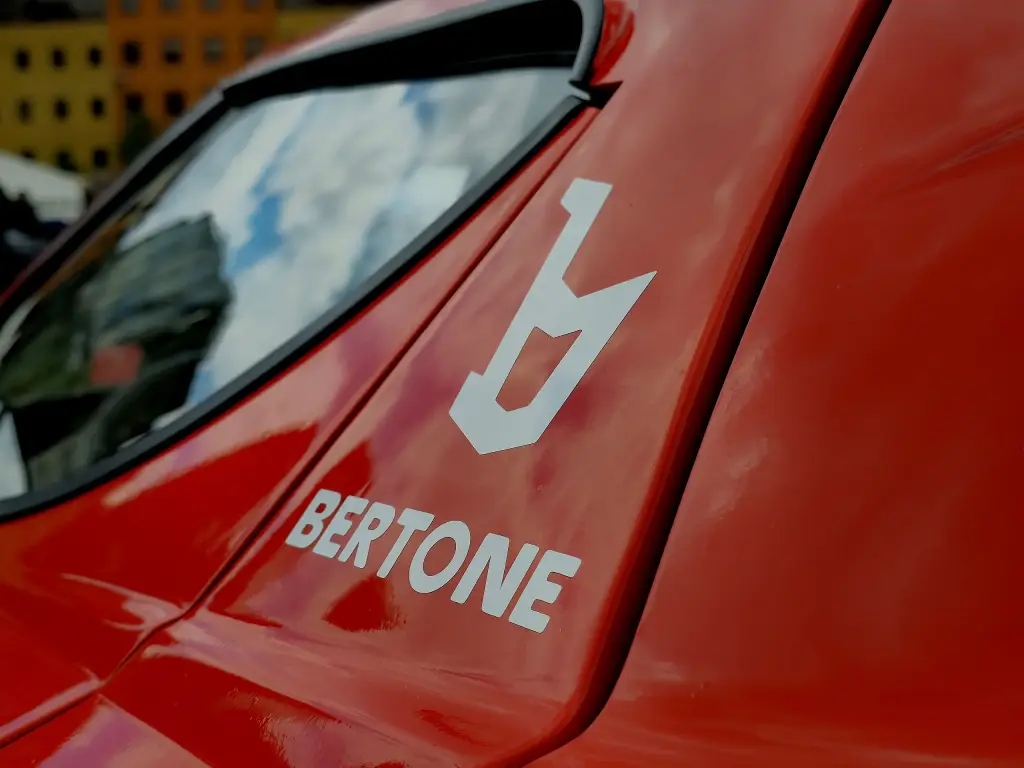
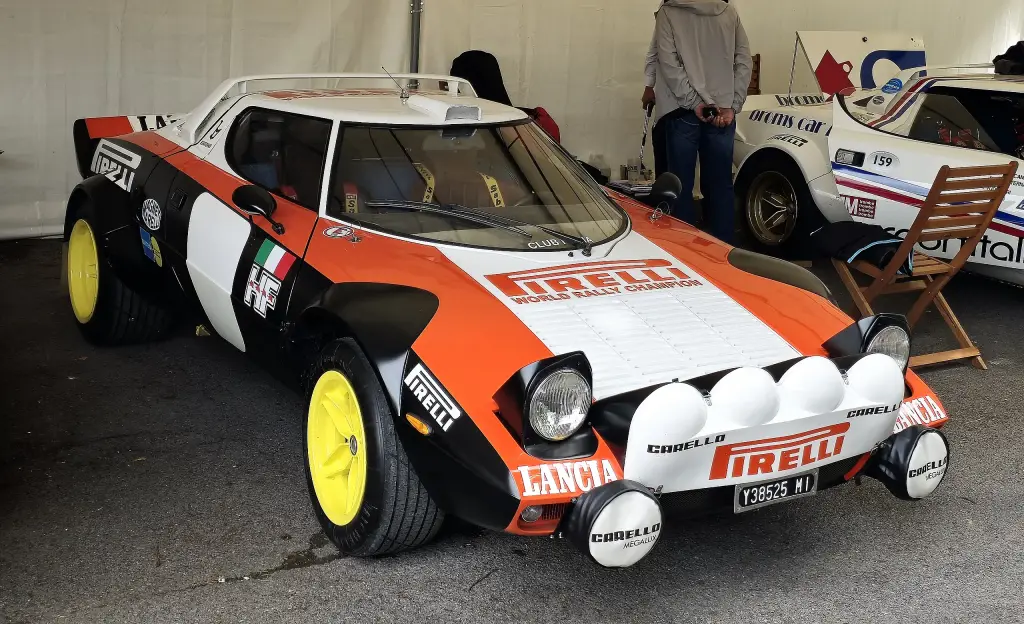
The Lancia Stratos HF, type 829, was a rear mid-engined sports car designed for rallying. It won the World Rally Championship in 1974, 1975 and 1976, the Targa Florio in 1974, the Tour de France Automobile five times and the Giro d’Italia automobilistico three times. It was the first car designed from scratch for rally competition, and its Bertone shape by Marcello Gandini is one of the most recognisable of the 1970s.
Lancia Stratos at a glance
| Maker | Lancia, body by Bertone, assembled at Chivasso |
|---|---|
| Production | 1973–1975 |
| Designer | Marcello Gandini, Bertone |
| Layout | mid engine, rear-wheel drive |
| Engine | Ferrari Dino 2.4-litre V6 |
| Power | 190 PS in road trim, about 275–320 hp in rally form |
| Top speed | 232 km/h in road trim |
| Acceleration | 0–100 km/h in 6.8 seconds |
| Weight | 900–950 kg |
| Wheelbase | 2,180 mm |
| Homologation | 500 cars required for Group 4 |
| Titles | 1974, 1975 and 1976 World Rally Championship |
History of the Lancia Stratos
Bertone makes the first move
Lancia had always worked with Pininfarina and had never used Bertone, so Nuccio Bertone set out to create the opportunity, knowing that Lancia needed a replacement for the ageing Fulvia in rallying. He built a running show car on the running gear of a friend’s Fulvia Coupé: the Stratos Zero, which he drove personally to the gates of the Lancia factory, passing under the barrier to applause from the workers. Lancia and Bertone then agreed to develop a rally car along the lines of Marcello Gandini’s ideas; Gandini had already designed the Lamborghini Miura and was working on the Countach.
Prototype and engine
The Bertone-designed Stratos HF prototype was shown at the 1971 Turin Motor Show, a year after the Zero. It was fluorescent red, with a crescent-shaped wrap-around windscreen giving maximum forward visibility and almost none to the rear, and it was tried with three engines in turn: the Fulvia unit, the Beta engine and finally the mid-mounted Ferrari Dino V6, which gave 190 hp in road trim. Using that engine had been planned from the start, but Enzo Ferrari hesitated to supply a car he saw as a rival to his own Dino V6; once Dino production had ended he agreed, and Lancia suddenly had 500 engines. The final shape shares features with the Miura, such as the dual clamshell bonnets and the way the door glass curves upward, but its short, wide wedge with a nose below the front wheel-arch crests is unique.
Built to rally
The rally project was led by Lancia team manager Cesare Fiorio, the British racer and engineer Mike Parkes and the works driver Sandro Munari, with Gandini taking a personal interest in the body and Nicola Materazzi doing the calculations for the chassis, steering, suspension and engine. The cabin was designed as a steel safety cell with two square-tube subframes welded on to carry the engine and suspension. The rear used a robust MacPherson layout with an anti-roll bar, the front double wishbones with coil springs, telescopic dampers and an anti-roll bar, and the overhangs were kept very short, with a wheelbase of only 2,180 mm and tracks of 1,430 and 1,460 mm. Production of the 500 cars needed for Group 4 homologation began in 1973, and the Stratos was homologated for the 1974 season.
Road car and racing record
The road car, sold as the Stratos HF Stradale, used the same 2.4-litre Dino V6 in a milder state of tune, giving 190 PS at 7,000 rpm and 226 Nm at 4,000 rpm, with 0–100 km/h in 6.8 seconds and 232 km/h. Racing versions produced around 275 hp in 12-valve form and 320 hp with 24 valves until the 1978 rules banned the 24-valve heads. Production ended in 1975 with 492 cars, Group 4 rules having been relaxed to 400 cars in 24 months. The Stratos won the championship titles of 1974, 1975 and 1976 with Sandro Munari and Björn Waldegård, and might have won more had Fiat group politics not moved rallying support to the Fiat 131 Abarth. It also won the Monte Carlo Rally in 1975, 1976 and 1977 with Munari and, with the private Chardonnet team, as late as 1979.
Design and features
- Purpose-built rally car: the first production car designed from the start for rallying.
- Ferrari Dino V6: a mid-mounted 2.4-litre engine shared with the rally cars.
- Gandini wedge: a short, wide body with clamshell bonnets and a wrap-around screen.
- Rally dominance: three world titles in a row and wins in every major event of the era.
Lancia Stratos versions
- Stratos HF Stradale: the 492 road cars, 190 PS.
- 12-valve rally car: about 275 hp.
- 24-valve rally car: about 320 hp until banned after 1977.
The Stratos grew out of the Lancia Fulvia rally programme and was preceded by the Stratos Zero show car; its rally successor was the Lancia 037. More cars are in the Lancia collection.
Sources
- Lancia Stratos, English Wikipedia: history, design, engines, racing record
- Lancia Stratos, Italian Wikipedia: Bertone, chassis, production, sales