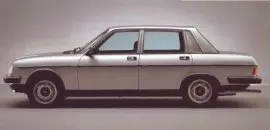
The Lancia Trevi, type 828, was a saloon produced from 1980 to 1984 and initially sold as the Lancia Beta Trevi. Most of it came from the Beta, with transversely mounted twin-cam four-cylinder engines driving the front wheels, but the rear was restyled into a classic three-box shape. Its name comes from the Italian for three volumes. In total 36,784 were built.
Lancia Trevi at a glance
| Maker | Lancia, Chivasso |
|---|---|
| Production | 1980–1984 |
| Shown | Turin Motor Show, May 1980 |
| Bodies | four-door three-box saloon |
| Engines | 1.6 and 2.0 twin-cam, 2.0 i.e., 2.0 Volumex |
| Power | 102 to 135 CV |
| Layout | front engine, front-wheel drive |
| Gearbox | five-speed manual, three-speed automatic optional |
| Suspension | MacPherson struts all round |
| Brakes | discs, with ABS optional |
| Tyres | 185/65 R14 Pirelli P6 |
| Built | 36,784 |
History of the Lancia Trevi
A saloon to rebuild trust
The Beta Trevi was presented at the Turin Motor Show in May 1980 and shown to the British market at the Birmingham show that November. Most of the car came from the Beta, and the work concentrated on the rear: a completely different roofline, a new rear window angle and redesigned lights. The chief engineer was Sergio Camuffo, who had also been responsible for the original Beta and the Gamma. Lancia sold the Beta alongside the Trevi for two years as the Beta Berlina, and its sales literature stressed that the car was both luxurious and sporting.
Restoring credibility
Lancia’s intention was that the restyled Beta would help rebuild credibility after the rusting scandal, when the company had to buy back cars with corroded subframe mounting points. Autocar wrote in 1981 that Lancia’s position had taken an unreasonably big knock and that a new Lancia, thanks to the over-compensation needed to make the point, promised to be as rust-resistant as any rival. The same review called the Trevi a conventional three-box saloon that was a Beta under the skin, although most body panels and the interior were completely new. The car was part of a general conservative trend in which fastbacks and unusual shapes gained conventional boots, as with the Volkswagen Jetta, the Citroën Visa, the Fiat Ritmo, the Simca Solara and the Saab 900.
Engines and the Volumex
At launch there were two engines, a 1.6 of 102 CV and a 2.0 of 115 CV, both carburetted, with a three-speed automatic available. Bosch electronic ignition arrived on the 2000 i.e. in 1981, raising output to 122 CV at 6,400 rpm. The last version, the Trevi Volumex, was introduced at the Turin show in 1982 to improve performance without harming economy: a twin-scroll Roots-type supercharger, still with carburettors rather than the expected injection, lifted output to 135 CV and top speed to 190 km/h, with 205 Nm of torque. Lancia argued that a supercharger gave better response and low-speed torque than the turbos that had largely replaced it elsewhere. The Volumex had revised front seats, a matt-black chin spoiler, Zegna upholstery and ZF power steering as standard, and Lancia UK did not import it.
The dashboard and the end
The Trevi’s interior, designed by Mario Bellini, was the most talked-about feature: a complex architecture of shapes in a small space, which contemporary journals called ugly, gimmicky and overstyled, resembling Swiss cheese or something from Star Trek. The car was not warmly received by the British press, and in Italy it suffered from internal competition, first from the more successful Prisma from late 1982 and then from Fiat’s own 131 and Regata, which were cheaper. A second series of June 1983 dropped the Beta name, lengthened the final drive and gearbox ratios to cut consumption, and left only the 2.0 i.e. Production ended in 1984 alongside the Gamma. One special Trevi was built in 1984 by the former Abarth engineer Giorgio Pianta: the Bimotore, with a second Volumex engine in the rear and 300 CV in total, made so that Pirelli could test tyres for the road version of the Delta S4.
Design and features
- Three-box body: a conventional saloon shape built on Beta mechanicals.
- Supercharged Volumex: a Roots blower giving 135 CV and strong low-speed torque.
- Camuffo engineering: the same chief engineer as the Beta and Gamma.
- Bimotore prototype: a twin-engined test car with 300 CV for Pirelli tyre work.
Lancia Trevi versions
- 1600: 102 CV, carburettor.
- 2000: 115 CV, carburettor.
- 2000 i.e.: 122 CV with Bosch electronic ignition.
- Volumex: supercharged 2.0 with 135 CV.
- Bimotore: one-off twin-engined prototype of 1984.
The Trevi was the saloon version of the Lancia Beta and was squeezed out by the Lancia Prisma and Lancia Thema. More cars are in the Lancia collection.
Sources
- Lancia Trevi, English Wikipedia: history, engines, Volumex, press criticism
- Lancia Beta Trevi, Italian Wikipedia: engines, second series, Bimotore, production