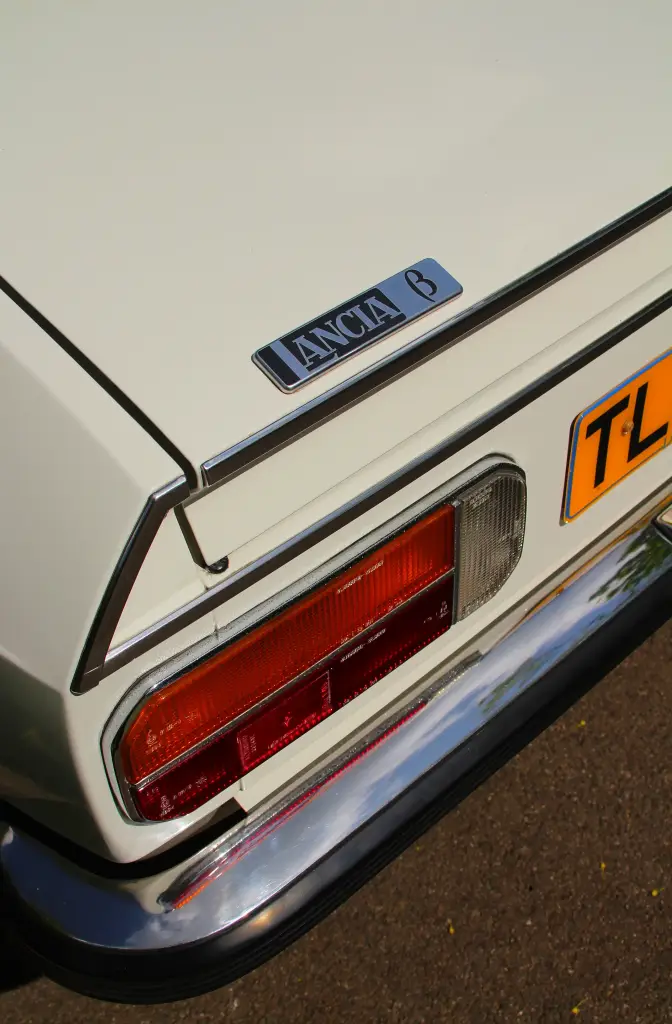
The Lancia Beta, type 828, was produced from 1972 to 1984 and was the first new model from Lancia after Fiat took over the company in 1969. It came as a fastback saloon, the Trevi three-box saloon, a coupé, a targa Spider and the HPE estate, while a separate mid-engined model was sold as the Beta Montecarlo. The name revived the Greek letters used by Vincenzo Lancia, although the first letter was avoided to prevent confusion with Alfa Romeo.
Lancia Beta at a glance
| Maker | Lancia, Turin |
|---|---|
| Production | 1972–1984 |
| Bodies | saloon, Trevi, coupé, Spider targa, HPE estate, Montecarlo |
| Engine | Fiat twin-cam four, 1.3 to 2.0 litres |
| Layout | front engine, front-wheel drive; Montecarlo mid-engined |
| Gearbox | five-speed manual, automatic from 1978 |
| Suspension | all independent, MacPherson struts front and rear |
| Brakes | discs on all four wheels |
| Steering | rack and pinion |
| Designer | Gianpaolo Boano, Fiat style centre |
| Project engineer | Sergio Camuffo |
| Named after | the second letter of the Greek alphabet |
History of the Lancia Beta
After the takeover
When Fiat acquired Lancia in 1969 the company had been without a technical director for a year, following the death of Antonio Fessia. In early 1970 Sergio Camuffo was told to develop a new model for production by the end of 1972, with limited money and a short timetable. The result used an existing engine, the Fiat twin overhead cam four with an alloy head and cast iron block, mounted transversely and driving the front wheels, and a gearbox developed from a unit Fiat’s partner Citroèn was working on. The aim was to keep Lancia’s quality image and price premium while cutting development time and cost.
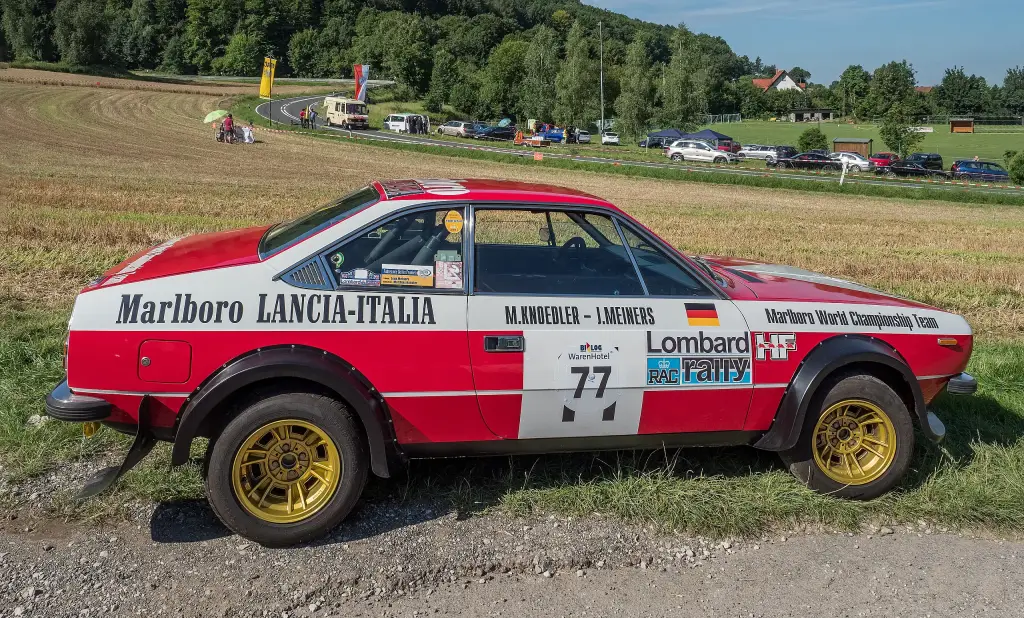
What the Beta offered
Every version had a twin-cam engine, a five-speed gearbox, rack and pinion steering, fully independent suspension with MacPherson struts at both ends and disc brakes on all four wheels. The engine and gearbox sat on a subframe bolted under the body, tilted 20 degrees rearwards to improve weight transfer and lower the centre of gravity. The rear suspension was unusual: MacPherson struts attached to parallel transverse links pivoting on a central cross member, with an anti-roll bar ahead of the struts. Lancia never patented the design, and it inspired similar layouts at other makers in the 1980s and 1990s.
The range grows
The saloon arrived in 1972 with 1,438, 1,592 and 1,756 cc engines of 90, 100 and 110 hp, a 1,297 cc entry model following in 1974. A short-wheelbase coupé came in June 1973, the 2+2 Spider convertible a year later, and the HPE estate at the Geneva show of 1975 on the saloon’s wheelbase. Pininfarina restyled the exterior for 1975, moving the rear window upright and lowering the waistline; electronic ignition and an automatic gearbox arrived in 1978. The mid-engined Beta Montecarlo, derived from the Pininfarina X1/20 project, completed the family.
Rust and reputation
Early cars suffered from very rapid body corrosion because the steel had not been given adequate anti-corrosion treatment, and the Beta’s reputation suffered accordingly. Italian sources also record complaints about the electrical system. The mechanical criticism was less fair: the twin-cam engines, derived from the 124 Sport and 132, were reworked by Lancia with their own heads and induction for transverse installation, and the roadholding was widely praised. The Trevi version with its three-box body continued the name alongside the saloon until 1984.
Design and features
- Shared Fiat platform: the Tipo Tre floorpan also served the Fiat Tempra and Alfa Romeo 155.
- Advanced rear suspension: a MacPherson layout with parallel transverse links, later copied by other makers.
- Five speeds everywhere: even the smallest Beta had a five-speed gearbox and disc brakes all round.
- Many bodies: saloon, Trevi, coupé, Spider and HPE estate from one range.
Lancia Beta versions
- Beta saloon: fastback four-door from 1972.
- Beta Coupé: short-wheelbase two-door from 1973.
- Beta Spider: 2+2 targa convertible.
- Beta HPE: high-performance estate of 1975.
- Beta Trevi: three-box saloon with the same running gear.
- Beta Montecarlo: mid-engined two-seater sold under the Beta name.
The Beta replaced the Lancia Fulvia and shared its platform thinking with the Lancia Delta and Lancia Prisma. Its mid-engined relative is the Lancia Montecarlo. More cars are in the Lancia collection.
Sources
- Lancia Beta, English Wikipedia: origins, engineering, body styles, updates
- Lancia Beta, Italian Wikipedia: development, engines, corrosion, saloon details