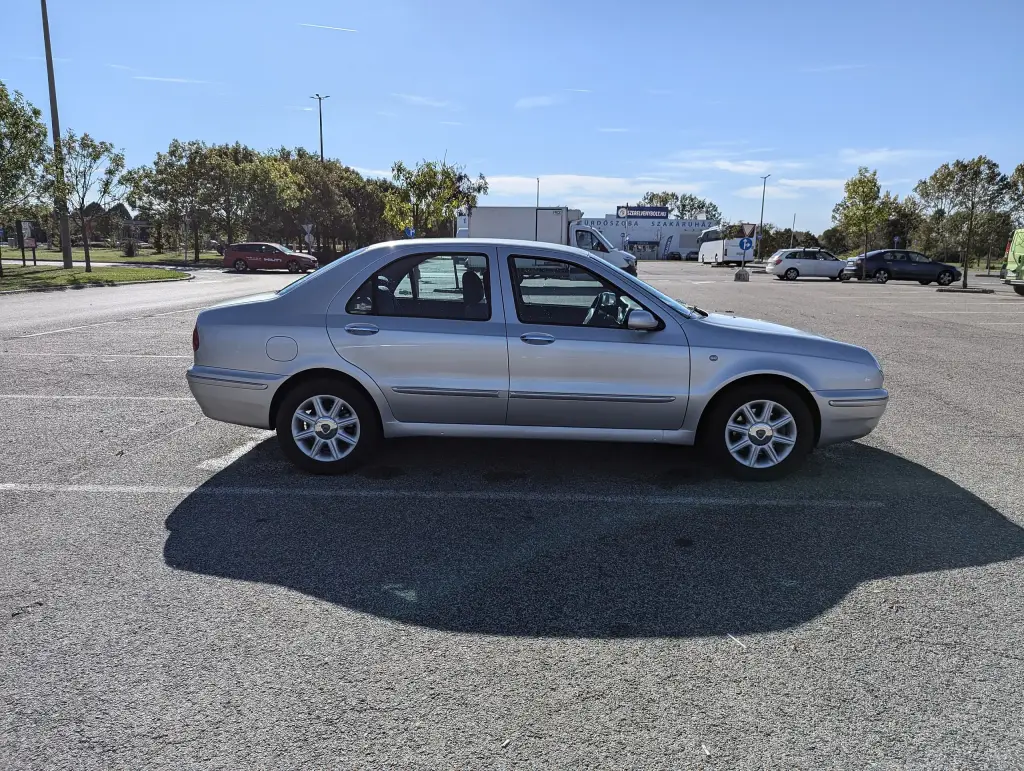
The Lancia Lybra, type 839, was a compact executive car produced from 1998 to 2005 on the floorpan of the Alfa Romeo 156, replacing the Dedra. Like its predecessor it came as a Berlina saloon and as an SW estate. Its name refers to the zodiac sign of Libra and marked the end of Lancia’s Greek-letter model names. In all 164,660 cars were made.
Lancia Lybra at a glance
| Maker | Lancia, Rivalta then Mirafiori |
|---|---|
| Production | 1998–2005 |
| Bodies | Berlina saloon, SW estate |
| Platform | Alfa Romeo 156 type, shared with Fiat Bravo, Brava and Marea |
| Engines | 1.6, 1.8 and 2.0 petrol, 1.9 and 2.4 JTD diesel |
| Power | up to 150 PS in the 2.4 JTD |
| Top speed | about 195 km/h for the 1.9 JTD of 115 PS |
| Layout | front engine, front-wheel drive |
| Suspension | MacPherson front, guided longitudinal arms rear |
| Drag coefficient | 0.31 for the saloon |
| Designer | Centro Stile Lancia, finished by Michael Robinson |
| Total built | 164,660 |
History of the Lancia Lybra
Born in a difficult period
The late 1990s were a dark time for Fiat and its automotive subsidiaries. Losses were mounting and the group management, led by the Italo-American financier Fresco, a former number two at General Electric, was determined to divest from cars. Lancia still had to replace the ageing Dedra, so the Lybra was developed on the Tipo 2 evolution 3 platform designed for the Alfa Romeo 156 and also used by the Fiat Bravo, Brava and Marea, but with softer, more comfort-oriented suspension: MacPherson struts at the front instead of the Alfa’s high wishbones, and guided longitudinal arm rear suspension that was more comfortable and more compact but less capable than the Alfa’s layout.
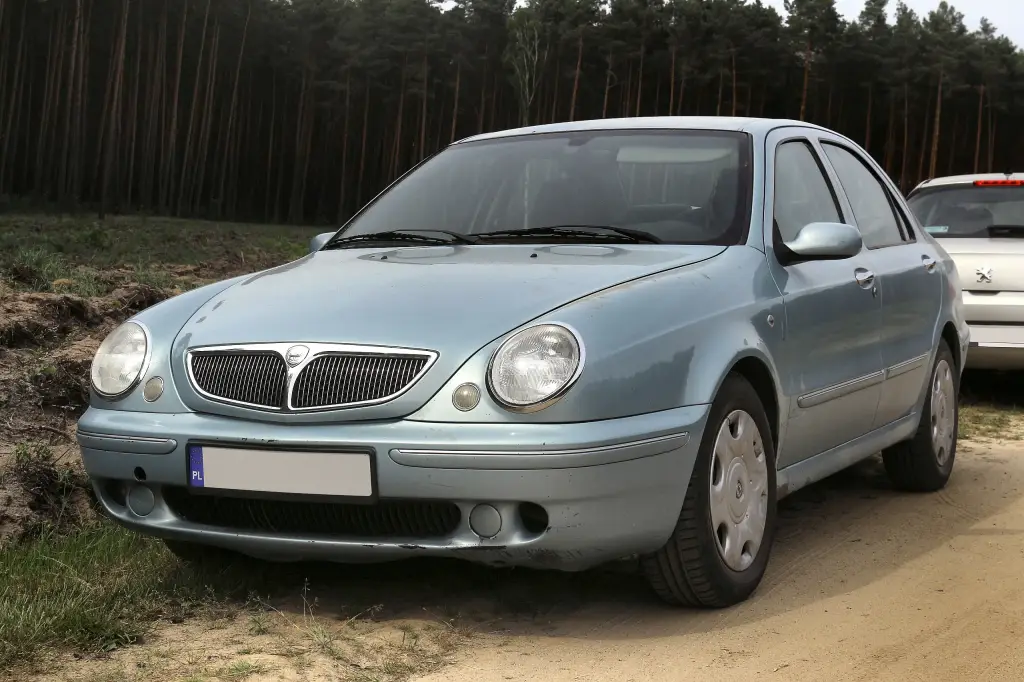
Style and equipment
The car was styled in-house at the Centro Stile Lancia, unlike earlier Lancias commissioned from outside studios. Initial work was by Enrico Fumia in 1992 and the project was finished by Michael Robinson after Fumia left; the interior was designed by Flavio Manzoni. The exterior deliberately moved away from the squared shapes of the 1980s and 1990s towards the rounded forms and round headlamps of 1950s Lancias such as the Aurelia and Appia, with a drag coefficient of 0.31 for the saloon. Base equipment included electric front windows, a colour display, dual-zone heating, ABS and EBD, four airbags, a height-adjustable driver’s seat and a four-way adjustable steering wheel. Options ran to air conditioning, satellite navigation with a GSM phone, a Bose sound system, xenon headlights, a sunroof, Nivomat self-levelling rear suspension and two extra side curtain airbags.
On the road and in the market
The Lybra was launched in March 1999 and went on sale in September, in saloon form in France first and as an SW estate from April 2000. The American actor Harrison Ford appeared in the launch advertising as a wealthy customer. The diesel engines were the most popular thanks to their economy, reliability and performance beyond the published figures: the 115 PS 1.9 JTD reached about 195 km/h and the 150 PS 2.4 JTD about 210 km/h. Sales were uphill almost from the start, partly because of Lancia’s fading image after the disappointing second-generation Delta and partly because of the retro, un-sporty line, which was deliberate: Fiat wanted Lancia to stand for comfort and elegance so as not to compete with Alfa Romeo. Most cars stayed in Italy, where the LX estate was popular as a company car.
Trims and the end
At launch the trims were Lybra, LS and LX; Business and LS Plus were added in 2003. The Emblema, shown at the Bologna Motor Show in November 2002, was inspired by the classic Lancia Flaminia and came with tobacco brown or beige leather, magnesium dashboard trim, 16-inch ten-spoke wheels, privacy glass and a gloss black roof. The Lybra never received a facelift and its petrol engines, transmissions, electronics and cabin stayed largely unchanged, which hurt sales in the second half of its life. Production moved from Rivalta to Mirafiori in 2002 and ended in 2005. In 2006 the Chinese company Zotye agreed with Fiat to license the Lybra for production in China, but the project was cancelled after its 2007 presentation, and the nearest indirect successor was the Lancia Delta of 2008.
Design and features
- Alfa 156 platform: the same structure as the 156, Bravo, Brava and Marea, but tuned for comfort.
- Retro styling: round headlamps and soft lines recalling the Aurelia and Appia, with a 0.31 drag coefficient.
- Strong diesels: the 1.9 and 2.4 JTD were the pick of the range for economy and pace.
- Four special editions: Business, Executive, Intensa and Emblema.
Lancia Lybra versions
- Berlina: the four-door saloon, sold from 1999.
- SW: the estate, from 2000.
- Business and LS Plus: added in 2003.
- Executive: luxury trim with nearly every option as standard.
- Intensa: dark accents and grey pentagram wheels.
- Emblema: flagship of 2002 inspired by the Flaminia.
The Lybra replaced the Lancia Dedra and was indirectly succeeded by the 2008 Lancia Delta; it sat below the Lancia Kappa in the range. More cars are in the Lancia collection.
Sources
- Lancia Lybra, English Wikipedia: history, styling, trims and equipment, production
- Lancia Lybra, Italian Wikipedia: platform, engines, market, Emblema, China project