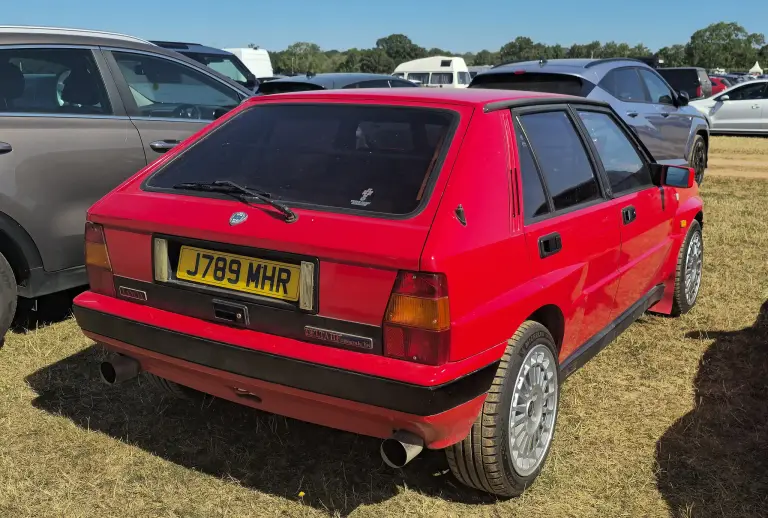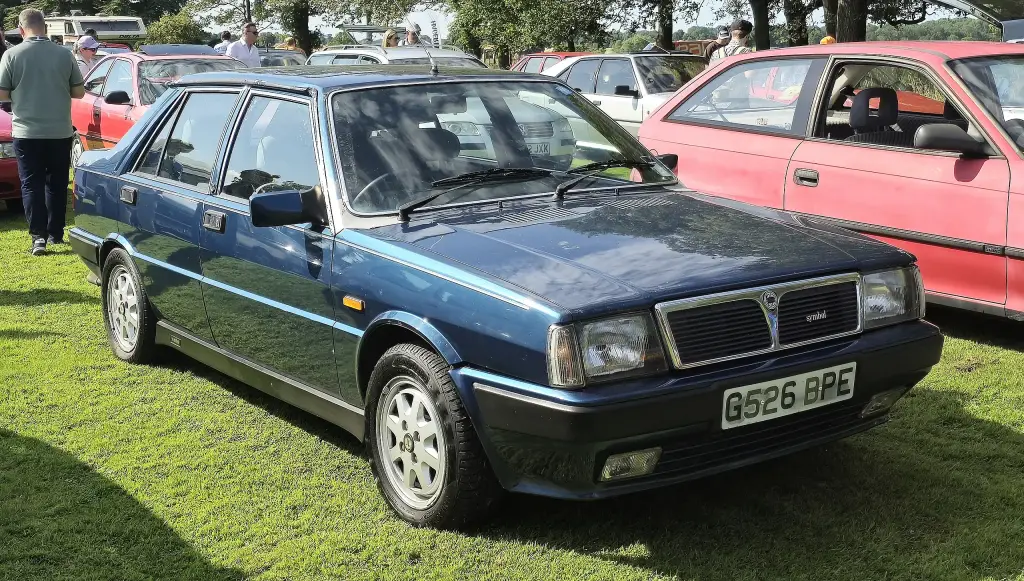
The Lancia Prisma, type 831, was a small family saloon built from 1983 to 1989 as the booted version of the first-generation Delta. Like the Delta it was designed by Giorgetto Giugiaro, and like the Delta it was also offered as a four-wheel-drive integrale, though with a non-turbocharged engine and a locking rear differential.
Lancia Prisma at a glance
| Maker | Lancia, Chivasso and Rivalta |
|---|---|
| Production | 1983–1989 |
| Designer | Giorgetto Giugiaro |
| Body | four-door, five-seat saloon |
| Engines | 1.3, 1.5, 1.6 and 2.0 petrol, 1.9 diesel and turbodiesel |
| Power | 65 to 115 PS |
| Layout | front engine, front-wheel drive; four-wheel drive on 4WD and integrale |
| Gearbox | five-speed manual, three-speed automatic |
| Suspension | MacPherson struts all round, anti-roll bars |
| Boot | 410 litres |
| Built | 317,378 |
| Replaced by | Lancia Dedra |
History of the Lancia Prisma
A saloon from the Delta
Turning the Delta hatchback into a saloon was given back to its original designer, Giorgetto Giugiaro, who worked on the car in 1979 and 1980. The two cars share the platform and its 2,475 mm wheelbase, the drivetrains, the doors and the windscreen. The Prisma was launched in late December 1982 and went on sale in Italy in early January 1983, with its European premiere at the Geneva Motor Show. It became the most popular Lancia almost at once: with daily production of 250 cars, cumulative output reached 100,000 in 1984.
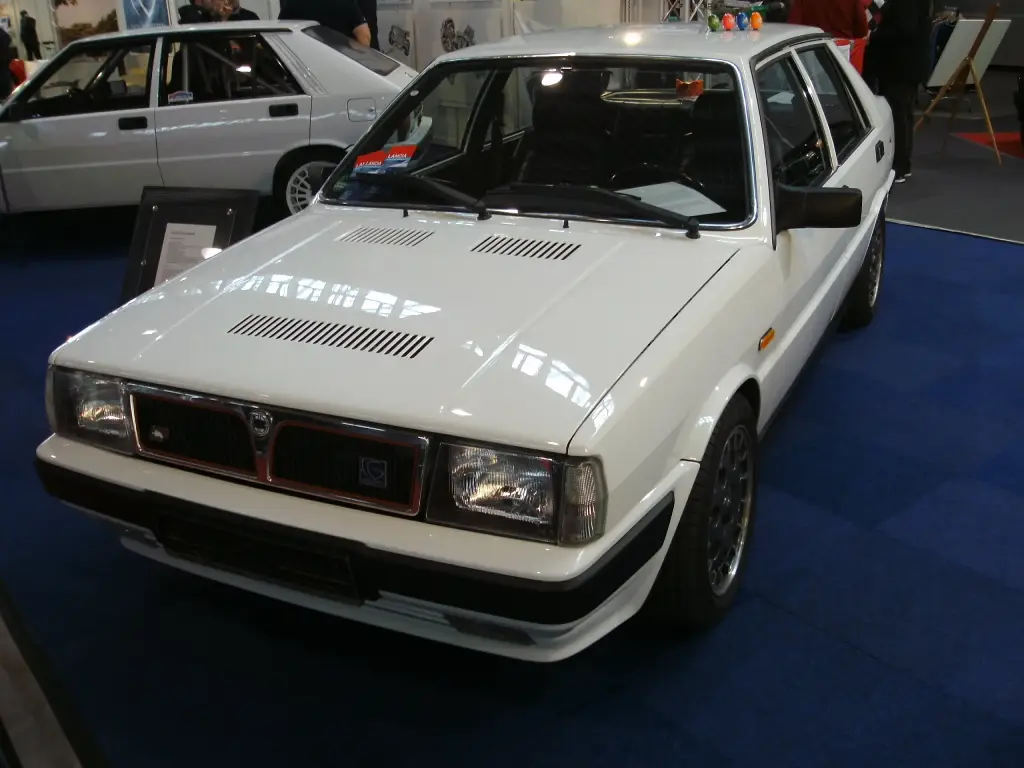
First series
The initial range had five models mirroring the revised 1982 Delta. The 1300 used a 1,301 cc engine of 78 PS with a five-speed gearbox; the 1500 had a 1,498 cc 85 PS engine with either the same gearbox or Lancia’s own three-speed automatic built at Verrone. At the top the 1600 used the 1,585 cc twin-cam of 105 PS from the Delta 1600 GT with Marelli Digiplex ignition, four disc brakes, a close-ratio five-speed and lower-profile tyres on wider wheels, plus the richest standard equipment, Zegna check cloth and air conditioning as an exclusive option. The interior was well finished with a comprehensive instrument panel, and options included a check control, alloy wheels and a 50/50 split-folding rear seat.
The diesels
June 1984 brought the Prisma diesel, Lancia’s first modern diesel passenger car, which mattered because more than a third of Italian sales in the class were diesel. Its naturally aspirated 1,929 cc single-overhead-cam four with an iron block, aluminium head and indirect injection gave 65 PS, and the engine weighed only 11 kg more than the 1.6 petrol. It had been developed by Fiat and also went into the Fiat Regata DS, though without some of Lancia’s noise and vibration solutions, and diesel Prismas had a slightly domed bonnet to clear the taller engine. A turbo diesel followed in May 1985 with a KKK turbocharger, wastegate, intercooler and oil cooler, giving 80 PS and 172 Nm, with the ZF five-speed of the Delta HF turbo, disc brakes, wide tyres and standard power steering.
Second series and the end
A major refresh appeared at the Turin Motor Show in April 1986, with more enveloping bumpers, a redesigned grille and bonnet recalling the flagship Thema, a ventilation grille on the C-pillar, full-wheel hubcaps and a new interior with new seats, instruments and air conditioning. The range grew to seven models, including the new 1.6 i.e. with Weber-Marelli IAW electronic injection and 108 PS and the Prisma 4WD with the two-litre 115 PS engine and Lancia’s permanent four-wheel drive with three differentials; in June 1987 the 4WD became the Prisma integrale. The 1.6 i.e. could exceed 200 km/h and was among the fastest cars of its size, quicker than the Alfa Romeo 75 and BMW 3 Series of the day. The Prisma was replaced by the Dedra in 1989 after 317,378 cars, about a third of them 1.6s and some 80,000 diesels. Fiat’s then president Gianni Agnelli had a unique Prisma with a 2.0 turbo engine of about 200 PS and Connolly leather, built by Abarth in two examples.
Design and features
- Delta under the skin: the same platform, doors and windscreen as the hatchback, with a 410-litre boot.
- Giugiaro saloon: a sober three-box shape that appealed to Italian buyers.
- First Lancia diesel: a 1.9-litre Fiat-developed unit of 65 PS, later turbocharged to 80 PS.
- Integrale version: permanent four-wheel drive with three differentials from 1987.
Lancia Prisma versions
- Prisma 1300 and 1500: 78 and 85 PS, the latter also with automatic.
- Prisma 1600 and 1.6 i.e.: 105 PS carburetted and 108 PS injected.
- Prisma diesel and turbo ds: 65 and 80 PS.
- Prisma 4WD and integrale: two-litre 115 PS with permanent four-wheel drive.
- Prisma LX: end-of-run luxury trim of 1988.
The Prisma was the saloon sister of the Lancia Delta and was replaced by the Lancia Dedra; it sat below the Lancia Thema. More cars are in the Lancia collection.
Sources
- Lancia Prisma, English Wikipedia: layout, series, engines, second series
- Lancia Prisma, Italian Wikipedia: market, engines, production, Agnelli’s car