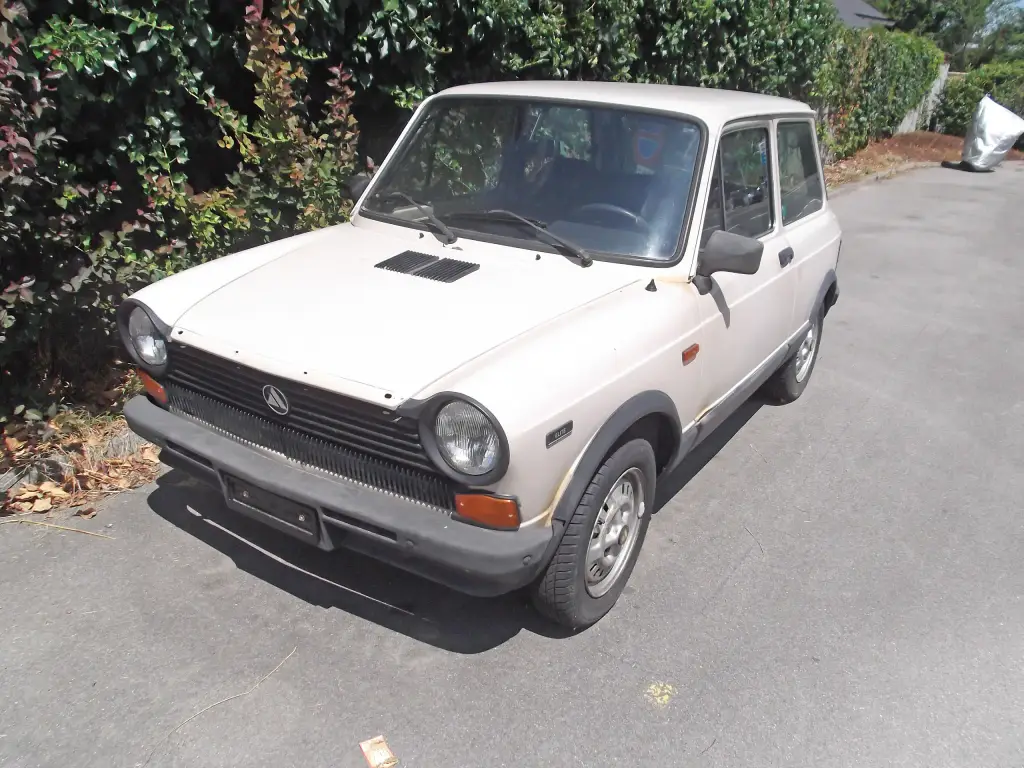
The Autobianchi A112 was a small three-door hatchback introduced in 1969 as a replacement for the Bianchina and Primula. It was developed on a shortened version of the Fiat 128 platform, and its mechanicals went on to underpin the Fiat 127. Production in Autobianchi’s Milan factory lasted until 1986, when the Lancia-badged Y10 took over.
Autobianchi A112 at a glance
| Maker | Autobianchi, Milan |
|---|---|
| Production | 1969–1986 |
| Body | three-door hatchback |
| Engine | 903 cc overhead-valve four, from the Fiat 850 |
| Power | 42–47 PS in standard form, more in the Abarth |
| Layout | front engine, front-wheel drive |
| Top speed | about 144 km/h in Italian road tests |
| Acceleration | 0–100 km/h in 13.7 seconds |
| Gearbox | four-speed manual, five-speed later and on the Abarth |
| Brakes | discs front, drums rear |
| Built | over 1.2 million |
| Successor | Autobianchi and Lancia Y10 |
History of the Autobianchi A112
A small car to answer the Mini
In the second half of the 1960s Fiat watched the Mini take a growing share of the Italian small-car market, especially among young and female buyers, while its own 850 looked obsolete. Dante Giacosa proposed a small, elegant front-wheel-drive car to be built by the controlled company Autobianchi. The project, coded X1/2, was also a large-scale field test of the parts that would go into the future Fiat 127. It was presented at the Turin Motor Show in 1969 and went on sale that autumn; demand was so strong that waiting lists of more than a year built up.
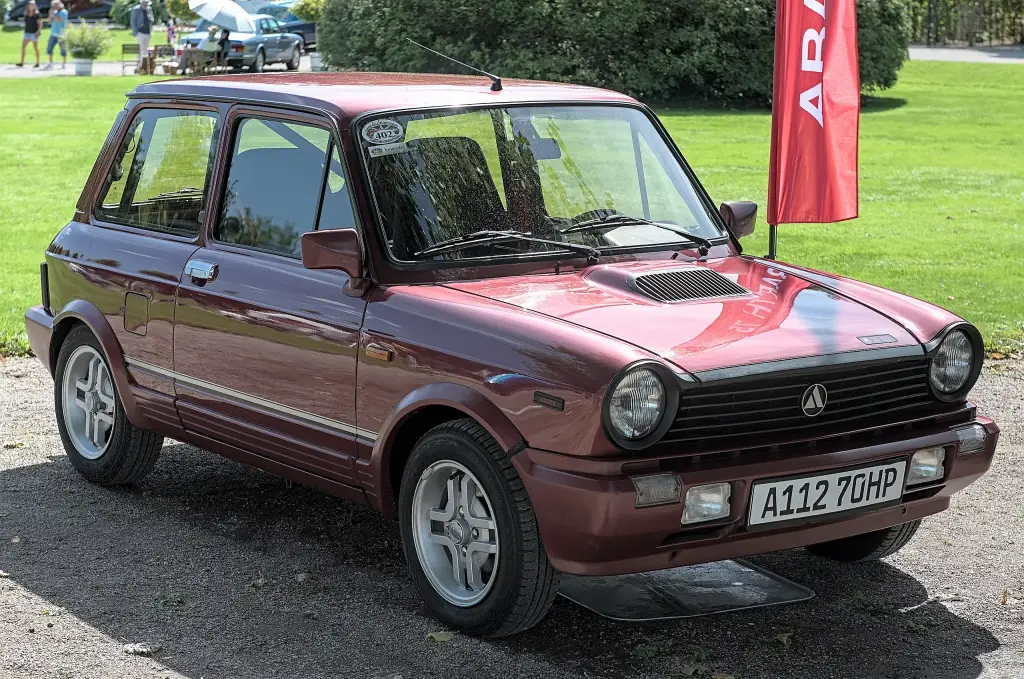
First series, 1969–1973
The first A112 had a single 903 cc pushrod engine derived from the Fiat 850 unit, mounted in front and driving the front wheels — the first time this engine appeared in that layout. Italian sources quote 44 CV, enough for about 144 km/h and 0–100 km/h in 13.7 seconds. Brakes were discs at the front and drums at the rear. In 1970 the car finished second in the European Car of the Year vote behind the Fiat 128.
Elegant and Abarth
In 1971 the range was widened with the A112 E, which had a contrasting roof colour, better trim and later a five-speed gearbox, and with the Abarth, a sporting version with a 982 cc engine prepared by Carlo Abarth’s workshop. The standard car then became known as the Normale.
Second and third series
March 1973 brought a new grille with a larger mesh, rubber bumpers with chrome inserts and new alloy wheels; the E was renamed Elegant and could be ordered in a single colour. The third series of 1975 made the car a five-seater, added much larger vents on the C-pillars and gave the Abarth a 1050 cc engine. Rayton Fissore showed a special-bodied Gold Shadow in 1978 with bodywork reminiscent of the Porsche 928.
Nuova A112 and the fifth series
In November 1977 the Nuova A112 arrived with a slightly taller roof and a more habitable interior, and the Elegant received a 965 cc engine with 48 PS. From the end of 1977 the car was also sold as the Lancia A112 outside Italy, and in Sweden Saab marketed it as the Saab Lancia A112. The fifth series of July 1979 added large black plastic cladding at the rear, new side trim and bumpers, and renamed the Normale as the Junior. Production ended in 1986 after more than 1.2 million cars.
Design and features
- Front-wheel drive: the A112 was the first car to put the Fiat 850 engine in a front-engine, front-drive layout.
- Three-door body only: every A112, from Normale to Abarth, was a three-door hatchback.
- Light and nimble: Italian tests found acceleration better than the claimed 44 CV suggested.
- Five series of updates: grille, bumpers, roof height and trim changed repeatedly over 17 years.
Autobianchi A112 versions
- Normale, later Junior: the base 903 cc car.
- A112 E, later Elegant: contrasting roof, better trim, five-speed gearbox.
- Abarth: 982 cc, then 1050 cc, sporting version.
- Elite and LX: more comfortable equipment added in the late 1970s.
- Lancia A112: export badge used outside Italy from 1977.
The A112 was replaced by the Lancia Y10, which shared its role as the small car of the group. Other Lancias of the period are in the Lancia collection.
Sources
- Autobianchi A112, English Wikipedia: history, engines, series changes, production
- Autobianchi A112, Italian Wikipedia: context, performance figures, market