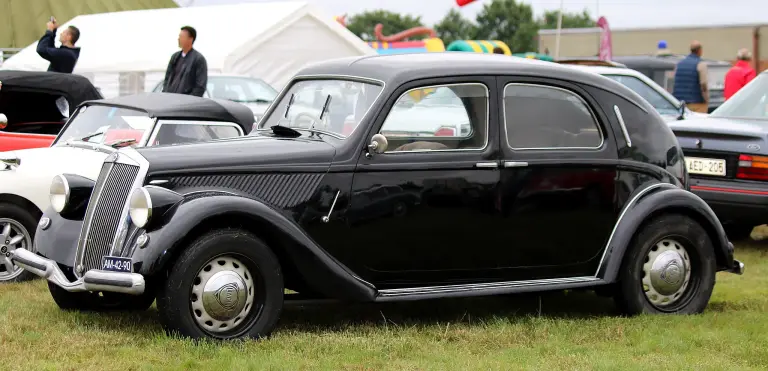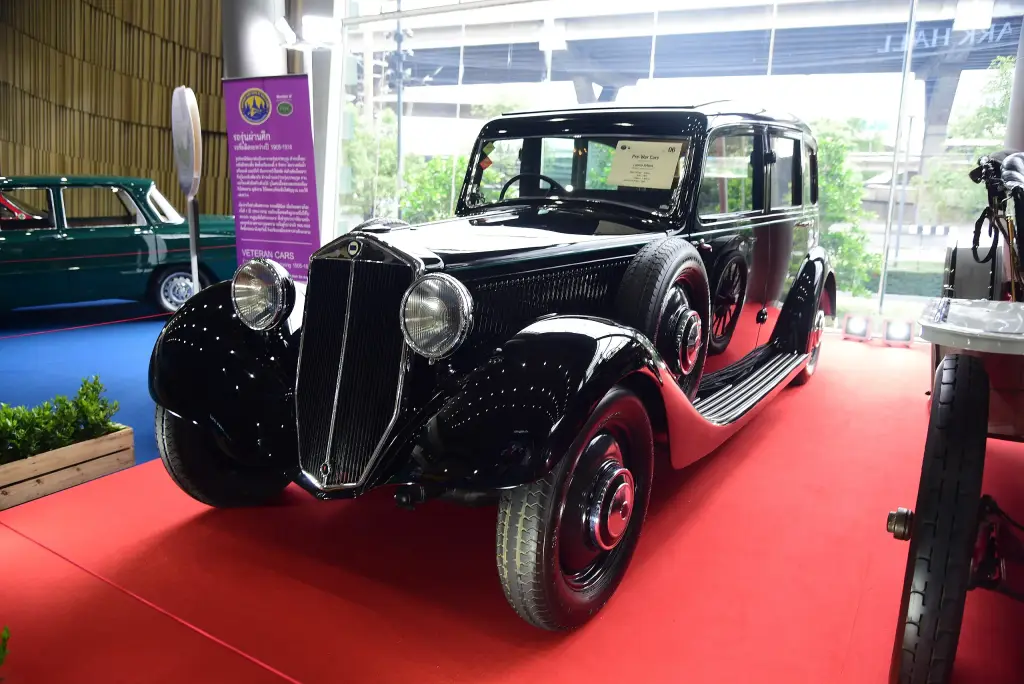
The Lancia Artena, known internally as the Tipo 228, was produced from 1931 to 1936 and again from 1940 to 1942, the second time chiefly for army and government use. It was the smaller of the two models that replaced the Lambda, sharing its chassis and factory bodies with the more luxurious V8 Astura. In total 5,567 were built.
Lancia Artena at a glance
| Maker | Lancia, Turin |
|---|---|
| Production | 1931–1936 and 1940–1942 |
| Engine | 1,924 cc V4, 17 degrees between banks |
| Power | 55 hp at 4,000 rpm, 51 hp in the fourth series |
| Top speed | 115 km/h, 105 km/h in the fourth series |
| Gearbox | four-speed manual, direct fourth |
| Chassis | separate frame, 3.0 m or 3.2 m wheelbase |
| Suspension | independent front, live axle rear |
| Brakes | drums on all four wheels |
| Body | four-window or six-window saloon, or bare chassis |
| Total built | 5,567 |
| Named after | Artena, a town of the Volsci |
History of the Lancia Artena
Replacing the Lambda with two models
At the start of the 1930s Lancia had to replace the ten-year-old Lambda and still offered the 4-litre V8 Dilambda as its flagship. The plan was for two closely related cars for different customers: the Artena with a four-cylinder engine below two litres and the Astura with a 2.6-litre V8 and a wheelbase about 19 cm longer to take the bigger engine. Both were shown at the Paris Motor Show in October 1931, and they broke the decade-old habit of naming Lancias after Greek letters, taking instead the names of places.
Chassis and engine
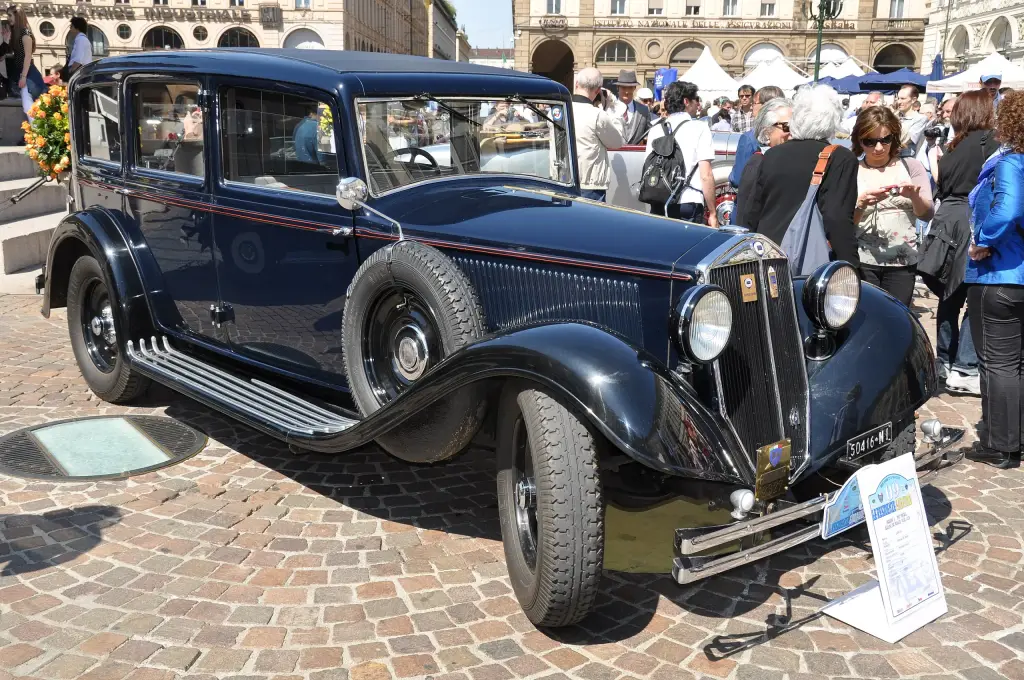
Unlike the Lambda, the Artena had a separate chassis, deliberately so that coachbuilders could work on it: two vertical box sections, an X-shaped brace and slightly converging side members, with two round tubes supporting the engine. The Tipo 84 V4 had a one-piece cast iron block, a 17-degree angle, all exhausts on the left and a single Zenith downdraught carburettor on the right, with a chain-driven overhead camshaft and two parallel valves per cylinder. The engine was not bolted directly to the frame but suspended on two small auxiliary leaf springs to damp vibrations. Front suspension was the Lancia sliding pillar type, the rear a live axle on semi-elliptic springs with friction dampers.
Four series
The first series of 1931–1932 accounted for 1,500 cars and came as a four-window saloon for four or a six-window saloon for six, or as a bare chassis. The second series of 1932–1933 (1,520 cars) mainly brought modified engine mountings. The third series of 1933–1936 (2,040 cars) had new bodywork with a slanted grille, wrap-around front wings and, for the first time on the Artena, a choice of short (3.0 m, 228C) or normal (3.2 m, 228A) wheelbase; 1,552 long and 488 short cars were made.
The wartime fourth series
At the start of the Second World War the Royal Italian Army asked for the Artena to be put back into production to carry senior officers. The 1940–1942 fourth series had a new platform frame, long wheelbase only, a detuned Tipo 54A engine of 51 hp and pressed steel Fergat wheels. Of the 507 built, 361 were passenger cars in three official six-seat styles — the Ministeriale saloon, a Viotti four-light convertible saloon and the Torpedo trasformabile Militare — all with a partition behind the driver, and 191 were ambulance chassis. Coachbuilders including Stabilimenti Farina, Pinin Farina and Touring made cabriolets, coupés and torpedoes on earlier Artena chassis, and Viotti built two mobile studios for the broadcaster EIAR.
Design and features
- Separate chassis: a deliberate return from the Lambda’s unitary body to suit coachbuilders.
- Spring-mounted engine: auxiliary leaf springs were used to smooth out vibration.
- Two wheelbases: short and normal chassis from the third series.
- Proverbial robustness: the Artena was said to be among the first cars able to cover 100,000 km without an overhaul.
Lancia Artena versions
- First series: 1,500 cars, 1931–1932.
- Second series: 1,520 cars, quieter engine mountings.
- Third series: 2,040 cars, slanted grille, two wheelbases.
- Fourth series: 507 cars, 1940–1942, Ministeriale and ambulance versions.
- Coachbuilt bodies: cabriolets, coupés and torpedoes by Italian carrozzerie.
The Artena shared its chassis with the larger Lancia Astura and replaced the Lancia Lambda, while the smaller Lancia Augusta kept unitary construction. More cars are in the Lancia collection.
Sources
- Lancia Artena, English Wikipedia: series, production numbers, specification
- Lancia Artena, Italian Wikipedia: chassis design, coachbuilders, wartime series