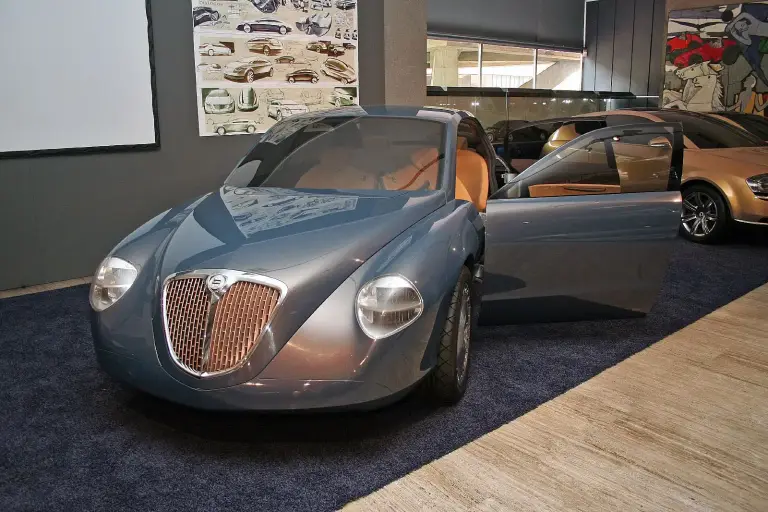
The Lancia Megagamma was a small, almost one-box concept MPV designed by Italdesign and presented at the 1978 Turin Motor Show. In hindsight it influenced later designs more than it succeeded itself: it has been called the conceptual birth mother of the MPV and minivan movement, and Fiat, then Lancia’s parent, judged it too risky to produce.
Lancia Megagamma at a glance
| Maker | Italdesign for Lancia |
|---|---|
| Shown | Turin Motor Show, April 1978 |
| Type | compact MPV concept |
| Designer | Giorgetto Giugiaro, Italdesign |
| Basis | Lancia Gamma platform |
| Engine | 2.5-litre Lancia flat-four, single overhead camshaft |
| Fuel system | Bosch L-Jetronic fuel injection |
| Layout | front engine, front-wheel drive |
| Body | five-door, almost one-box |
| Drag coefficient | 0.34 |
| Roof | 25 cm higher than the Gamma saloon |
| Production | none |
History of the Lancia Megagamma
A one-box idea
The Megagamma grew out of Italdesign’s long interest in one-box shapes. Giugiaro’s studio had already shown the Alfa Romeo New York Taxi in 1976, built for the Museum of Modern Art in New York, and would follow the Megagamma with the 1982 Capsula, the 2000 Maserati Buran and the 2010 Proton EMAS. The Lancia concept was a compact five-door vehicle with a high roof, a flat floor and an upright driving position, built on the front-wheel-drive platform of the Lancia Gamma.
Engineering
Mechanically the Megagamma used the Gamma’s layout: a front-mounted 2.5-litre single-overhead-camshaft flat-four with Bosch L-Jetronic electronic fuel injection, driving the front wheels. Its roof was 25 cm higher than the Gamma flagship’s, which gave far more room inside and let the driver sit upright with an advanced pedal box, offering a more ergonomic posture while freeing space for the knees. The high seating points were measured from the vehicle floor and from the pavement, and the shape achieved a drag coefficient of 0.34.
Why it mattered
The Megagamma prefigured many features of the modern MPV: a roomy but compact and flexible cabin with a flat floor, in the tradition of earlier small buses such as the Volkswagen Type 2 and the DKW Schnellaster, and ahead of later compact MPVs such as the Nissan Prairie of 1981, the Mitsubishi Chariot of 1983 and, much later, the Fiat 500L. Its influence reached the Renault Espace, the Honda Shuttle and the American minivans. At the time of its debut, despite the interest it aroused in the press and with the public, Fiat did not understand the commercial potential of the prototype and refused to approve any production, even for demonstration purposes. The tall, boxy styling language of the concept reappeared in Giugiaro’s later small Fiats, the Panda of 1980 and the Uno of 1983.
Design and features
- Almost one-box shape: a compact five-door with a high roof and a flat floor.
- High seating: an upright, ergonomic driving position with an advanced pedal box.
- Gamma mechanicals: a 2.5-litre flat-four with Bosch L-Jetronic injection and front-wheel drive.
- Efficient shape: a drag coefficient of 0.34, good for such a tall vehicle in 1978.
Lancia Megagamma versions
- Megagamma: the single 1978 Turin show car; no production version was ever approved.
The Megagamma was built on the platform of the Lancia Gamma, and its tall, practical body influenced later people carriers such as the Lancia Musa. More Lancias are in the Lancia collection.
Sources
- Lancia Megagamma, English Wikipedia: design, engineering, influence
- Lancia Megagamma, Italian Wikipedia: show debut, roof height, Fiat’s rejection