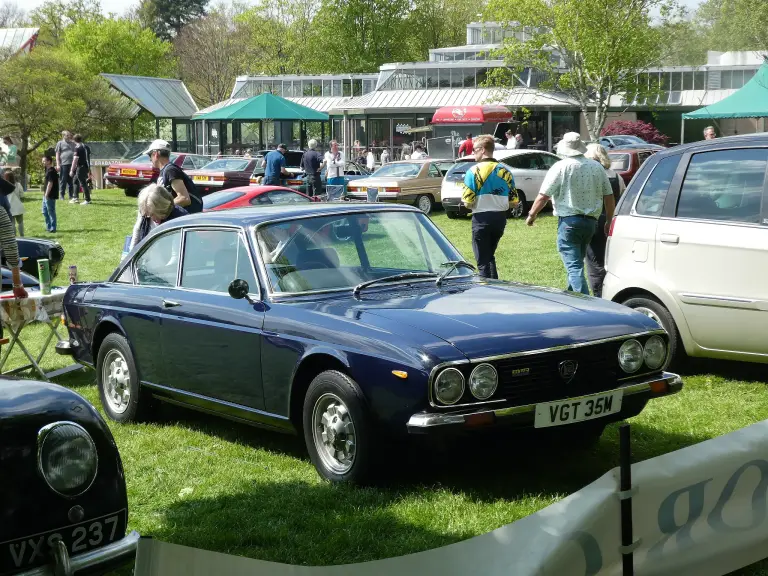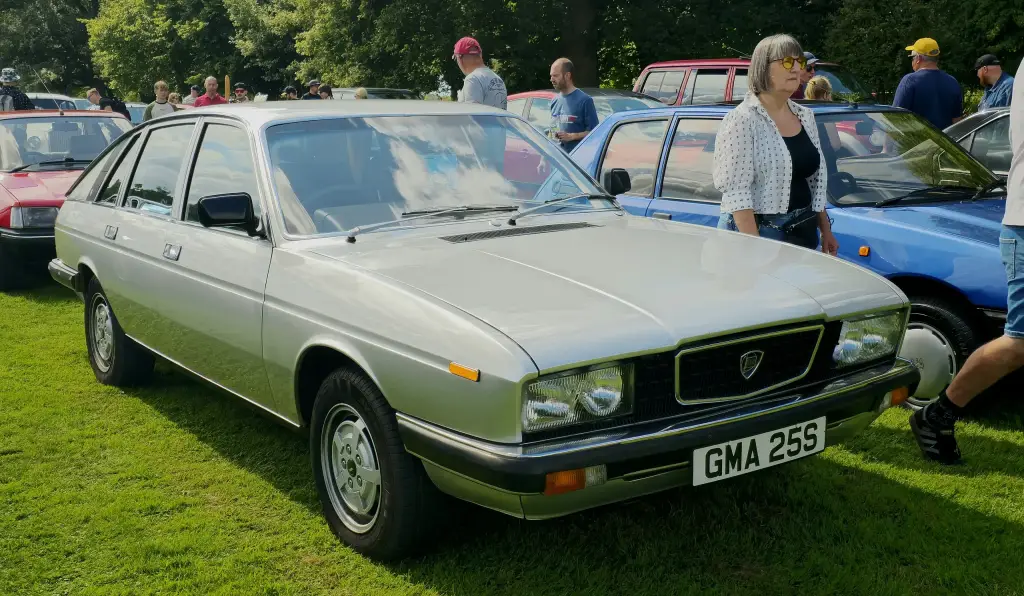
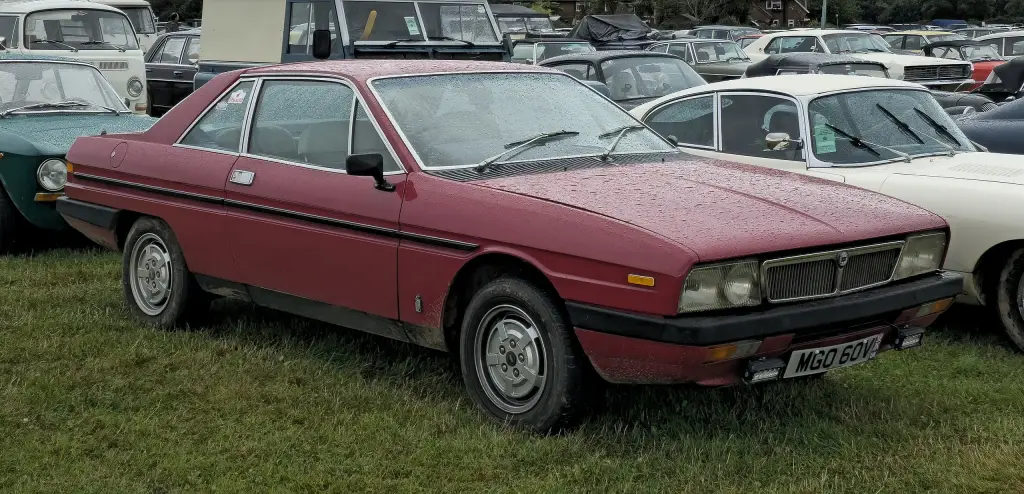
The Lancia Gamma, type 830, was an executive car produced from 1976 to 1984 as the replacement for the Lancia 2000. It was sold as a four-door fastback saloon and as a two-door coupé, both styled by Pininfarina, with 15,272 saloons and 6,790 coupés built. Gamma is the third letter of the Greek alphabet, reviving the naming used by the company before 1945.
Lancia Gamma at a glance
| Maker | Lancia, Borgo San Paolo |
|---|---|
| Production | 1976–1984 |
| Bodies | fastback saloon, two-door coupé |
| Designer | Pininfarina; Leonardo Fioravanti (saloon), Aldo Brovarone (coupé) |
| Engine | flat-four, 1,999 and 2,484 cc |
| Power | 120 PS in 2.0 form, 140 PS in 2.5 |
| Top speed | about 185 km/h (2.0), 195 km/h (2.5) |
| Layout | front engine, front-wheel drive |
| Gearbox | five-speed manual, four-speed automatic optional |
| Drag coefficient | about 0.37 |
| Saloons built | 15,272 |
| Coupés built | 6,790 |
History of the Lancia Gamma
Planning a new flagship
By the mid-1960s Lancia’s big-car tradition was fading: the Flaminia was ageing and the Flavia had grown from 1.5 to 2 litres to keep up with rivals, ending as the 2000 in 1971. After Fiat took over, work began on a new flagship under the project code Y2, to distinguish it from the Beta, then called Y1. The engine had to be larger than two litres, and after at least three years of proposals the choice fell on a new all-aluminium overhead-cam flat-four rather than a development of the Flaminia V6 or a Fiat or Dino unit. Fiat left the project largely to Lancia’s engineers at Borgo San Paolo, with Pininfarina designing both bodies.
Design
The saloon was designed at Pininfarina by Leonardo Fioravanti under Sergio Camuffo of the Lancia style centre, basing his work on the 1967 Pininfarina BMC 1800 Aerodynamica concept by Paolo Martin. Early proposals with a different rear were made by Aldo Brovarone, who later designed the coupé. The saloon was a fastback with a conventional boot rather than a hatchback: Pininfarina said at the launch that a hatchback was avoided to spare rear passengers from draughts when luggage was loaded. The result was a two-box shape with a drag coefficient of about 0.37, front-wheel drive, a longitudinally mounted flat-four and generous interior space.
Engines and the famous flaw
Pressure-cast in alloy with wet liners, the flat-four was light and gave 95 per cent of its maximum torque at just 2,000 rpm. The 2.5-litre version produced 140 PS and the 2.0-litre 120 PS, the smaller engine existing because Italian tax rose sharply above two litres: it was created by reducing the bore rather than the stroke. Both used Weber carburettors, and the 2.5 was also offered with fuel injection. The car’s notoriety came from the power steering pump, which was driven directly from the left-hand camshaft rather than by an accessory belt. Heavy load on the pump, such as starting the engine or turning to full lock, could make the timing belt jump or break and cause serious engine damage. The flat-four was also large for a four-cylinder and lacked the prestige of a six.
Second series and derivatives
The first series saloon of 1976–1980 accounted for 4,553 two-litre and 5,942 2.5-litre cars. The 1980 second series brought Bosch L-Jetronic injection for the 2.5, a new grille, an air intake below the front bumper, lower-profile tyres and a revised interior with Zegna cloth, a digital clock and reading lights. The 2.0 dropped to 116 PS. Several concepts were built on the Gamma platform: the 1977 Pininfarina Gamma Spider targa, the 1977 Italdesign Megagamma MPV, the 1980 Gamma Scala saloon, a 1981 six-window saloon by the Lancia style centre and the 1982 Gamma Olgiata shooting brake.
Design and features
- Flat-four engine: an all-alloy overhead-cam unit giving strong low-speed torque.
- Pininfarina styling: a fastback saloon and a low-bonnet coupé from the same studio.
- Front-wheel drive: unusual for a large Italian saloon of the period.
- Well-known weakness: the camshaft-driven power steering pump could damage the timing belt.
Lancia Gamma versions
- Gamma 2000: 1,999 cc, 120 PS, built mainly for Italy.
- Gamma 2500: 2,484 cc, 140 PS.
- Gamma 2500 I.E.: Bosch L-Jetronic injection from 1980.
- Coupé: two-door by Pininfarina, 6,790 built.
- Concepts: Spider, Scala, Olgiata and the Italdesign Megagamma.
The Gamma replaced the Lancia 2000 at the top of the range and shared its front-wheel-drive layout with the Lancia Beta; the Megagamma concept used its platform. More cars are in the Lancia collection.
Sources
- Lancia Gamma, English Wikipedia: design, engines, production, concepts
- Lancia Gamma, Italian Wikipedia: project history, engines, second series, concepts