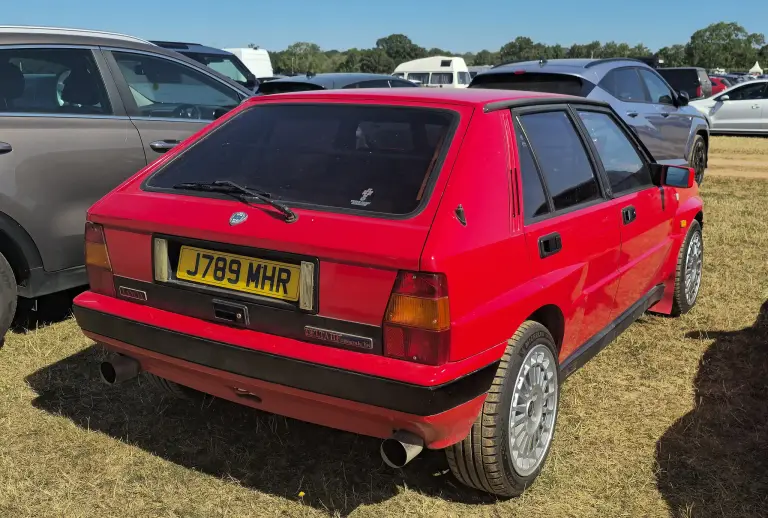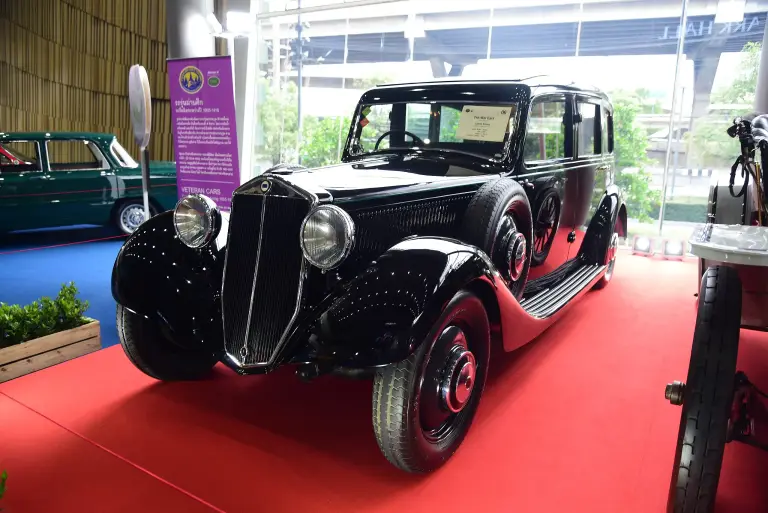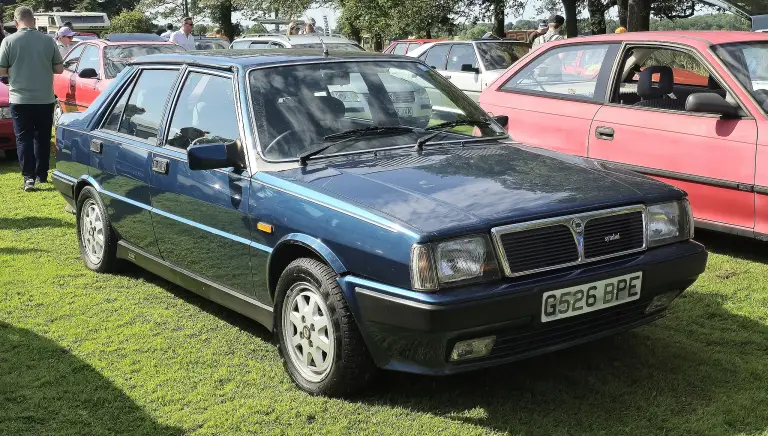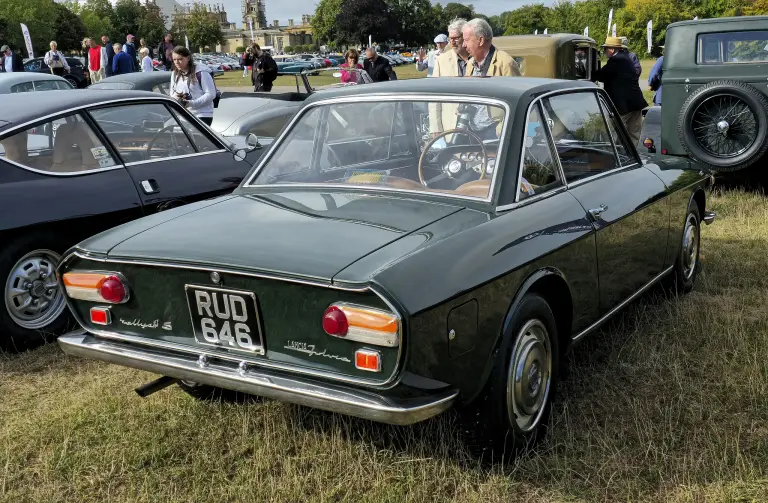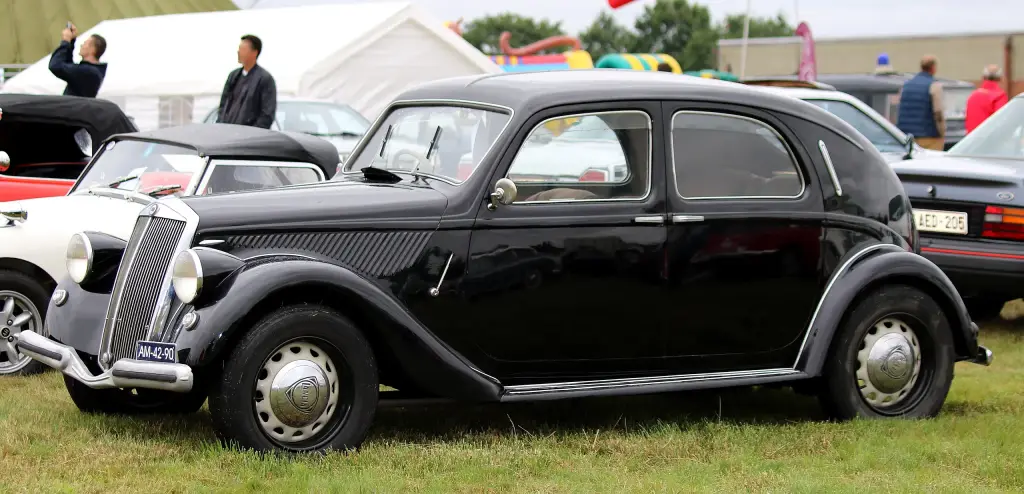
The Lancia Aprilia was a family car built from 1937 to 1949. One of the first cars designed with the help of a wind tunnel, it reached a drag coefficient of 0.47. Production began in February 1937, the month its creator died, and the Aprilia remained the last of Vincenzo Lancia’s designs.
Lancia Aprilia at a glance
| Maker | Lancia, Turin |
|---|---|
| Production | 1937–1949 |
| Class | family car |
| Body | four-door saloon, pillarless |
| Engine | 1,352 cc V4, later 1,486 cc |
| Power | 47 PS, later 48 PS |
| Drag coefficient | 0.47 |
| Suspension | independent, four wheels |
| Braking and steering | right-hand drive as standard |
| First series | mod. 238, 10,354 cars, 1937–1939 |
| Second series | mod. 438, 9,728 cars, 1939–1949 |
| Total | 20,082 cars, 7,554 chassis, about 700 French |
History of the Lancia Aprilia
Vincenzo Lancia’s final project
After the success of the Augusta, which accounted for nearly 85 per cent of Lancia’s output and turnover in 1934–1936, Vincenzo Lancia set out to complete what the Augusta had begun. The new car added what had been impossible in 1931: aerodynamics, hemispherical combustion chambers and independent suspension at all four wheels, all for the first time on a Lancia. In the last months of 1934 he called in his directors and engineers and started work on a conventional but aerodynamic car of a little over 1,200 cc, light enough to stay under a tonne as a five-seat saloon.
Aerodynamics and body
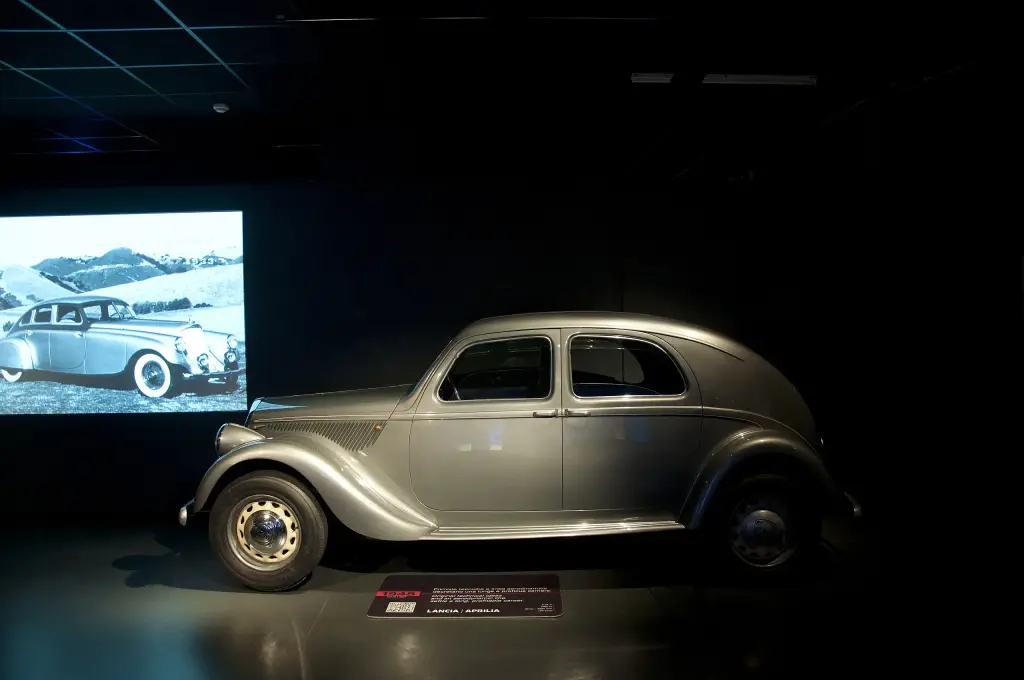
Wind tunnel work with Battista Farina and the Polytechnic of Turin showed that the shape of the tail mattered most; the resulting body had a drag coefficient of 0.47, a record for the period apart from the Tatra T87. The unitary body was patented on 9 January 1936 and was stiffer than the Augusta’s. Rain gutters and external hinges were removed for the sake of the airflow, and the doors, curved in plan for the look of the car, needed new ball-pivoted hinges that were hidden — the first Lancia without visible hinges. Their soft, precise closing sound became part of the Lancia reputation for quality.
Series and engines
The berlinetta aerodinamica was shown in 1936 and production started in February 1937. The first series, model 238, had a 1,352 cc V4 with hemispherical chambers giving 47 PS; 10,354 were built up to 1939. The second series, model 438, of 1939–1949 had a 1,486 cc engine of 48 PS and 9,728 were made, along with a Lusso version and a lengthened lungo of which 706 were built in 1946–1949. In total 20,082 cars and 7,554 chassis for coachbuilders were built in Turin.
France and special bodies
Lancia had opened a plant at Bonneuil, south of Paris, in 1931, and the Aprilia was assembled there from 1937 to 1939 as the Lancia Ardennes. Apart from the name and slightly larger headlights to suit French yellow-light rules, the Ardennes was indistinguishable from the Turin car; 1,620 were built before the war ended production. Special bodies included a Zagato design of 1938, a Touring convertible, the army’s Torpedo militare, a barchetta by Riva di Merate tuned by Luigi Pagani, a Bertone convertible of 1947 and an early Michelotti design for Vignale. The Aprilia also appears in the Tintin adventure Land of Black Gold.
Design and features
- Wind-tunnel body: a drag coefficient of 0.47, remarkable for a family saloon of 1937.
- Unitary construction: a welded body-and-floor structure stiffer than the Augusta’s.
- Independent suspension: the first Lancia with independent suspension on all four wheels.
- Hidden hinges: ball-pivoted door hinges, a first for the marque and a signature of its quality.
Lancia Aprilia versions
- First series (mod. 238): 1,352 cc, 47 PS, 10,354 built.
- Second series (mod. 438): 1,486 cc, 48 PS, 9,728 built.
- Lusso: more highly trimmed second-series saloon.
- Lungo: lengthened version, 706 built 1946–1949.
- Lancia Ardennes: French-assembled version, 1,620 built.
The Aprilia followed the Lancia Augusta and was replaced by the Lancia Ardea and later the Lancia Appia. More cars are in the Lancia collection.
Sources
- Lancia Aprilia, English Wikipedia: series, production, French assembly
- Lancia Aprilia, Italian Wikipedia: development, aerodynamics, body engineering