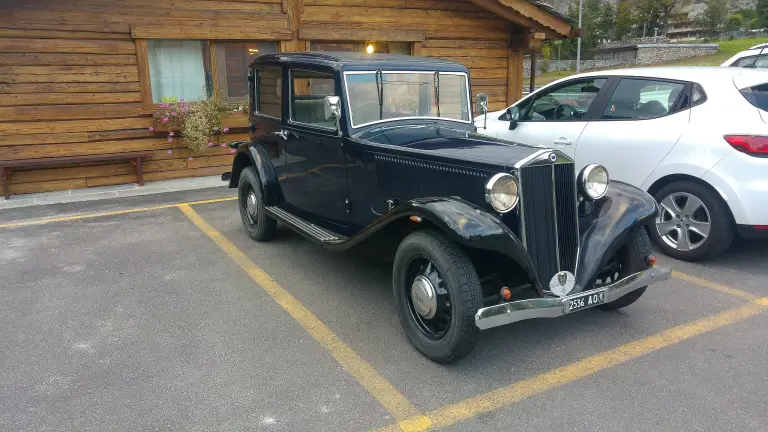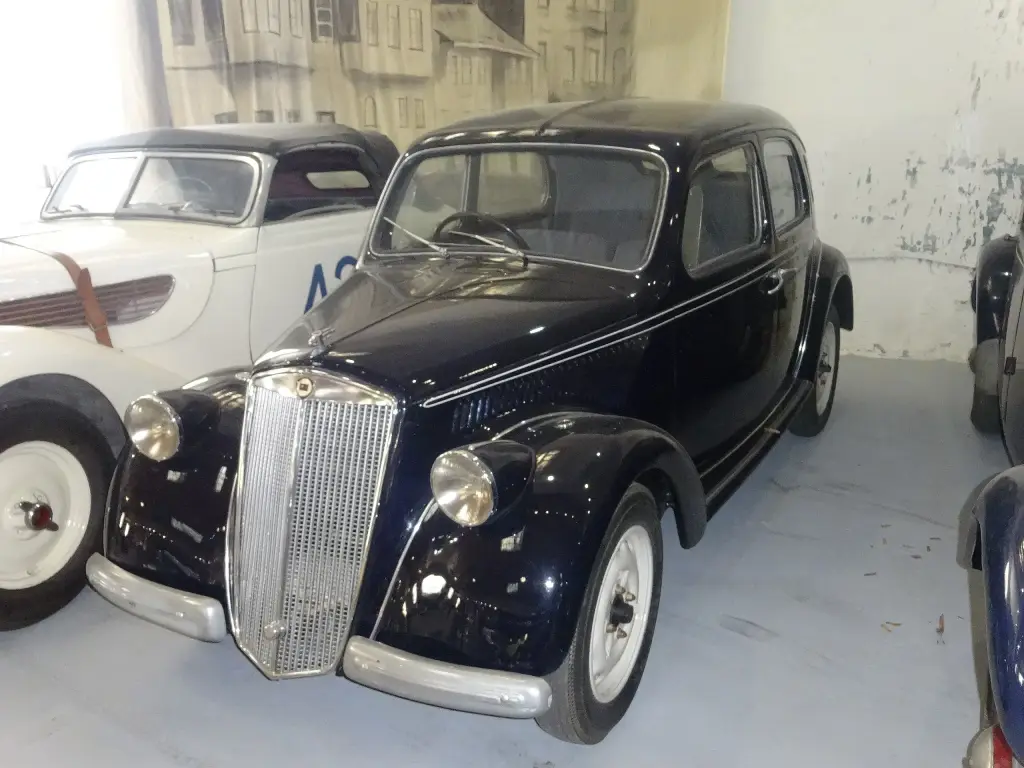
The Lancia Ardea was a small family car produced from 1939 to 1953. It was the smaller sister of the Aprilia, with a body scaled down from it, and its short bonnet held the smallest V4 engine ever used in a small family car. The third series of 1948 was the first mass-produced car with a five-speed manual gearbox.
Lancia Ardea at a glance
| Maker | Lancia, Turin |
|---|---|
| Production | 1939–1953 |
| Class | small family car |
| Engine | 903 cc narrow-angle V4, about 19 degrees |
| Power | 28.8 hp, 30 bhp in the fourth series |
| Layout | front engine, rear-wheel drive |
| Gearbox | four speeds, five from 1948 |
| Body | four-door saloon, pillarless |
| Wheelbase | 2,440 mm |
| Saloons built | nearly 23,000 |
| Commercial versions | over 8,500 vans and light trucks |
| Named after | Ardea, a town in Lazio |
History of the Lancia Ardea
A small Lancia for the years of crisis
The Ardea was conceived as a small, economical car to sit below the Aprilia, and its body repeats the Aprilia’s shape at about nine-tenths of the scale, as the Ardea had earlier imitated the Aprilia’s larger sister. The design is associated with Vittorio Jano, who moved from Alfa Romeo to Lancia in February 1938. Its engine used a patented valve gear in which a single chain-driven camshaft worked eight short pushrods and rockers to operate inclined overhead valves, giving hemispherical combustion chambers without the cost of two camshafts.
Engineering
The 903 cc V4 had a very narrow angle between the banks, quoted as 19°54′. The block was cast iron with thin walls to avoid aluminium, and the connecting rods were duralumin; the whole engine weighed about 80 kg. Front suspension kept the classic Lancia independent layout with vertical sliding pillars, while the rear used a simple live axle on leaf springs instead of the Aprilia’s more complex arrangement. The body was unitary and the rear doors were hinged at the back with no centre pillar, so the whole side opened for access.
Four series
The first series of 1939–1941 accounted for 2,992 cars, the second of 1941–1948 for 4,438 and brought a 12-volt electrical system, the third of 1948–1949 for 3,600 and introduced the five-speed gearbox, and the fourth of 1949–1953 for 11,700 with an aluminium cylinder head, a higher compression ratio and 30 bhp. Almost 23,000 standard saloons were built in total. The car was presented to Mussolini in November 1939, two months after the start of the war, with fuel rationed and motoring restricted — hardly the moment for a new model.
Taxis, vans and pick-ups
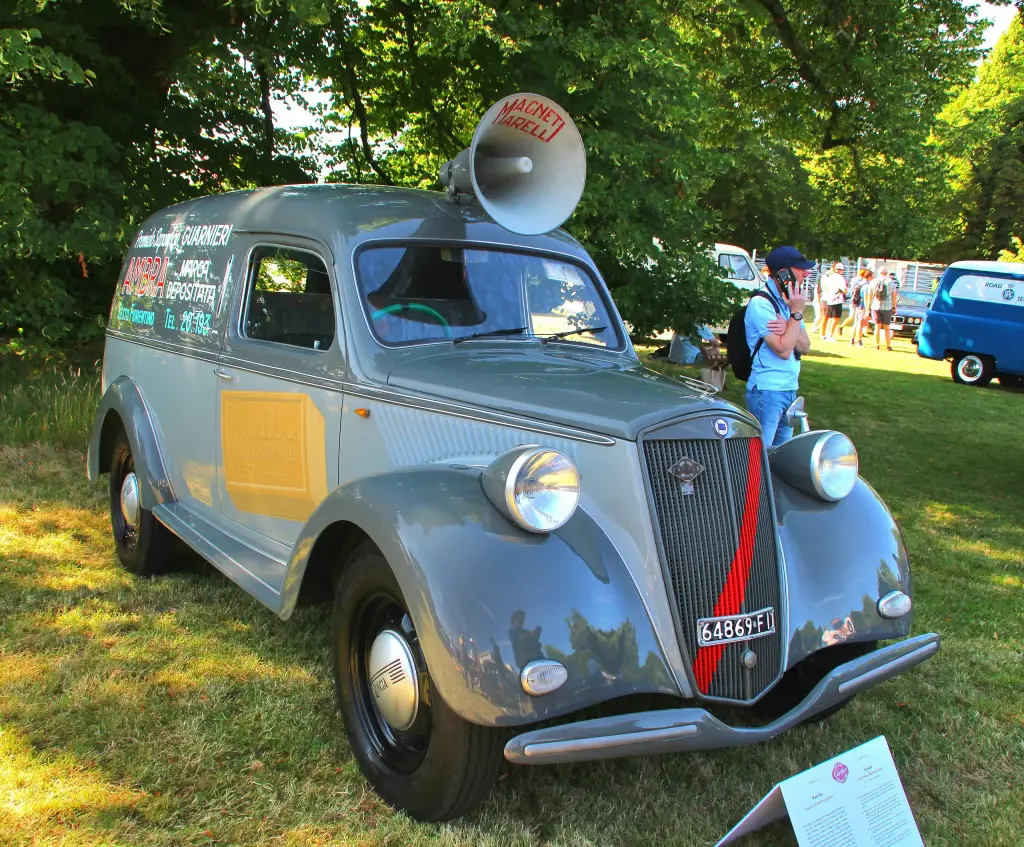
Between 1940 and 1942 about 500 Ardeas were built with a lengthened body and a squared rear cabin as Rome taxis, on a chassis with a 2,950 mm wheelbase and wider tracks. After the war more than 8,500 commercial versions were made: the furgoncino van on the type 550 chassis and the camioncino pick-up on the type 650 chassis, both built by Lancia itself rather than by outside coachbuilders, and replaced by equivalent Appia versions in 1954. Bare chassis were also offered to coachbuilders in 1939–1941.
Design and features
- Smallest V4 in a family car: a 903 cc unit of about 80 kg with hemispherical chambers.
- Five-speed gearbox: the third series of 1948 was the first mass-produced car so equipped.
- Pillarless doors: aft-hinged rear doors gave easy access to a small cabin.
- Right-hand drive: Lancia kept supplying right-hand-drive cars into the 1950s even in left-hand-drive markets.
Lancia Ardea versions
- First series: 2,992 cars, 1939–1941.
- Second series: 4,438 cars, 12-volt electrics.
- Third series: 3,600 cars, five-speed gearbox.
- Fourth series: 11,700 cars, aluminium head and 30 bhp.
- Tassì Roma: long-wheelbase taxi, about 500 built.
- Furgoncino and camioncino: factory-built van and pick-up, over 8,500 in total.
The Ardea replaced the Lancia Augusta at the bottom of the range and was itself replaced by the Lancia Appia. More cars are in the Lancia collection.
Sources
- Lancia Ardea, English Wikipedia: series, production numbers, variants
- Lancia Ardea, Italian Wikipedia: engineering, dimensions, launch context