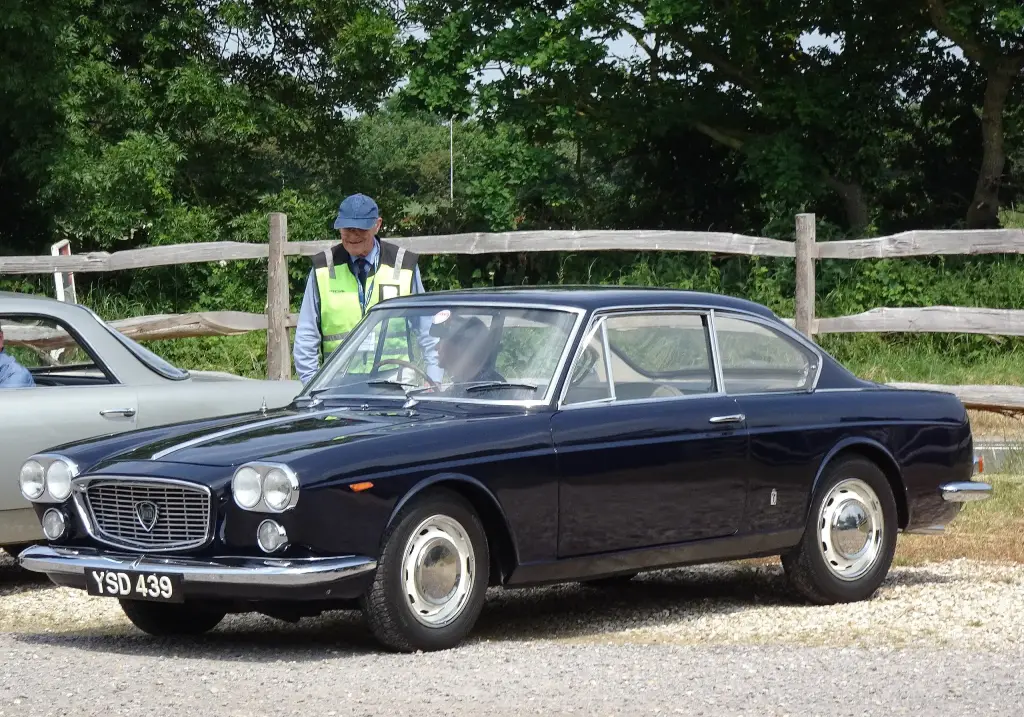
The Lancia Flavia was an executive car produced from 1961 to 1971. Launched at the Turin Motor Show in 1960 with a 1,500 cc engine, it was the first front-wheel-drive Lancia and the first Italian production car with a flat-four engine and with disc brakes on all four wheels. Its place between the Appia and the Flaminia was chosen deliberately, and it was named after the Via Flavia.
Lancia Flavia at a glance
| Maker | Lancia, Turin and Chivasso |
|---|---|
| Production | 1961–1971 |
| Shown | Turin Motor Show, 1960 |
| Engine | aluminium flat-four, 1,500 to 1,991 cc |
| Power | 78 PS at launch, over 100 PS later |
| Layout | front engine, front-wheel drive |
| Suspension | unequal-length wishbones at the front |
| Brakes | Dunlop discs on all four wheels |
| Weight distribution | 62 per cent at the front |
| Bodies | saloon, Pininfarina coupé, Vignale convertible, Zagato coupé |
| Designer | Antonio Fessia |
| Successor | Lancia 2000 |
History of the Lancia Flavia
Fessia’s answer to a gap in the range
The Flavia was developed by Antonio Fessia in the late 1950s at the direction of Carlo Pesenti, the new owner of Lancia, to fill the gap between the small Appia and the large Flaminia. Fessia was a convinced advocate of front-wheel drive, and the idea went back to the CEMSA Caproni F.11 he had designed and shown in Paris in 1947, with a flat-four engine mounted longitudinally ahead of the front axle. Originally the car was to be called Esperia, but the name was changed to Flavia shortly before launch. The Flavia was presented at the Turin Motor Show in November 1960 and shown to Prime Minister Amintore Fanfani and the press at Vallelunga circuit on 19 December 1960.
Engineering
Under the bonnet was a light alloy flat-four with double overhead camshafts, the first boxer engine in an Italian production car, driving the front wheels through double constant-velocity joints. The engine sat on an auxiliary subframe lower than the main structure to keep the centre of gravity down, and was mounted on silentbloc bushes. Front suspension used unequal-length wishbones, and the brakes were Dunlop discs on all four wheels with a split hydraulic circuit and servo assistance — the first Italian production car with four-wheel disc brakes. The front-wheel-drive layout placed 62 per cent of the weight over the front wheels to improve traction. The body by Piero Castagnero had a bold nose with twin headlamps, large glass areas and an interior with six seats and the classic Lancia cloth.
Engines and development
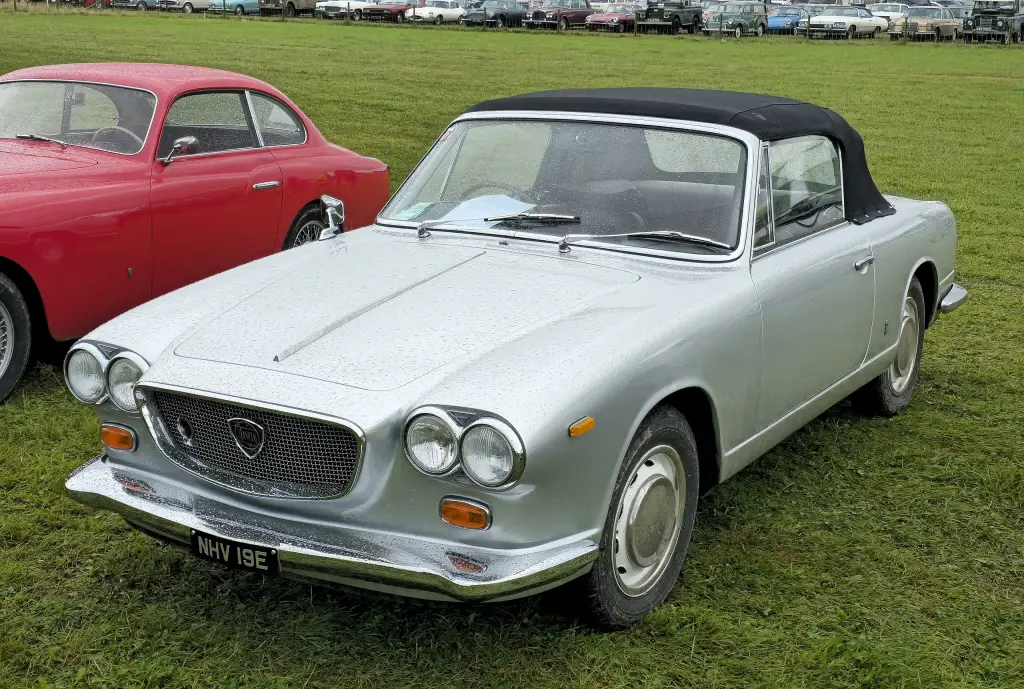
The original 1,500 cc engine of 78 PS was small for the car. In autumn 1963 a 1,800 cc unit of 92 PS joined it, and in 1965 came mechanical Kugelfischer fuel injection, the first on an Italian production car, raising output to 102 PS. A 1,750 Nardi-engined saloon with 92 PS filled the gap in 1962–1963. Later the engine grew to 1,991 cc. A two-door coupé designed by Pininfarina on a shortened platform soon followed, Vignale built 1,601 convertibles, and Zagato made a lightweight two-door Sport of which 626 were built plus three prototypes, fitted with twin carburettors giving just over 100 CV. Early cars suffered from timing chain stretch and from corrosion of the aluminium cylinder heads when copper gaskets were used.
Series II and the 2000
In May 1967 a rebodied Berlina with a new interior went on sale as model 819, usually called the Series II, with the Vignale and Zagato versions discontinued and the coupé temporarily withdrawn. The coupé returned in March 1969 at the Geneva show with new bodywork and the 2-litre 820-series engine, with carburettor or injection and four- or five-speed gearboxes. In 1971, after Fiat took control, the Flavia name was dropped along with the smaller engines and the car continued as the Lancia 2000. British magazine tests of the period recorded 149 km/h for the 1500 and 166 km/h for the 1800 saloon, with 0–60 mph in 18.6 and 15.0 seconds.
Design and features
- First front-wheel-drive Lancia: chosen by Fessia with 62 per cent of the weight at the front.
- Flat-four engine: an aluminium boxer, the first in an Italian production car.
- Four-wheel disc brakes: another Italian first, with a split circuit and servo.
- Coachbuilt range: Pininfarina coupé, Vignale convertible and Zagato Sport.
Lancia Flavia versions
- Berlina 1500: the original 1961 saloon, 78 PS.
- Berlina 1800 and 1800 Iniezione: 92 and 102 PS, Kugelfischer injection from 1965.
- Coupé: Pininfarina two-door on a shorter platform.
- Convertibile: Vignale, 1,601 built.
- Sport: Zagato lightweight coupé, 626 built.
- Series II: rebodied Berlina of 1967, model 819.
The Flavia sat between the Lancia Appia and the Lancia Flaminia, and became the Lancia 2000 in 1971. More cars are in the Lancia collection.
Sources
- Lancia Flavia, English Wikipedia: chronology, bodies, engines, road tests
- Lancia Flavia, Italian Wikipedia: Fessia, engineering, presentation, model history