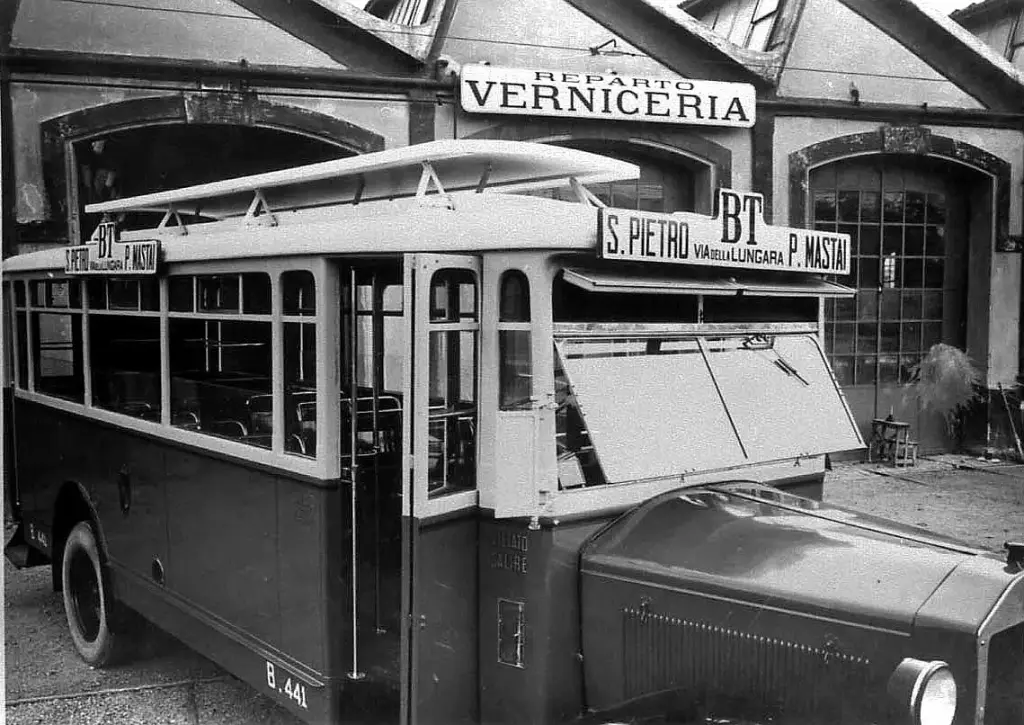
The Lancia Omicron was a bus chassis produced by Lancia from 1927 to 1936, with 601 built in total. It could be fitted with many body types, from a short urban bus to a long one and even a double-decker, and it carried passengers on long-distance routes including desert journeys in North Africa. Rome’s bus operator ATAG bought 286 of them, and some lasted in service until 1957.
Lancia Omicron at a glance
| Maker | Lancia, Turin |
|---|---|
| Production | 1927–1936 |
| Type | bus chassis |
| Versions | Omicron C short, Omicron L long, plus a three-axle option |
| Wheelbase | 8,300 mm short, 9,530 or 9,850 mm long |
| Engine | Lancia Tipo 77 six-cylinder petrol |
| Power | 92 or 96 hp |
| First diesel | Lancia-Junkers, from 1933 |
| Built | 601 |
| Used in Rome | 286, by ATAG |
| Longest service | until 1957 in Rome |
| Bodybuilders | Fratelli Macchi, Carminati and others |
History of the Lancia Omicron
Buses for a growing city
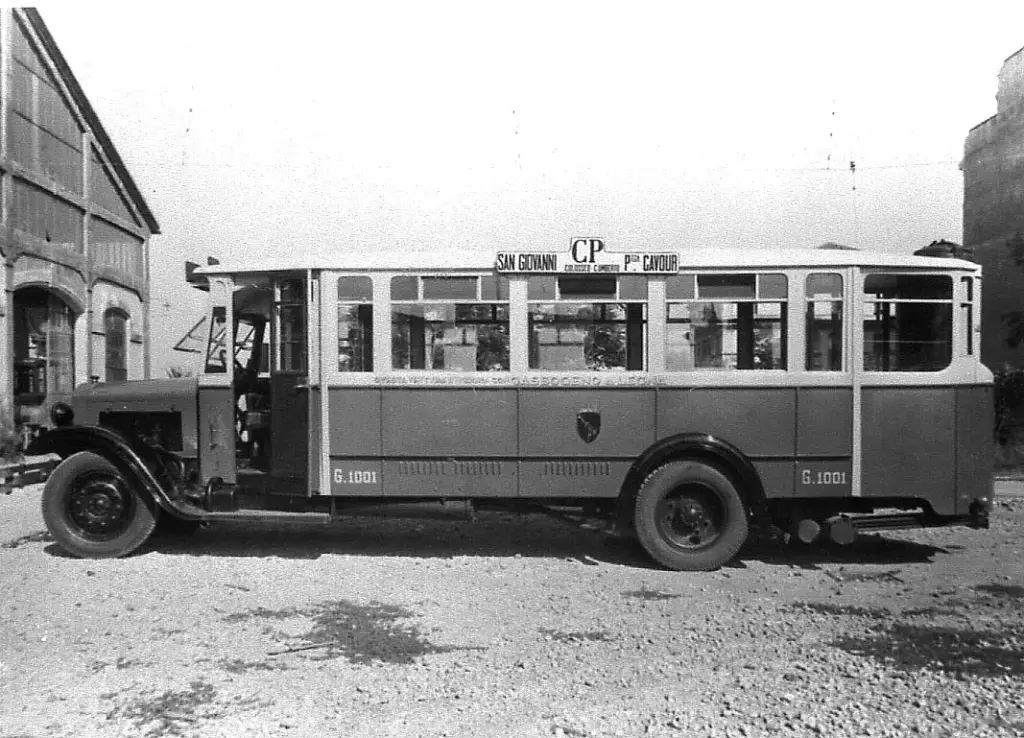
On 20 September 1927 the Rome operator ATAG took over the bus service run by Ugolini and immediately expanded its fleet, ordering a large number of the most modern vehicles then in production from Lancia: the small but efficient Omicron. These buses proved far longer-lived than the rival SPA vehicles, and part of the fleet stayed in service until 1957. Short and long versions existed, the Omicron C and the Omicron L, easily distinguished on the door side by the number of windows: three large ones plus two narrow at the ends on the short bus, four large ones on the long car.
Chassis and engines
The chassis measured 8.3 m in the short version and 9.53 m in the long one, and almost all bodies were built by Fratelli Macchi of Varese, with a group of 400 cars bodied by an unknown builder and clearly different in detail. Early buses used the Lancia Tipo 77 six-cylinder of 7,060 cc running on petrol, a powerful engine of sporting origin, but it became ruinous to run when petrol prices rose after the 1929 crisis. ATAG and Lancia turned to diesel: after unsuccessful attempts to burn heavier fuel in carburettors, Lancia bought patents from the German Junkers company and produced the two-cylinder two-stroke Lancia-Junkers Tipo 89 of 3,179 cc and 64 hp, fitted from May 1933. Its modest power led to the three-cylinder Tipo 90 of 4,770 cc and 95 hp from 1935, though the Junkers engine was expensive to buy and maintain and only a few skilled mechanics could repair it.
Comfort problems
Mechanically excellent, the Omicron was weak on comfort, ventilation and capacity compared with trams on the central lines. The seats were upholstered in leather, in armchair form at the rear and facing forward at the front, and the windows were fixed with only a small opening at the top, far from enough for ventilation. In summer the combination of leather smell and exhaust fumes, still exiting low down, caused many complaints. Access at front and rear was very narrow, with a mechanically operated folding door in front and an open platform behind, and the various remedies tried, such as fixed and rotating fans, air vents and opening roof lights, were only palliatives.
Long-distance and export use
The Omicron chassis could be fitted with urban, long-distance and double-decker bodies, and the bus was luxurious for the early 1930s, used for long trips and in the deserts of North Africa to connect places in Sudan and Algeria. British advertising promoted the chassis’s load capacity with a test in which it carried eight tons of steel ingots and hauled five laden trailers, a total of more than 50 tons. The urban routes of Rome and Tivoli used two-door bodies by Macchi and Carminati, and the first diesel engine in the range, fitted in 1934, showed Lancia’s continuing technical innovation.
Design and features
- Many bodies: short and long urban buses, long-distance coaches and double-deckers.
- Six-cylinder petrol power: the Lancia Tipo 77 of 92 or 96 hp.
- Early diesel: Junkers-licensed two- and three-cylinder engines from 1933.
- Long life: 286 Omicrons in Rome, some still running in 1957.
Lancia Omicron versions
- Omicron C: short chassis, 8,300 mm wheelbase, three large windows per side.
- Omicron L: long chassis, 9,530 or 9,850 mm wheelbase, four large windows.
- Three-axle chassis: offered alongside the two-axle versions.
- Double-decker: built on the same chassis for high-capacity routes.
The Omicron was the bus chassis of the late 1920s and early 1930s, a generation before the Lancia Esatau bus family. More vehicles are in the Lancia collection.
Sources
- Lancia Omicron, English Wikipedia: production, versions, engines, load test
- Lancia Omicron in Rome, Italian Wikipedia: ATAG fleet, comfort problems, engine history