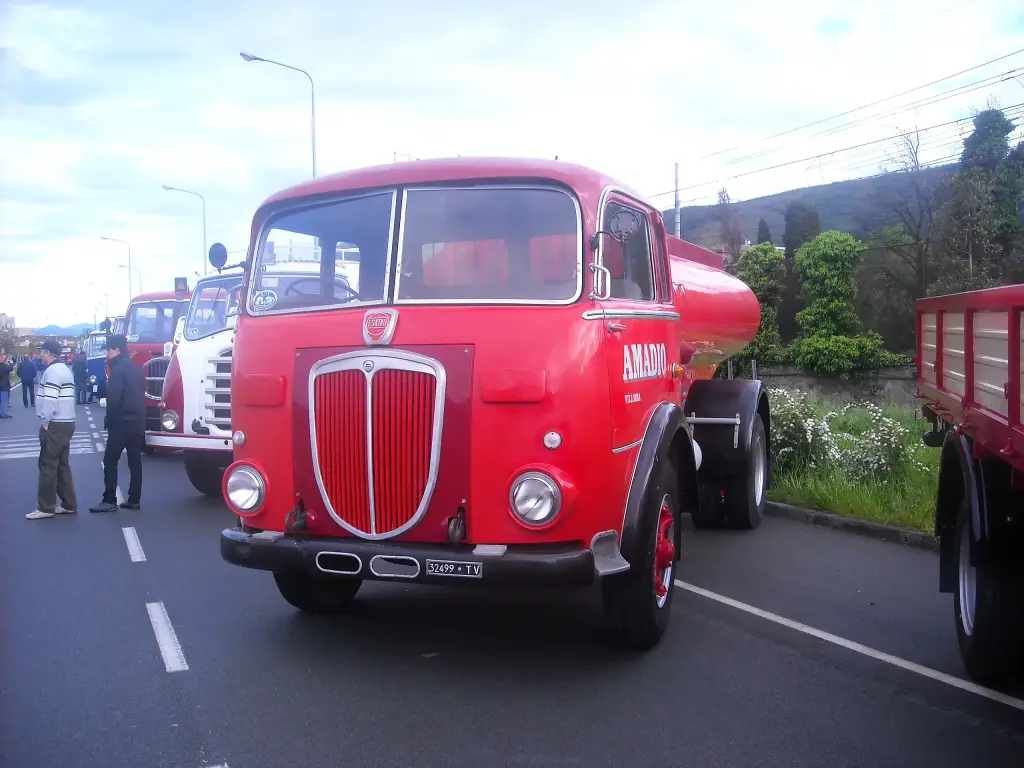
The Lancia Esatau is a series of truck and bus chassis produced by Lancia Veicoli Industriali from 1947 to 1973. Trucks were made until 1963, when the Esagamma replaced them, while bus chassis stayed in production until 1973. In all 13,362 examples were built.
Lancia Esatau at a glance
| Maker | Lancia Veicoli Industriali, Bolzano |
|---|---|
| Production | 1947–1973 |
| Trucks | 1947–1963 |
| Bus chassis | 1948–1973 |
| Engines | 8,245 cc and 8,867 cc six-cylinder diesels, V10 in V.11 and V.81 buses |
| Power | 122 hp, later 132 hp; bus versions from 122 to 144 hp |
| Top speed | about 60 km/h, later about 75 km/h |
| Payload | over 7,500 kg on the 864 |
| Fuel | under 20 litres per 100 km on the 864 |
| Built | 13,362 |
| Replaced by | Lancia Esagamma |
History of the Lancia Esatau
Rebuilding after the war
After the Second World War Lancia, dealing with bomb-damaged factories and the cost of reconstruction, continued making trucks. In 1947 it presented the Esatau 864, the first version of the model, still with a set-back cab in the so-called musone style. Its engine gave 122 CV, later raised to 132 CV, and the truck could reach a little under 60 km/h, later about 75 km/h. It kept characteristic Lancia touches such as the chrome shield-shaped radiator grille, and in running costs it stood out from its rivals: consumption was below 20 litres of diesel per 100 km with a payload of over 7,500 kg.
Conventional and forward control
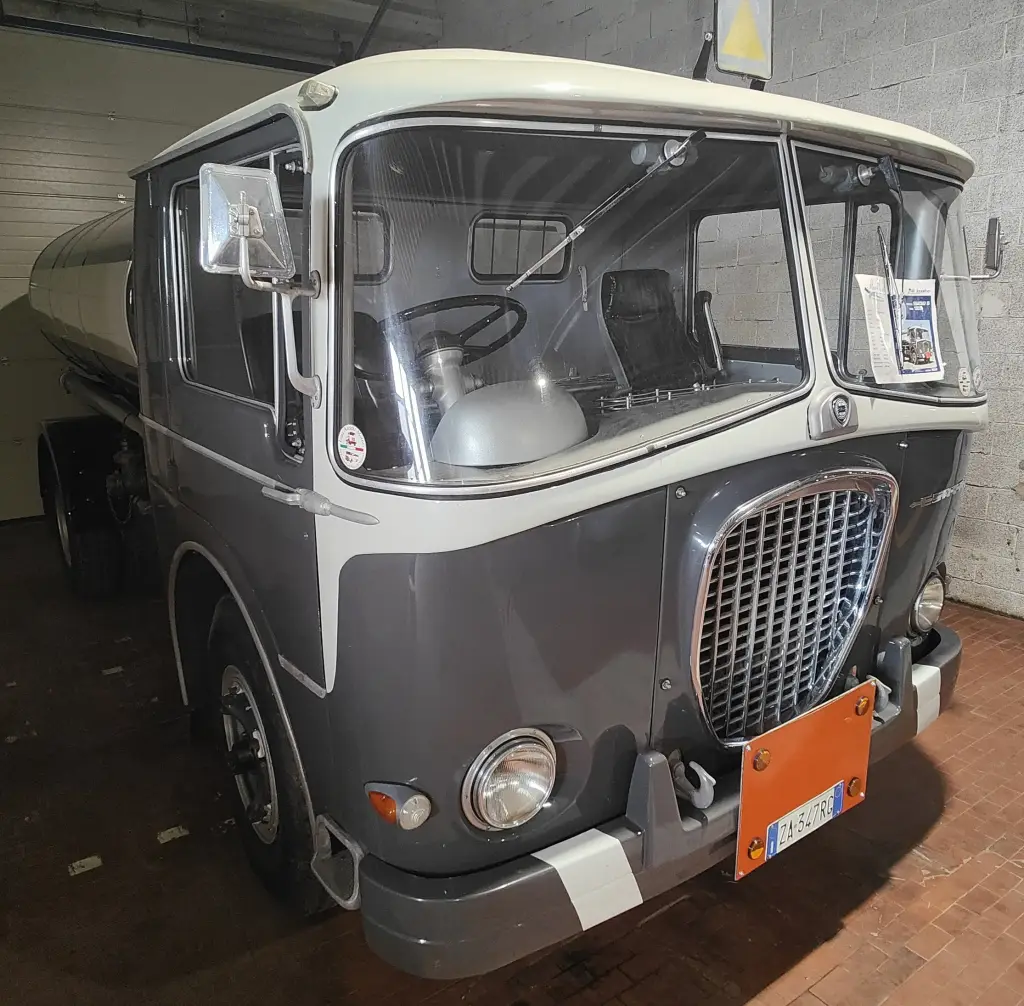
In 1948 the range gained the Esatau 964, a 6×2 with a third axle behind the rear axle. In 1955 came the Esatau A with a new forward-control cab by Carozzeria Casaro, which did away with the bulky bonnet that had held the engine. In 1957 the completely renewed Esatau B appeared with a flat front and a windscreen standing proud of the radiator, which earned it the nicknames Televisore and Signorina. Its 8,867 cc straight-six gave 150 CV, the truck reached 65 km/h with a load of 8,000 kg and could officially climb a 34 per cent gradient; the clutch was servo-assisted and the gearbox had a reduction unit and preselection.
Buses and trolleybuses
Esatau chassis were adapted for buses and trolleybuses for Italian operators such as ATM in Milan and ATAC in Rome. The V.10 was built from 1948 to 1953 with 122 hp. The V.11 followed in 1951–1952 with a Garavini body and a Lancia V10 engine of 122 hp: 52 were built, the city version 10,500 mm long and the suburban 11,000 mm. A 12,000 mm trolleybus version was built for Athens, with 46 in service from 1961 to 1991, and the same trolleybuses ran in Florence and Capua. The V.81 of 1953–1959 was mostly bodied by Viberti, with the last 23 by Pistoiesi; 183 were built, its PV81 version giving 130 hp and the V10 138 hp, raised to 144 hp from 1957.
The end of the trucks
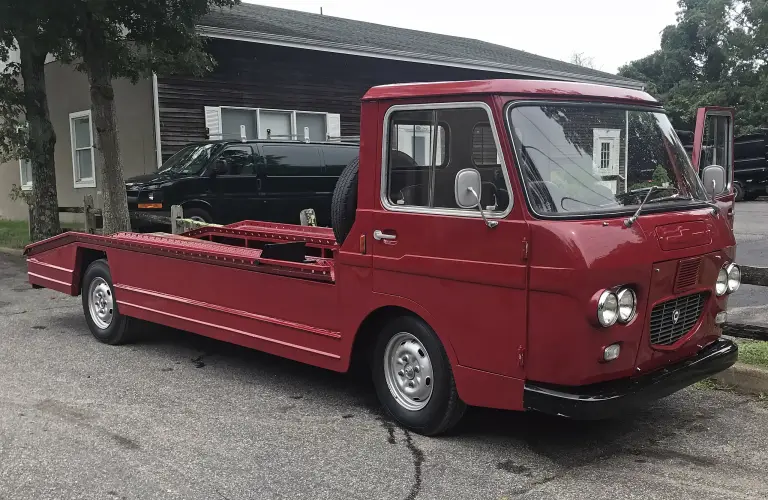
Truck production ended in 1963, shortly after the Esagamma joined the range. Many Esatau trucks in their various series were used on building sites, as tankers and as car transporters. In 1960 a first-series Esatau 864 was involved in the Rome crash in which the singer Fred Buscaglione died at the age of 38, when his Ford Thunderbird hit the truck in the Parioli district.
Design and features
- Economical six: 8,245 and 8,867 cc diesels of 122 to 150 hp.
- Progressive cab design: from the bonneted 864 to the forward-control A and the flat-fronted B.
- Bus family: V.10, V.11 and V.81 city and suburban buses, including trolleybus versions.
- Long service: chassis in production for 26 years, with trolleybuses running into the 1990s.
Lancia Esatau versions
- Esatau 864: the 1947 bonneted 4×2 truck.
- Esatau 964: 6×2 with a third axle, from 1948.
- Esatau A: forward-control cab by Casaro, 1955.
- Esatau B: flat-fronted 150 hp truck from 1957.
- V.11: V10-engined bus and trolleybus, 52 built.
- V.81: larger bus of 1953–1959, 183 built.
The Esatau was replaced by the Lancia Esagamma, and its earlier relative was the Lancia 3Ro. The smaller Lancia Esadelta came later. More vehicles are in the Lancia collection.
Sources
- Lancia Esatau, English Wikipedia: versions, engines, bus models, production
- Lancia Esatau, Italian Wikipedia: history, running costs, Esatau B, Buscaglione accident