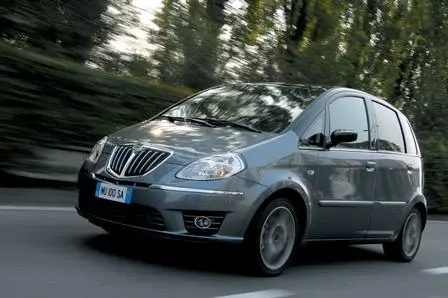
The Lancia Musa, type 350, was a five-seat compact MPV made by Fiat and sold under the Lancia brand from 2004 to 2012. It was a modified version of the Fiat Idea, using the Project 188 platform of the second-generation Fiat Punto, with front-wheel drive and five doors. It entered a segment Lancia had never covered before and became the best-selling compact MPV in Italy in 2006, 2007, 2008 and 2009.
Lancia Musa at a glance
| Maker | Fiat, Mirafiori, for Lancia |
|---|---|
| Production | 2004–2012 |
| Class | compact MPV, B-segment |
| Basis | Fiat Idea, Project 188 platform |
| Design | Fabrizio Giugiaro, supervised by Flavio Manzoni then Marco Tencone |
| Length, width, height | 3.99 m, 1.70 m, 1.66 m |
| Wheelbase | 2.51 m |
| Engines | 1.4 petrol, 1.3 and 1.9 diesel |
| Gearbox | five- and six-speed manual, DFN automated manual |
| Boot | 320 to 1,420 litres |
| Facelift | 2007 |
| Total built | about 237,500 |
History of the Lancia Musa
A Lancia version of the Idea
The Musa was developed from the Fiat Idea, from which it inherited not only the platform but also the mechanicals, electronics and engines. It was distinguished from its twin by a more elegant body and a noticeably higher-quality interior, and it carried the family look introduced by the smaller Ypsilon in 2003. The design, an adaptation of the Idea by Fabrizio Giugiaro, was supervised first by Flavio Manzoni and later by Marco Tencone. It debuted at the Geneva Motor Show in 2004, with sales starting in Italy on 18 September 2004 and in other European countries on 16 October.
Design and practicality
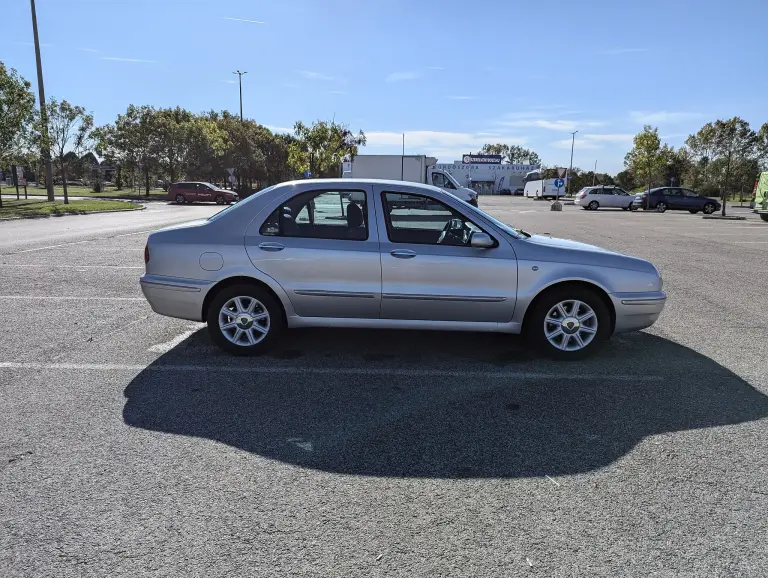
At 3.99 m long, 1.70 m wide and 1.66 m high on a 2.51 m wheelbase, the Musa was compact enough for the city and comfortable enough for long journeys, with a cabin for five including the driver. The front was dominated by a retro chrome grille flanked by drop-shaped headlamps that also contained the sidelights, main beams and indicators, with a strip of raw black plastic across the bumper to limit paint damage in car parks. The side was almost identical to the Idea apart from a large M pressed into the door frames, and the boot held 320 to 1,420 litres thanks to a split-folding rear bench. Inside, the instrument cluster sat in the centre of the dashboard, as it did in the Ypsilon, with the radio and heating controls beneath it.
Equipment and the 2007 facelift
The interior used Alcantara or leather and chrome details, and like the Idea the Musa offered an automated manual transmission marketed as Dolce Far Niente, or D.F.N., on every engine except the eight-valve 1.4 FIRE. A revised Musa was shown at the 2007 Venice Film Festival and made its show debut at Frankfurt in October 2007, with a new Lancia logo, a bumper fascia with chrome mouldings, bodyside mouldings with chrome inserts, LED rear lamps and a boot 70 litres larger with a loading floor 4 cm lower, plus better headlining soundproofing. Options included the Blue&Me infotainment system, and in 2008 an EcoChic dual-fuel petrol and LPG version was added for Italy. A start-stop system arrived in 2009 with the 1.4 FIRE 16-valve and the Euro 5 1.3 Multijet II diesel of 95 PS, and from late 2008 the range ran to 20 versions with five- and six-speed manuals or the five-speed DFN.
The end
The Musa was built at Fiat’s Mirafiori plant in Turin until September 2012. Despite its good results over eight years, it left the Lancia range without a direct replacement: within the Fiat group the Fiat 500L took over not only the role of the Idea and the Multipla but also the Musa’s inheritance.
Design and features
- Fiat Idea base: the same platform, engines and electronics, but with higher-grade trim.
- Compact size: under four metres long yet with up to 1,420 litres of load space.
- D.F.N. gearbox: an automated manual transmission marketed as Dolce Far Niente.
- EcoChic and start-stop: LPG and stop-start versions added late in the run.
Lancia Musa versions
- First series: 2004–2007, petrol and diesel engines.
- Second series: the 2007 facelift with a larger boot and LED rear lamps.
- EcoChic: dual-fuel petrol and LPG, from 2008 for Italy.
- D.F.N. versions: automated manual transmission.
The Musa followed the Lancia Ypsilon in style and was the practical member of the range; its platform thinking had come a long way from the Megagamma concept. More cars are in the Lancia collection.
Sources
- Lancia Musa, English Wikipedia: background, design, facelift, production
- Lancia Musa, Italian Wikipedia: market position, dimensions, equipment, second series