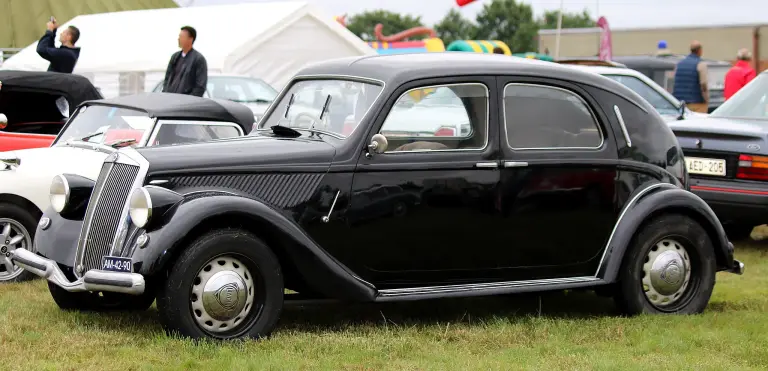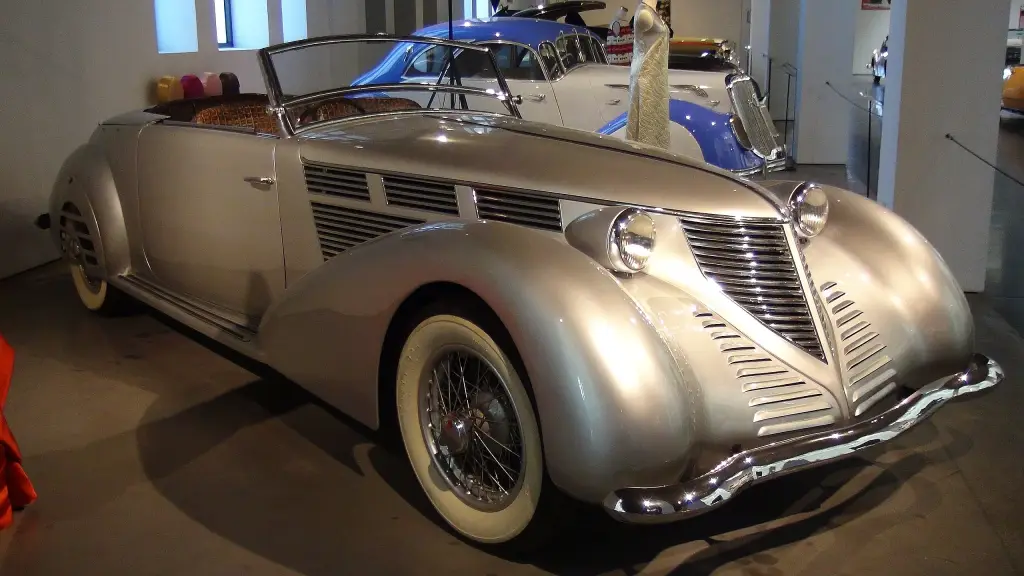
The Lancia Astura was produced from 1931 to 1939 as the larger of the two models that replaced the Lambda. Where the Artena had a four-cylinder engine, the Astura carried a V8, and its separate chassis was used by coachbuilders to create some of the most elegant Italian bodies of the decade. A total of 2,912 were built.
Lancia Astura at a glance
| Maker | Lancia, Turin |
|---|---|
| Production | 1931–1939 |
| Engine | 2,606 cc V8, 19 degrees; 3.0-litre V8 from 1933 |
| Power | 72 hp, 82 hp for the 3.0-litre |
| Top speed | about 125 km/h |
| Gearbox | four-speed manual |
| Chassis | separate frame, short and long wheelbase |
| Suspension | independent front, live axle rear |
| Body | four-light or six-light saloon, or bare chassis |
| Chassis weight | 960 kg; saloon 1,250 kg |
| Total built | 2,912 |
| Named after | the castle of Astura near Nettuno |
History of the Lancia Astura
A smaller V8 below the Dilambda
In the early 1930s Lancia’s range rested on the Lambda at the end of its ten-year life and the 4-litre V8 Dilambda as flagship. The Lambda was to be replaced by two models, and the Astura was the larger: a V8 of only 2.6 litres, essentially a simplified and reduced Dilambda engine, with a wheelbase about 19 cm longer than the Artena’s to make room for it. It was shown at the Paris Motor Show in October 1931 and took the name of a historic castle near Nettuno rather than a Greek letter.
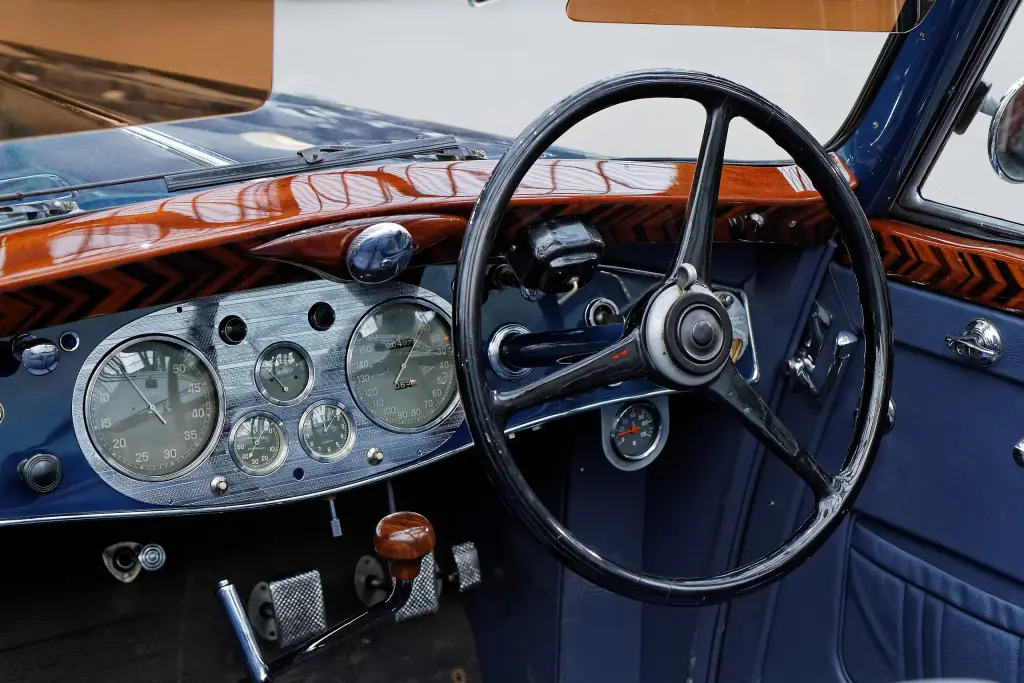
Engine and chassis
The 19-degree V8 had a cast iron block, a triple distribution chain and a self-cleaning oil filter, and a particularly unusual two-piece head: a cast iron lower part holding the valves and an aluminium upper part carrying the rocker shaft, with a single central camshaft turning between the two. Cooling used the Artena’s thermostatic radiator shutters and lubrication was centralised. The chassis followed the Artena’s pattern of box sections, an X brace and converging side members; front suspension was the Lancia sliding pillar layout and the rear a live axle on semi-elliptic springs with Siata friction dampers. The weight was modest — 960 kg for the chassis, 1,250 kg for the factory saloon — and top speed around 125 km/h.
Four series
The first series of 1931–1932 accounted for 496 cars and the second of 1932–1933 for 750, the latter with modified engine mountings to reduce noise and vibration. The third series of 1933–1937 built 1,243 cars, and it was here that the Astura split into short and long wheelbases, received a new 3-litre V8 of 82 hp and better brakes. The fourth series of 1937–1939 built 423 cars, long wheelbase only, and effectively took the place of the Dilambda in the range; its chassis often carried formal Ministeriale bodies by Boneschi and Pininfarina.
The coachbuilders’ car
Lancia offered the Astura only as a saloon, leaving other bodies to the carrozzerie. Almost every Italian coachbuilder and several foreign ones made special Asturas: Bertone, Boneschi, Borsani, Brianza, Castagna, Colli, Garavini, Ghia, Stabilimenti Farina, Touring and Viotti at home, and Weinberger & Buhne, John Charles, Abbott and Kevill Davies & March abroad. A 1936 Pinin Farina cabriolet once owned by Eric Clapton won Best of Show at Pebble Beach in 2016, and a fourth-series car won the public vote at the Concorso d’Eleganza Villa d’Este in 2019. The engine of the last series also provided the basis for the Lince armoured car.
Design and features
- V8 power: a 2.6-litre 19-degree V8, later a 3.0-litre of 82 hp.
- Unusual cylinder head: a two-piece head with cast iron valve section and aluminium rocker housing.
- Light for its class: about 1,250 kg as a saloon, giving lively performance.
- Coachbuilder appeal: a separate chassis that carried some of the finest Italian bodies of the 1930s.
Lancia Astura versions
- First series: 496 cars, 1931–1932.
- Second series: 750 cars, quieter engine mountings.
- Third series: 1,243 cars, 3.0-litre engine, two wheelbases.
- Fourth series: 423 cars, long wheelbase, Ministeriale bodies.
- Coachbuilt Asturas: cabriolets, coupés and saloons by Italian and foreign carrozzerie.
The Astura was the V8 sister of the Lancia Artena and replaced the Lancia Dilambda at the top of the range. More cars are in the Lancia collection.
Sources
- Lancia Astura, English Wikipedia: series, engines, production numbers
- Lancia Astura, Italian Wikipedia: engine design, weights, coachbuilders, concours results