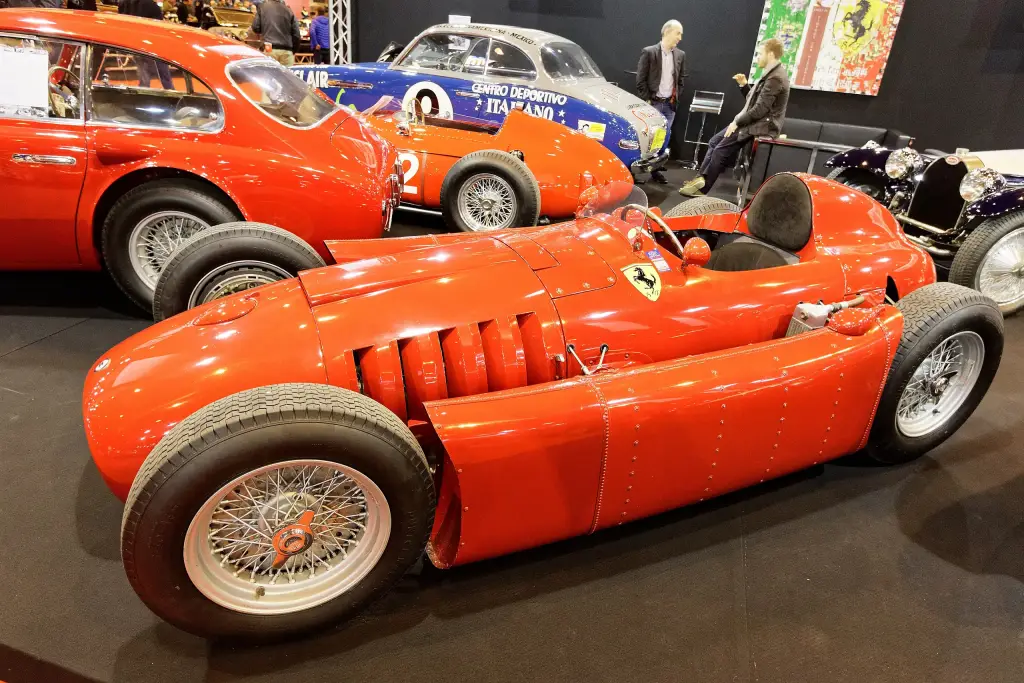
The Lancia D50 was a Formula One car designed by Vittorio Jano and built in 1954. It used the engine as a stressed member of the chassis, mounted it off-centre to lower the body, and carried fuel in panniers on either side of the cockpit. Only six were built. After the death of Alberto Ascari the cars passed to Ferrari and, as the Lancia-Ferrari D50, one took Juan Manuel Fangio to the 1956 world championship.
Lancia D50 at a glance
| Maker | Lancia, Turin |
|---|---|
| Season | 1954–1955 as a Lancia, then with Ferrari |
| Designer | Vittorio Jano |
| Engine | 2,496 cc naturally aspirated 90-degree V8 |
| Layout | front engine, rear-wheel drive |
| Gearbox | five-speed, mounted transversely at the rear |
| Front suspension | independent |
| Rear suspension | de Dion tube |
| Dry weight | about 620 kg |
| Fuel | pannier tanks between the front and rear wheels |
| Built | six cars |
| Results | 14 championship Grands Prix entered, five won |
History of the Lancia D50
Gianni Lancia goes racing
In the summer of 1953 Gianni Lancia decided to try Formula One and gave Vittorio Jano the job; detailed design was finished in September 1953. Gianni Lancia persuaded Alberto Ascari and Luigi Villoresi to sign on 21 January 1954, turning down Enzo Ferrari. Ascari’s guaranteed fee was 25 million lire a year for 1954 and 1955. Eugenio Castellotti, Ascari’s protégé, joined the team but raced sports cars in 1954 and only made his Formula One debut in 1955.
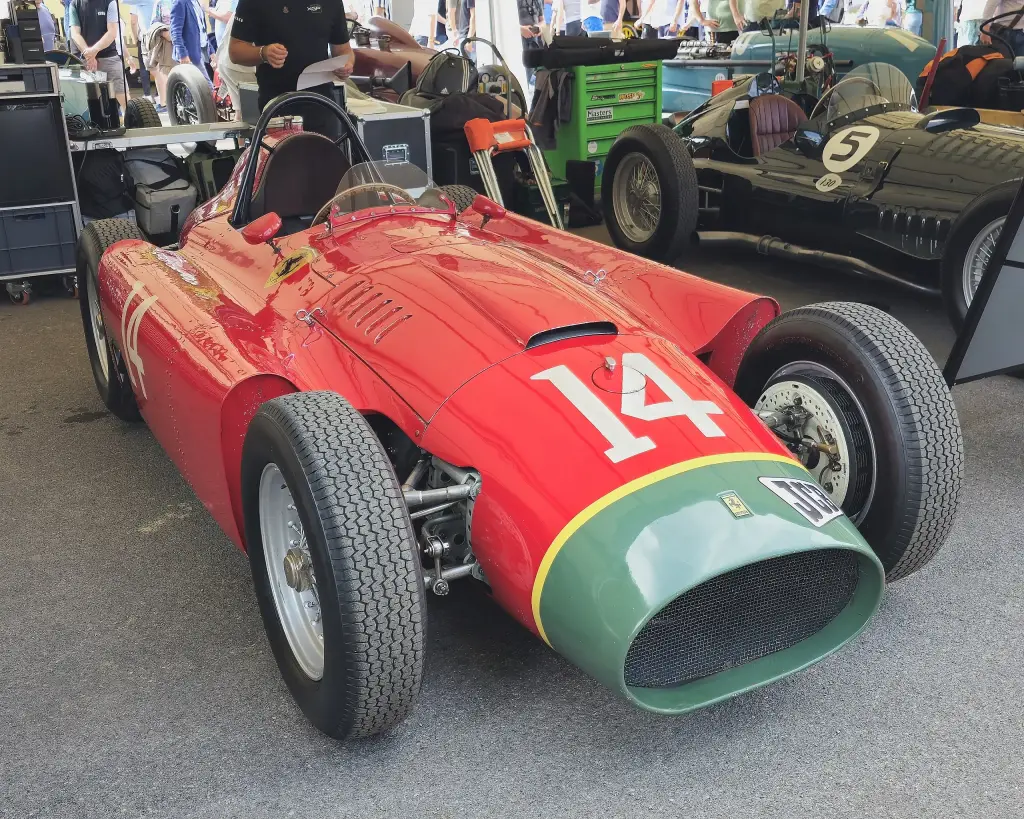
The chassis and the panniers
The D50 first ran on 20 February 1954. Its most striking feature was the fuel tanks, one on each side outboard of the body between the front and rear wheels. Wind tunnel tests with a 1:10 model at the Polytechnic of Turin showed aerodynamic benefits, but the arrangement made the balance vary as fuel was used: the car was exceptionally stable with full tanks and became less so as they emptied. The engine was a 90-degree V8 of 2.5 litres, the limit set by the 1954 regulations, and the car had independent front suspension and a de Dion rear axle, with the clutch, five-speed transverse gearbox and differential at the back. At its debut it weighed about 620 kg dry, against 690 kg for a Mercedes W196, 670 for a Maserati 250F and 650 for a four-cylinder Ferrari 625.
Ascari and the end of Lancia racing
The debut was planned for the French Grand Prix in June but slipped by four months to the Spanish Grand Prix in Barcelona on 24 October 1954. Ascari took pole position and fastest lap there before his clutch failed after ten laps. In 1955 came two wins, at Turin and Naples, and three second places at Pau, Monaco and Oulton Park, with three races where no D50 finished. Ascari was killed testing a Ferrari sports car at Monza in May 1955, and with Lancia in financial trouble the family sold its controlling share; the assets of Scuderia Lancia went to Ferrari.
Lancia-Ferrari and the 801
Ferrari continued to develop the car, removing many of Jano’s ideas, and it was rebadged the Lancia-Ferrari D50 and later simply the Ferrari D50. In that form it won the 1956 drivers’ championship with Juan Manuel Fangio. The cars lived on into 1957, heavily modified as Ferrari 801s, but were largely uncompetitive against the latest Maserati 250Fs. Two of the six original cars are preserved in Italian museums.
Design and features
- Engine as a chassis member: the V8 carried part of the load instead of sitting in a conventional frame.
- Off-centre engine: the unit was offset to allow a lower, narrower body.
- Pannier fuel tanks: tanks on each flank improved weight distribution and aerodynamics.
- Light and beautifully finished: 620 kg dry and a standard of finish unusual in a racing car.
Lancia D50 versions
- Lancia D50 (1954–1955): the original Jano design.
- Lancia-Ferrari D50 (1956): Ferrari-developed car, Fangio’s championship winner.
- Ferrari 801 (1957): further modified version for the 1957 season.
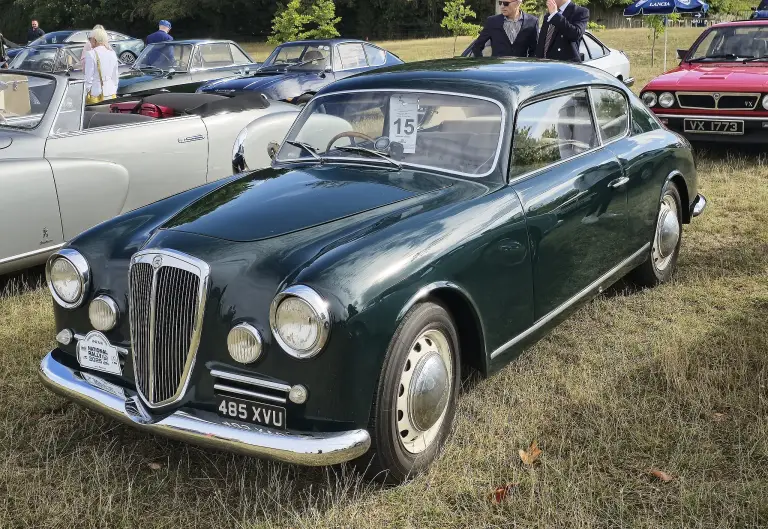
The D50 was the only Formula One car Lancia built, and it came from the same designer as the road cars of the period, such as the Lancia Aurelia. Its engine technology fed into the Lancia Flaminia V6. More cars are in the Lancia collection.
Sources
- Lancia D50, English Wikipedia: design, results, Ferrari history
- Lancia D50, Italian Wikipedia: project background, drivers, technical details