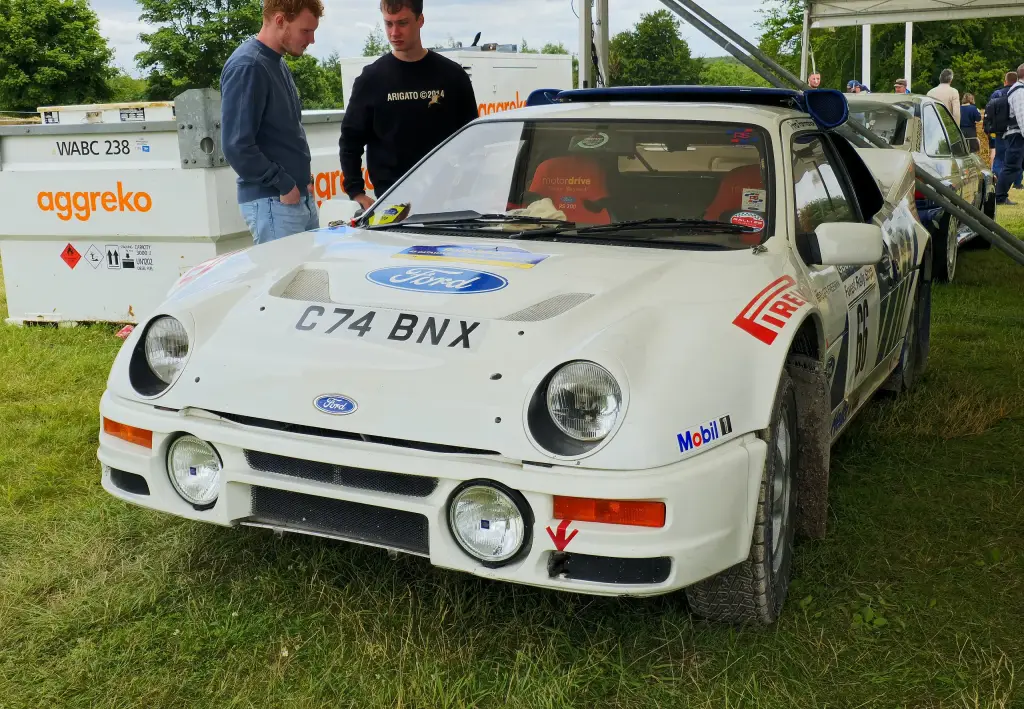
The Ford RS200 is a mid-engined, all-wheel-drive sports car produced by the Reliant Motor Company for Ford Motorsport in Shenstone, England, from 1984 to 1986. The road-going RS200 was the basis of Ford’s Group B rally car and was built to meet FIA homologation rules, which required 200 cars to be completed.
Ford RS200 at a glance
| Produced | 1984 to 1986, by Reliant at Shenstone |
|---|---|
| Layout | mid-engined, four-wheel drive, with the transmission at the front |
| Engine | 1,803 cc Ford-Cosworth BDT, single turbocharger |
| Output | 250 hp (186 kW) in road trim; between 350 and 450 hp (261 and 336 kW) in racing trim |
| Body | plastic-fibreglass composite designed by Ghia |
| Chassis | designed by Tony Southgate |
| Homologation | at least 200 road cars required |
| Price in 1985 | £49,995 |
| Best Group B result | third, Kalle Grundel, 1986 Rally of Sweden |
| Evolution cars | 24 of the 200 were later converted to Evolution specification |
History of the Ford RS200
After the Mk3 Escort arrived in 1980, Ford Motorsport set out to develop a rear-wheel-drive, turbocharged Escort for Group B rallying, the Escort RS 1700T. After a problem-filled development, and with little in common with the road Escort, Ford abandoned it in 1983. Rather than write off the cost, executives decided to use the lessons for a new, purpose-built rally car. They became adamant that it would have four-wheel drive, which they felt was necessary to compete with the Peugeot and Audi cars.
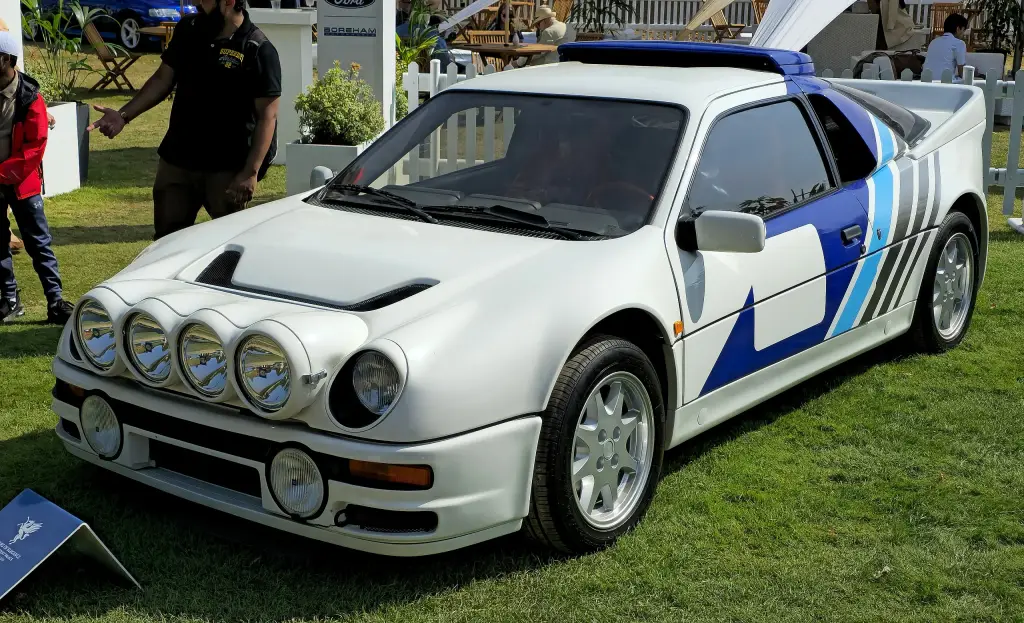
The new car was a unique design with a plastic-fibreglass composite body designed by Ghia, a mid-mounted engine and four-wheel drive. Reliant, a British maker known for its fibreglass bodies, built the cars for Ford. To help weight distribution the gearbox was mounted at the front, so power from the mid-mounted engine went forward to the front wheels and back again to the rear, a complex drive-train. The chassis was designed by the former Formula One designer Tony Southgate, with help from Ford’s John Wheeler, and the double-wishbone suspension with twin dampers on each wheel gave what was often regarded as the best-balanced platform of its rivals. Ford raided its parts bin: the windscreen and rear lights came from the early Sierra and the doors were cut-down Sierra items.
Power and the rally record
The engine was a 1.8-litre Ford-Cosworth BDT with a single turbocharger, giving 250 hp on the road and 350 to 450 hp in race trim, with upgrade kits taking road cars past 300 hp. The car had the balance and poise to be competitive, but its power-to-weight ratio was poor next to its rivals and the engine had notorious low-rpm turbo lag. Factory driver Kalle Grundel’s third place at the 1986 Rally of Sweden was its best finish in Group B.
One event later, at the Rally de Portugal, an RS200 was involved in one of the most dramatic accidents in World Rally Championship history, which killed three spectators and injured many others. Another RS200, driven by the Swiss Formula One driver Marc Surer, hit a tree during the 1986 Hessen-Rallye in Germany, killing his co-driver Michel Wyder. The FIA then abolished Group B after the 1986 season, and the RS200 was obsolete after just one full year of competition.
After Group B
For 1987 Ford had planned an Evolution car with a 2,137 cc development of the engine by Brian Hart, producing from 550 to 815 hp depending on set-up, with 580 hp at 8,000 rpm typical. The ban meant it never rallied, but more than a dozen were run in European rallycross from August 1986 to October 1992, and Martin Schanche of Norway won the 1991 European rallycross title in an RS200 E2 with over 650 bhp. One road car was converted for IMSA GTO racing with over 750 bhp, and a parts car was used at the Pikes Peak hill climb by Stig Blomqvist in 2001, 2002 and 2004.
Production
Ford contracted Reliant to build the 200 homologation cars at Shenstone, with spares for another 20 or more kept for the racing teams. The German source says that parts for all 200 were made by 1985 but that probably only 140 to 146 cars were completed. A further batch of 20 road cars had to be built to homologate the Evolution, and 24 of the original 200 were later converted to Evolution specification.
Design and features
- Layout: a mid-engine longitudinal four-cylinder, with the gearbox at the front and a shaft running to the rear wheels.
- Body: fibreglass composite, designed by Ghia and built by Reliant.
- Parts: Sierra windscreen, rear lights and cut-down doors.
Ford RS200 versions
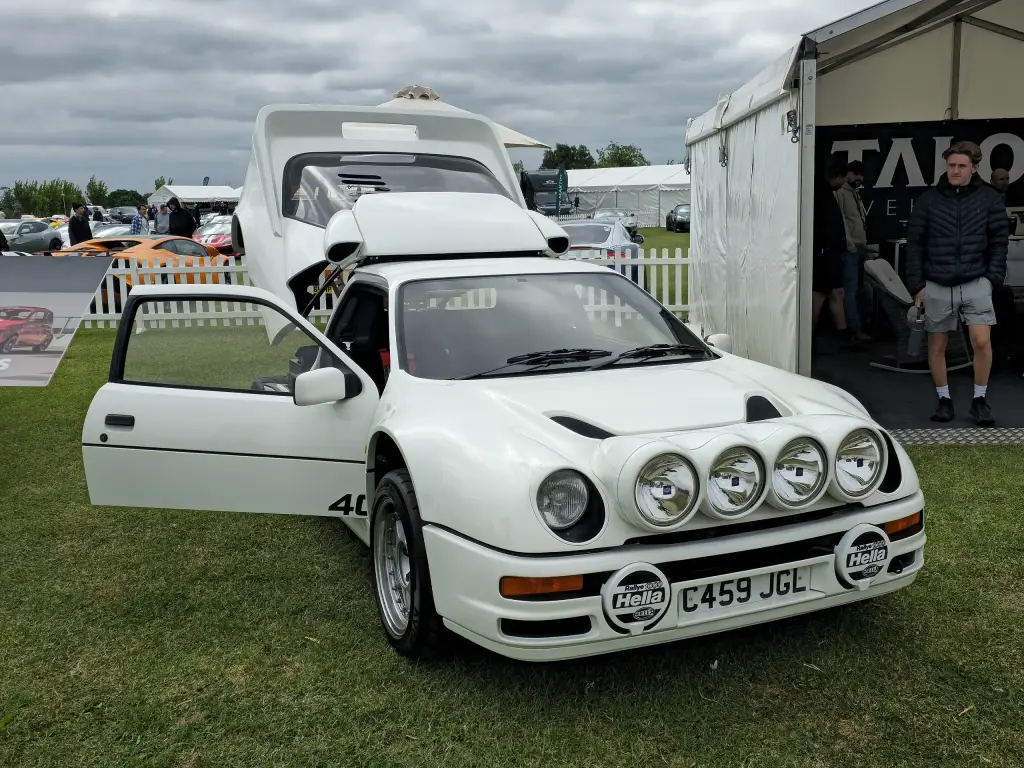
- Road car (1984–1986): 250 hp, sold to meet the 200-car homologation rule.
- Group B rally car: 350 to 450 hp, raced in 1986.
- Evolution (E/E2): a 2.1-litre engine; built for 1987 but used in rallycross.
- “S” version: 20 better-equipped cars offered through a Canadian entrepreneur.
The RS200’s rivals in Group B included the Lancia Delta, the Audi Quattro and the Peugeot 205. More cars are in our Ford collection.
Sources
- Ford RS200, English Wikipedia: history, production, evolution cars
- Ford RS200, German Wikipedia: development and number of cars completed