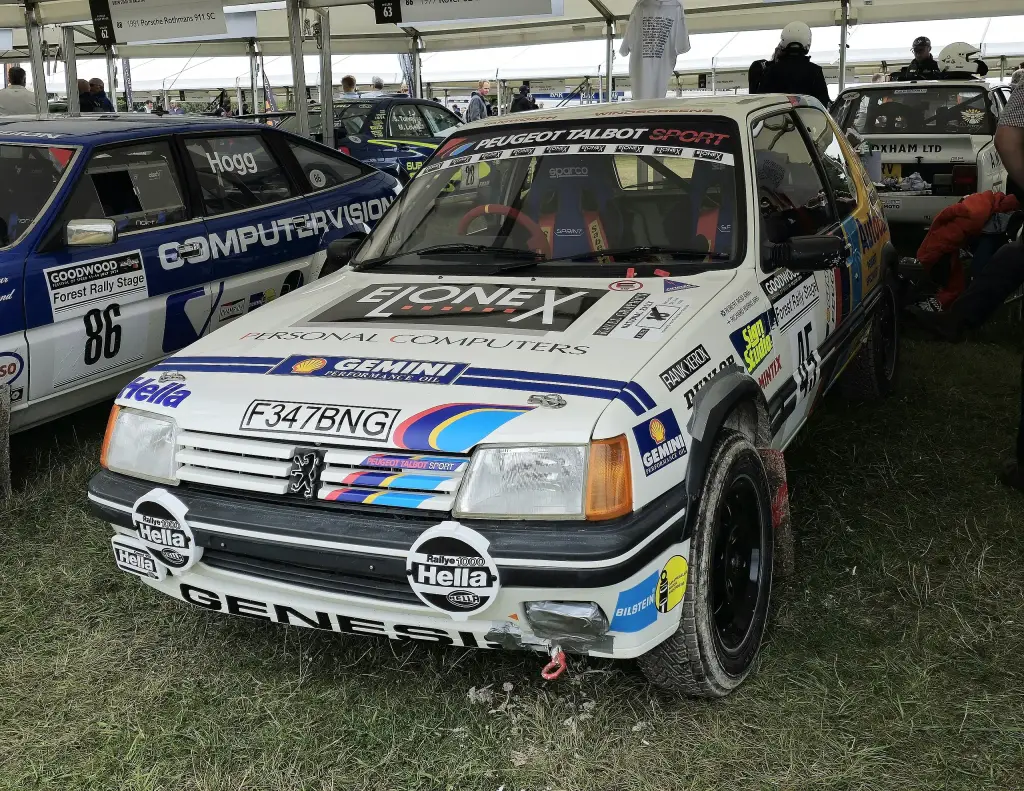
The Peugeot 205 is a supermini that Peugeot made from 1983 to 1999 without a full model change. Developed from Projet M24 and introduced on 25 February 1983, it replaced both the 104 and the Talbot Samba.
Peugeot 205 at a glance
| Production | 1983–1999, one generation |
|---|---|
| Launched | 25 February 1983 |
| Project | M24 |
| Class | supermini |
| Replaced | Peugeot 104, Talbot Samba |
| Engines | 954 cc to 1,905 cc, petrol and diesel |
| Petrol families | X, then XU and TU from 1987–1988 |
| Diesel | PSA XUD, 1,769 cc and 1,905 cc |
| Suspension | MacPherson struts front, trailing arms and torsion bars rear |
| Awards | What Car? Car of the Year 1984, CAR car of the decade 1990 |
| Replaced by | 206, from 1998 |
History of the Peugeot 205
Background
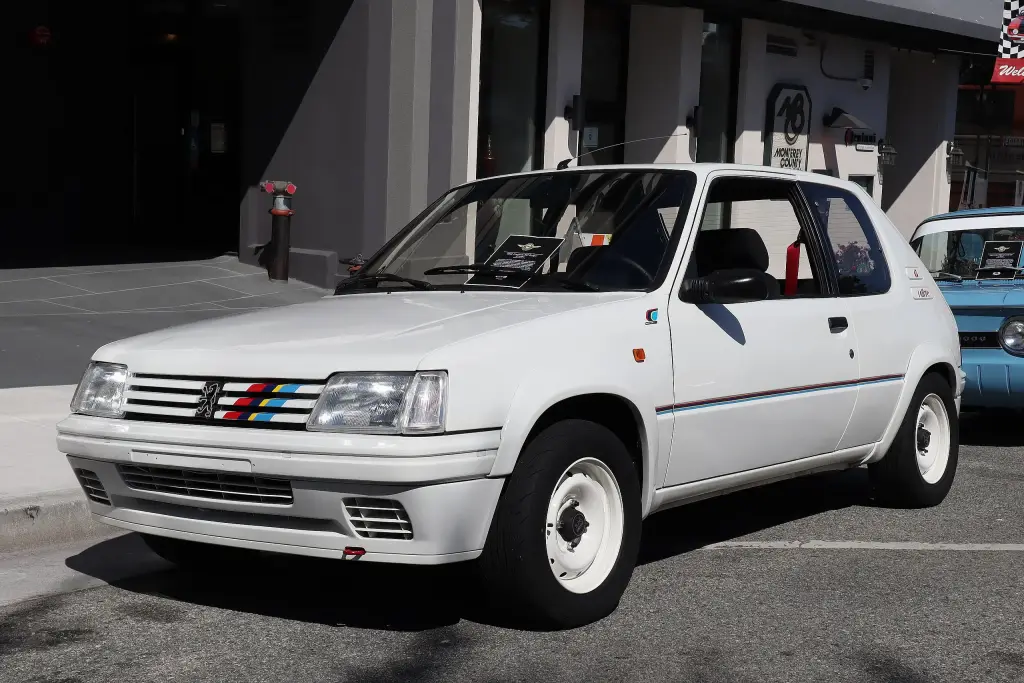
Before the 205, Peugeot was seen as the most conservative of the French big three, building large saloons such as the 504 and 505, although it had entered the modern supermini market in 1973 with the 104. The 205 came out of Peugeot’s 1978 takeover of Chrysler’s European divisions, Simca and the former Rootes Group, which brought experience in small cars such as the Simca 1100 and the Hillman Imp.
The car was launched in February 1983, with right-hand-drive production for Britain following in September. It narrowly lost the European Car of the Year award to the Fiat Uno, but the organisers later noted that it enjoyed a longer period of high demand. It was one of five important small cars launched in Europe within a year of each other, alongside the Uno, the second Fiesta, the Opel Corsa and the Nissan Micra.
Design and chassis
The styling is often credited to Pininfarina, although Gerard Welter says it was done in-house and that Pininfarina only styled the Cabriolet. The car is widely credited with turning Peugeot’s fortunes around, and its shape was echoed in every later Peugeot. The fully independent suspension used the PSA layout first seen on the 305 estate: MacPherson struts at the front and trailing arms with torsion bars at the rear, packaged to keep the boot floor wide and flat.
Early cars used the X petrol engine from the 104, replaced in 1987 and 1988 by the newer XU and TU families of PSA design. Capacities ran from 954 cc to 1,905 cc, with carburettor or fuel injection. The diesel models used the PSA XUD engine from the Citroën BX, of 1,769 cc (XUD7) and 1,905 cc (XUD9) and closely related to the XU petrol units. They were so refined that the 205 GRD was as fast as, and smoother than, the 205 GR petrol, while using much less fuel.
Later years
The 205 was an instant hit and its exterior styling was never significantly altered over fifteen years. The dashboard was redesigned for 1988, and late in 1990 the car received a minor facelift with new doors, clear front indicators, smoked rear lights, single-point injection and catalytic converters to meet the 1992 pollution limits. By 1990 it was still the benchmark of its class, and Jeremy Clarkson called that year’s car an instant modern classic.
The 306 of early 1993 and the 106 of September 1991 both took sales from the 205, but the end came only in 1999, when the 206 arrived. Commercial versions included the two-seater XA series and the tall 205 Multi, built by coachbuilders such as Gruau and Durisotti.
Design and features
- One generation: fifteen years with no full model change.
- Compact rear suspension: torsion bars and trailing arms that left a flat, wide boot floor.
- GTI: the hot hatch version that set the standard of its class.
- XUD diesel: diesel economy with petrol-like refinement.
- Commercial versions: two-seat XA and the coachbuilt 205 Multi.
Peugeot 205 versions
- 205 (1983): the original range with X engines.
- GTI: the performance model, later joined by the 1.9.
- Rallye: the light, stripped competition-inspired version.
- GTD and dTurbo: XUD diesel models, the dTurbo with a turbocharger from 1991.
- XA and 205 Multi: two-seat commercial and tall-bodied conversions.
The 205 replaced the Peugeot 104 and was itself replaced by the 206 in 1998, with the 106 covering the smaller end of the range. More in the Peugeot collection.
Video: The Greatest GTI – Peugeot 205 Lightweight
Video by on YouTube.
Sources
- Peugeot 205, English Wikipedia: history, design, engines, suspension, later years