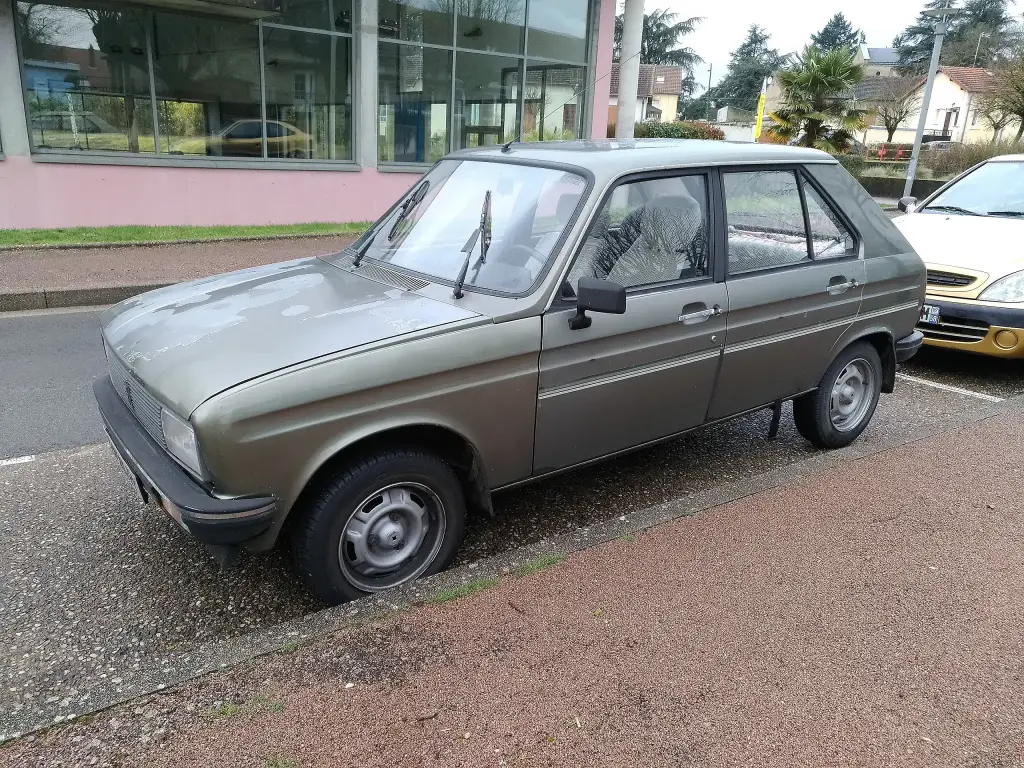
The Peugeot 104 is a supermini that Peugeot produced between 1972 and 1988. It was designed by Paolo Martin and was the first model built at the company’s Mulhouse plant, and the first new Peugeot since 1955 that was not offered with a diesel engine.
Peugeot 104 at a glance
| Production | 1972–1988 |
|---|---|
| Class | supermini |
| Designer | Paolo Martin |
| Plant | Mulhouse, the first model built there |
| Launch | September 1972 Paris Motor Show |
| Original body | four-door fastback saloon |
| Bodies added | three-door coupé (1973), five-door hatchback (1976) |
| Engine | 954 cc Douvrin (PSA X), aluminium, chain-driven overhead cam |
| Gearbox | in the sump, sharing engine oil |
| Engine mounting | leaning back at 72 degrees |
| Best year | 1977, about 190,000 cars |
| Diesel | not offered |
History of the Peugeot 104
The saloon of 1972
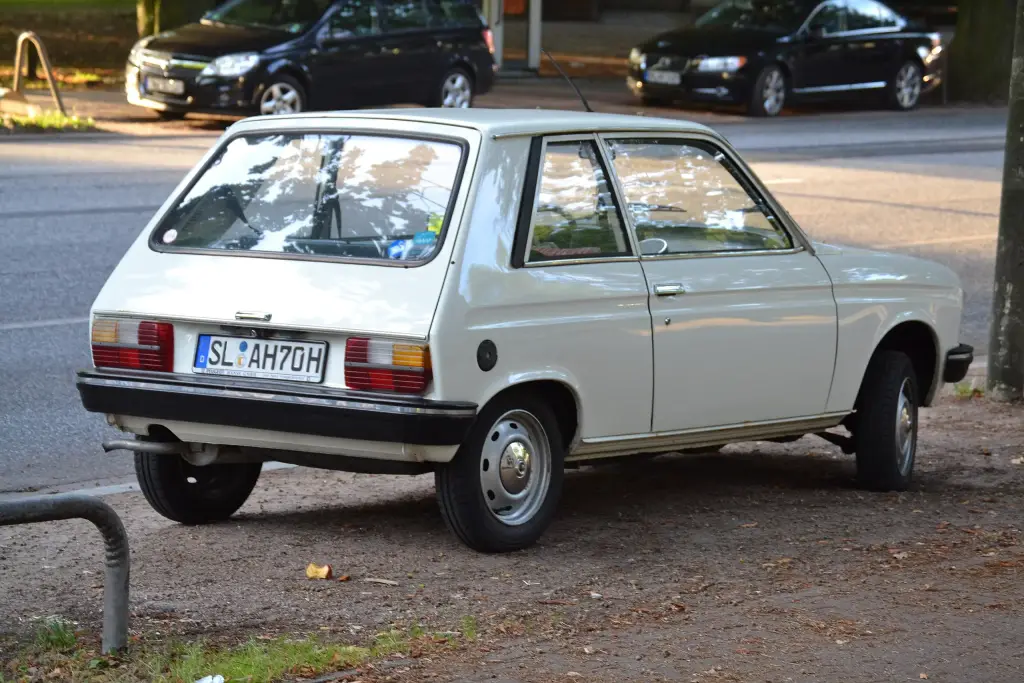
The 104 was presented at the Paris Motor Show in September 1972 as a compact four-door fastback. It had a short, sloping rear end that suggested a hatchback, but there was a separate boot as on a conventional saloon. Power came from a 954 cc all-aluminium Douvrin engine, the PSA X unit developed jointly with Renault, with a chain-driven overhead camshaft and the gearbox in the sump sharing the engine oil. The engine was mounted leaning backwards at 72 degrees, and the chassis gave the car unusually good ride and handling for its class.
Coupé and facelifts
A three-door coupé on a shortened chassis followed at the 1973 Paris show, with the same 954 cc engine and larger rectangular headlights instead of square ones. Short-wheelbase cars took names beginning with Z, such as ZL, ZA and ZS2, while equipment levels beginning with G or S were used for the longer four and five-door cars.
A facelift in July 1976 replaced the four-door saloon with a five-door hatchback; Peugeot had feared that a five-door 104 would take sales from the 204 Break, but production of the 204 ended that month. A 1.1-litre engine was introduced, the coupé was offered as the ZL and the more powerful ZS with 66 PS, and the camshaft of the 954 cc engine was revised to favour economy. In 1977, the model’s best year, about 190,000 were built.
The 1978 changes added the ZA, a two-seat commercial coupé, and larger rear lights with reversing lamps on all coupés. A special five-door called the Sundgau used the ZS engine; 1,200 were built in March and April 1978. For 1979 the ZL coupé moved to a 57 PS version of the 1,124 cc engine. The 1980 facelift brought new model names and a 1.2-litre engine in the SR. In 1982 the car received smaller headlights, a new grille and reversing lights in the five-door rear clusters, and the ZS coupé was given a 1,360 cc engine of 80 PS with two carburettors instead of one double-barrel unit.
End of the line
In 1983 the range was cut back to make room for the 205 and exports to most markets ended. The car stayed on sale in France until production finished in 1988. The sporting ZS remained until late 1985, and for 1986 only the 50 PS 1,124 cc engine was left. A minor facelift in 1987 brought a grille with three body-coloured bars and anthracite bumpers, and the Z, Style Z and five-door GLS continued with that engine until 1988. A limited run of 1,000 ZS 2 cars was built in 1979 with a 93 PS 1,360 cc engine.
Prototypes and relatives
Several prototypes were based on the 104, including an electric version built in 1975 with Alstom and EDF, seven cars in all, four coupés and three vans; a diesel; the M18 five-door estate of about 1976; the M23 three-door van; a pick-up; and the Peugette roadster on the 104 ZS platform. After Peugeot took over Citroën in 1975 the coupé body was shared with the 602 cc two-cylinder Citroën LN, later the LNA.
Design and features
- PSA X engine: an all-aluminium 954 cc unit with a chain-driven overhead cam, developed with Renault.
- Gearbox in the sump: transmission and engine shared their oil, an arrangement pioneered by the Mini.
- Coupé body: a short-wheelbase three-door with rectangular headlights and Z-series names.
- Electric prototype: seven cars built in 1975 with Alstom and EDF, four coupés and three vans.
- Citroën LN: the coupé body carried over to Citroën with a two-cylinder engine.
Peugeot 104 versions
- Saloon (1972): four-door fastback with a separate boot.
- Coupé (1973): shortened chassis, ZL, ZA and ZS versions.
- ZS: the sporting coupé, 66 PS at first and 80 PS from 1982.
- ZS 2 (1979): 1,000 cars with a 93 PS 1,360 cc engine.
- Sundgau (1978): 1,200 five-door cars with the ZS engine.
- Five-door hatchback (1976): replaced the saloon for the rest of the run.
The 104 was replaced in the range by the Peugeot 205 and led to the 106, which used the Citroën AX platform. More in the Peugeot collection.
Video: PEUGEOT 104 GL – 1975 – Great !!
Video by on YouTube.
Sources
- Peugeot 104, English Wikipedia: history, engines, versions, prototypes, Citroën LN