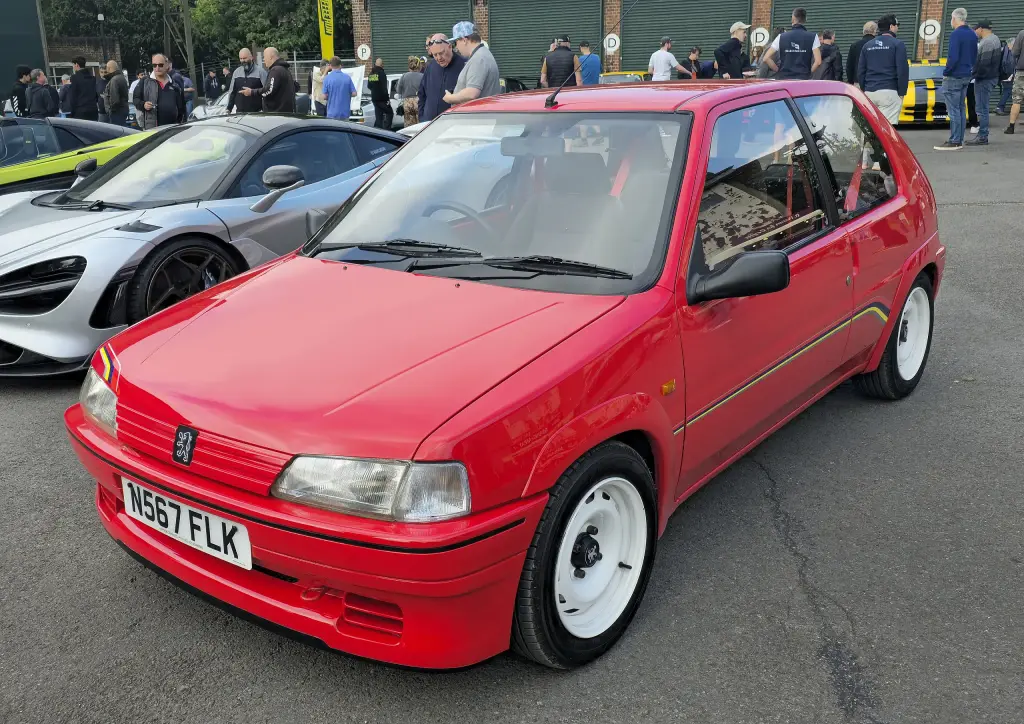
The Peugeot 106 is a supermini produced by Peugeot from 1991 to 2003. It was the company’s entry-level model for its whole life, launched as a three-door hatchback with a five-door joining the range in August 1992.
Peugeot 106 at a glance
| Production | September 1991 to July 2003 |
|---|---|
| Class | supermini |
| Bodies | three-door from 1991, five-door from August 1992 |
| Platform | a development of the Citroën AX |
| Suspension | MacPherson struts front, transverse torsion bars rear |
| Phase I engines | 1.0, 1.1 and 1.4 petrol, 1.4 diesel, later 1.5 |
| Phase I trim | XN, XR, XT, XSi |
| Phase II (1996) | side impact bars, airbags, 1.6 GTI |
| Rallye weight | 825 kg |
| Successor | 107, launched in June 2005 |
History of the Peugeot 106
Phase I (1991–1996)
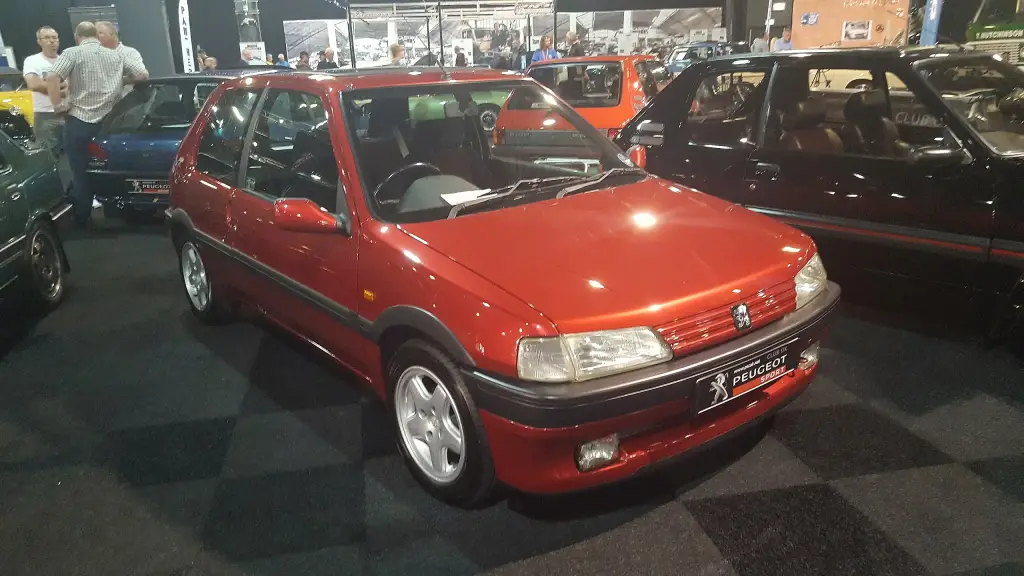
The 106 arrived in September 1991 as the entry point of the Peugeot range, below the 205. It was a substantial development of the Citroën AX platform, aimed at the Renault Clio and offered as a more modern alternative to the slightly larger 205, with independent suspension all round: MacPherson struts at the front and compact transverse torsion bars at the rear. Only a three-door was offered at first, with a five-door added in August 1992.
Trim levels ran from the basic XN through the XR and XT to the sporty XSi. The cheapest cars had areas of visible metalwork on the doors and a sparse interior, and even a radio was an option on some versions. The 1.0 and early 1.1-litre engines had carburettors for the first year, replaced by fuel injection from the end of 1992 because of EEC emissions rules. A 1.4 diesel joined in August 1992 and was replaced in late 1994 by a larger, more torquey 1.5. In right-hand-drive markets there was no power steering, because there was no room for the pump, and air conditioning was never offered.
Many of the cars sold in Britain were special editions such as the Graduate, Inca, Aztec and Independence, usually based on the XN and set apart by bodywork graphics, a sunroof and a few options.
Phase II (1996–2003)
The 106 was updated in July 1996 with side impact bars and, for the first time, driver and passenger airbags. A new 1.6 GTI joined the range as the successor to the 205 GTI, and the car grew 114 mm in length thanks to a larger front end that echoed the 406. In January 1996 the same platform had produced the Citroën Saxo, almost identical in size and shape. The arrival of the 206 at the end of 1998 cut the range back to the Zest versions and the GTI, alongside special editions such as the Quiksilver and Look.
Rallye and GTI
The Rallye was sold as having fewer frills and more thrills: steel wheels painted white, no power steering, central locking or electric windows, and a weight of 825 kg. There were pre and post-facelift versions, known as S1 and S2. The S1 used a high-revving 1.3-litre TU2J2 engine of 100 PS, the S2 a 1.6-litre TU5J2 of 103 PS; both were fuel injected with Magneti Marelli systems. The S1 block was aluminium, its dimensions close to the 1.4 iron block but with slightly reduced capacity to fit the French rally class below 1,300 cc.
Design and features
- AX platform: a proven small-car base with all-independent suspension.
- Light Rallye: 825 kg thanks to deleted equipment, on white steel wheels.
- 1.6 GTI: the spiritual successor to the 205 GTI, added with Phase II.
- Two phases: the 1996 update brought airbags, side bars and a longer nose.
- Special editions: Graduate, Inca, Aztec, Independence, Quiksilver and Look.
Peugeot 106 versions
- XN, XR, XT: the standard Phase I trim levels.
- XSi: the sporty model of the first phase.
- GTI (1996): 1.6-litre engine, the top of the Phase II range.
- Rallye S1: 1.3-litre TU2J2, 100 PS, aluminium block.
- Rallye S2: 1.6-litre TU5J2, 103 PS.
- Zest, Zest 2, Zest 3: the trimmed Phase II range of the late nineties.
The 106 replaced the Peugeot 104 in the entry slot, though the 205 was the car it sat below, and its successor was the 107. More in the Peugeot collection.
Video: Der Checker Peugeot 106
Video by on YouTube.
Sources
- Peugeot 106, English Wikipedia: production, phases, engines, Rallye and special editions