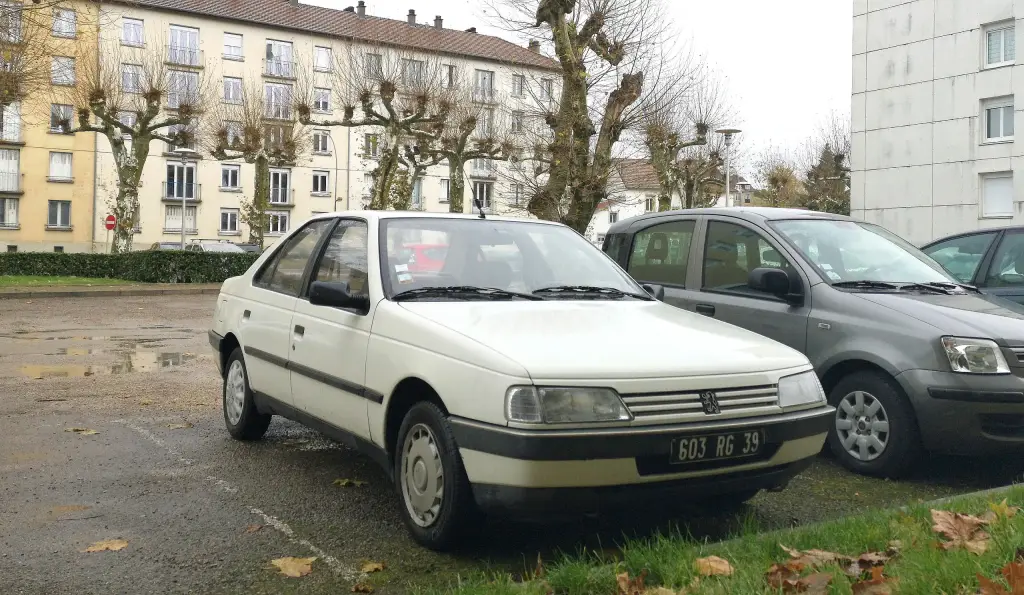
The Peugeot 405 is a large family car that Peugeot made from 1987 to 1997, with licensed production in Iran continuing until 2020. It was voted European Car of the Year for 1988 by the largest number of votes in the history of the contest.
Peugeot 405 at a glance
| Production | 1987–1997 in Europe, 2020 in Iran |
|---|---|
| Unveiled | July 1987 |
| Design | Pininfarina, similar to the Alfa Romeo 164 |
| Platform | shared with the Citroën BX |
| Engines | 1.4 to 1.9 petrol, 65 to 160 hp; 1.8 turbo and 1.9 diesels |
| Mi16 | 1,905 cc 16-valve, 160 hp, 220 km/h |
| Bodies | saloon and estate, front-wheel or four-wheel drive |
| Facelift | Phase II in 1992 |
| Sold worldwide | about 2.5 million |
History of the Peugeot 405
Launch
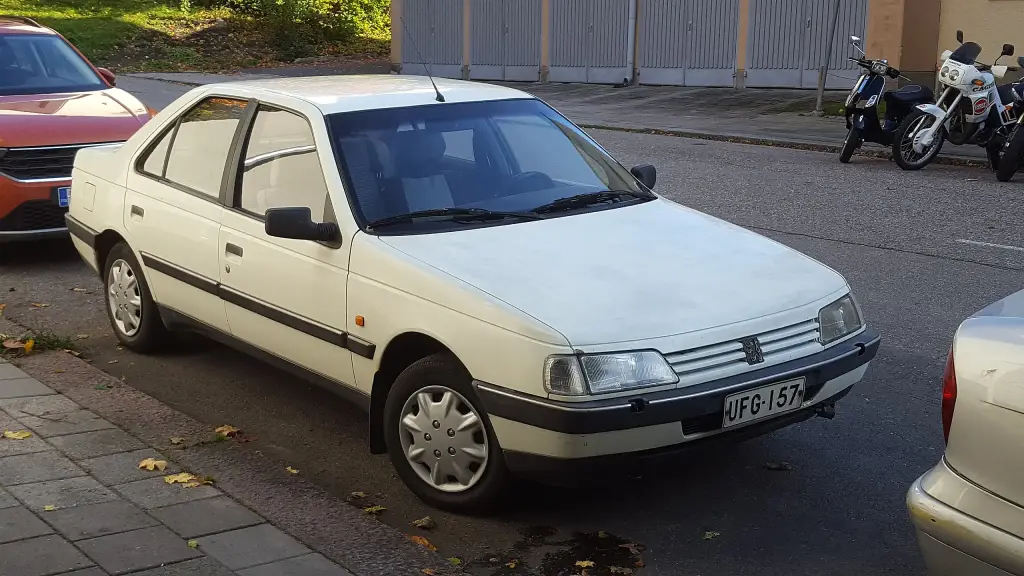
In July 1987 Peugeot unveiled ten versions of the 405 saloon at once for the 1988 model year. Sales on the continent began in October 1987 and in Britain in January 1988. It replaced the long-running 305, and also the Chrysler Alpine and Solara that had gone when the Talbot brand was dropped, while the slightly smaller 305 was discontinued soon after. The 605 became the range-topping Peugeot after 1989.
The estate arrived in May 1988, reaching Britain in October. Right-hand-drive cars were built at the former Rootes and Chrysler plant at Ryton near Coventry, and left-hand-drive cars at Sochaux. The car’s appearance is similar to the Alfa Romeo 164, launched the same year and also styled by Pininfarina; the 405 used the Citroën BX floorpan but not its hydropneumatic suspension, except on the rear axle of the four-wheel-drive versions.
Engines and versions
Four-cylinder petrol engines from 1.4 to 1.9 litres and 65 to 160 hp were offered, and in 1988 naturally aspirated 1.9 and turbocharged 1.8 diesels joined the range. The 1.4 of 1,360 cc had a four-speed gearbox and produced 70 hp at 5,600 rpm; the 1.6 of 1,580 cc had five speeds and 92 hp at 6,000 rpm; the 1.9 of 1,905 cc came with a five-speed or, in the lower-powered form, an automatic. The eight-valve 1,905 was sold in 110 and 125 hp tune depending on the year and market. The 16-valve Mi16 produced 160 hp at 6,500 rpm and reached 220 km/h, or 148 hp and 214 km/h in catalysed form. The 1.6 saloon had a drag coefficient of 0.29, with other versions up to 0.33.
Updates and the end
The 500,000th 405 was built in 1989 and the millionth left Sochaux in 1990, the year the BE1 transmission gave way to the BE3. In 1991 the dashboard, steering wheel and soundproofing were revised, and for 1992 the Phase II brought a new boot with better access, new rear lights and a new dashboard, with bonded windscreens and greater torsional rigidity. Production had passed 1,500,000 by then. The 406 arrived in the autumn of 1995 and the saloon was discontinued; the estate followed in early 1997, when the 406 estate was launched, ending European production after ten years. An airbag had been available since 1994 and was standard on left-hand-drive Mi16 and T16 cars.
About 2.5 million 405s were sold worldwide. It was among Europe’s best-selling larger family cars, especially in France and Britain, where it was the eighth best seller in 1992 and 1993, and it became popular in Thailand as well. Outside Europe it was built in Zimbabwe until 2002, in Egypt, in Iran by Iran Khodro from 1991 to 2020, in Chile, Argentina from 1992 to 1999 with over 500,000 sold, Poland, Taiwan, Thailand and Azerbaijan. In early 2020 its 33-year run was counted as the twentieth most long-lived single-generation car in history. No coupé was ever offered, apart from two examples of the purpose-built two-door 405 Turbo 16.
Design and features
- Record award: European Car of the Year 1988 by the largest vote in the contest’s history.
- Pininfarina styling: a shape close to the Alfa Romeo 164 of the same year.
- Mi16: 1,905 cc 16-valve with 160 hp and 220 km/h.
- Low drag: 0.29 for the 1.6 saloon.
- Long life: 33 years of production counting the Iranian cars.
Peugeot 405 versions
- Saloon (1987): ten versions at launch.
- Estate (1988): the five-door Break.
- Mi16: 16-valve performance model.
- Four-wheel drive: SRi x4, Mi16x4 and T16 with a driven rear axle.
- 405 Turbo 16: two purpose-built two-door cars.
The 405 replaced the Peugeot 305 and was replaced by the 406, with the 309 below it at Ryton. More in the Peugeot collection.
Video: Old Top Gear 1989 Peugeot 405 Road Test
Video by on YouTube.
Sources
- Peugeot 405, English Wikipedia: launch, engines, versions, updates, worldwide production