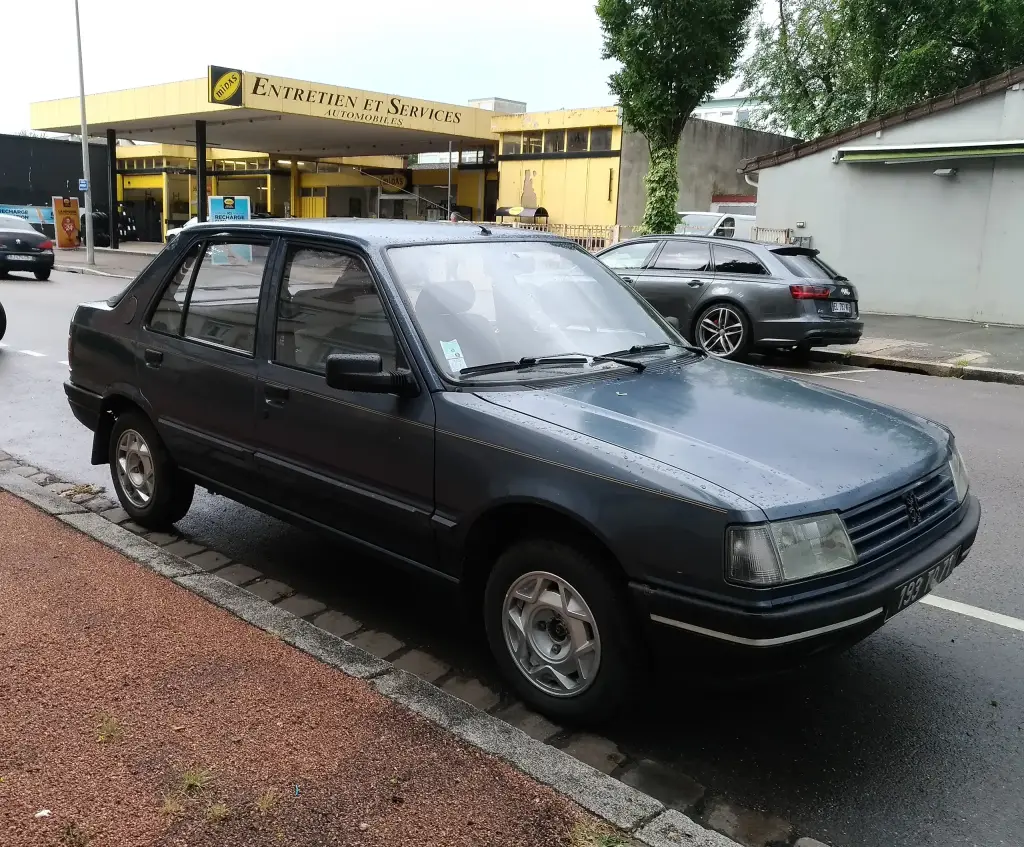
The Peugeot 309 is a small family car built between 1985 and 1994 in France, England and Spain by PSA Peugeot Citroën. It was originally intended to be sold as a Talbot, the Talbot Arizona, as the replacement for the Talbot Horizon.
Peugeot 309 at a glance
| Production | 1985–1994 |
|---|---|
| Project | C28, conceived as a Talbot |
| Bodies | five-door from 1985, three-door from February 1987 |
| Chassis | stretched Peugeot 205 floorpan and door shells |
| Engines | Simca 1,118 and 1,294 cc, XU 1,580 and 1,905 cc |
| Diesels | 1,905 cc XUD from July 1986, 1,769 cc for some markets |
| GTi | XU9 engine, from 1987 |
| Plants | Poissy, Ryton, and Spain |
| Facelift | Phase 2, summer 1989 |
History of the Peugeot 309
A Talbot that became a Peugeot
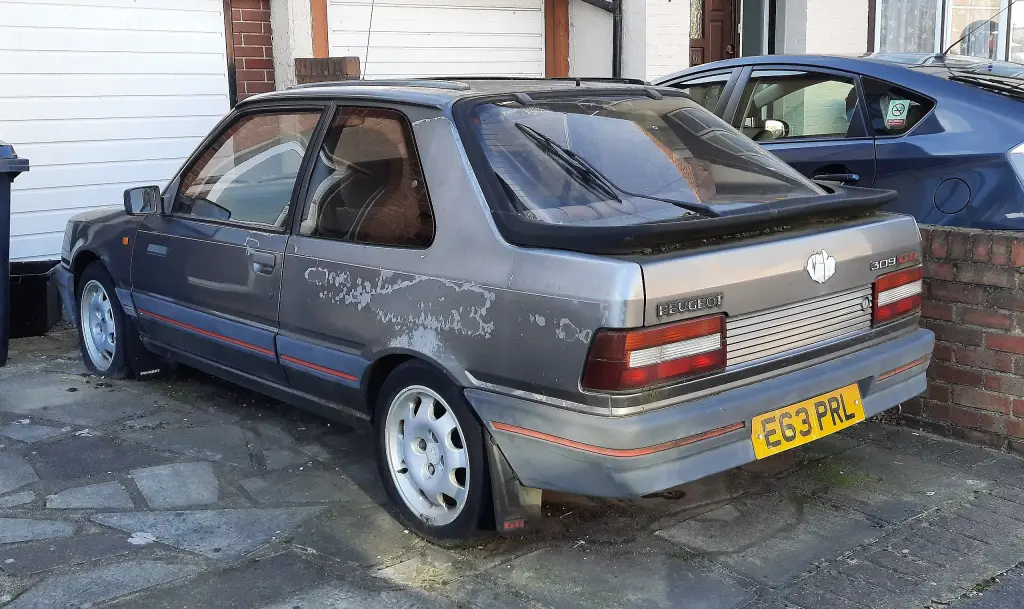
The car was conceived as Projet C28 to replace the Talbot Horizon, so its development was handled by the former Chrysler and Simca side of PSA. Styling came from the former Chrysler-Rootes studios in Coventry, and much of the engineering from the Simca site at Poissy. PSA’s only condition was that the new car should use as much existing architecture as possible: it therefore took a stretched Peugeot 205 floorpan and door shells, along with the Simca engines and transmissions of the Horizon.
In 1985 PSA decided to drop the Talbot brand, whose last new passenger car had been the 1981 Samba, and to sell the car as a Peugeot instead. The 309 was not meant to replace the 305, and the out-of-step number was chosen to distance it from the larger car and to reflect its Simca origins. It was the first Peugeot-badged hatchback of its size.
Production
Production began at Poissy at the end of summer 1985, with the first French customers taking delivery in October, while right-hand-drive cars were built at Ryton near Coventry, which Peugeot had inherited with Chrysler Europe in 1978. The first British 309 left Ryton in October 1985 and sales began in early 1986. Only a five-door hatchback was offered at first.
The 309 was the first Peugeot assembled at Ryton, and partly because of its British origins it became a popular car in the United Kingdom. The 405 joined it on the line in 1987, and the 306 and 206 were also built there; the 206 was the last model made at Ryton before it closed in December 2006.
Styling and engines
The slightly awkward styling, especially next to the 205 and 405, came from the decision to reuse the 205’s door shells, and from the fact that the car was designed in-house to be a Talbot rather than by Pininfarina. The design was anticipated by the 1982 Peugeot VERA Plus and the 1985 VERA Profil aerodynamic studies, the VERA Plus claiming a drag coefficient of 0.22, and many of those ideas reached later production Peugeots.
In Britain the engines were the chain-driven Simca overhead-valve units of 1,118 and 1,294 cc from the Horizon and Peugeot’s belt-driven single overhead cam XU units of 1,580 and 1,905 cc. Spanish-built cars used the 1,442 and 1,592 cc Poissy engines instead of the 1,580. The first diesels arrived in July 1986 with the 1,905 cc XUD in GLD and GRD form, followed by the SRD in 1987; some export markets had a 1,769 cc version of 60 PS from the start, while France only received the smaller diesel in 1992.
With 305 sales falling, the range was expanded in February 1987 with a three-door body. Five-door models generally carried equipment letters beginning with G and three-doors ones beginning with X. The 1,905 cc GTi used the same XU9 engine as the 205 GTi, and 1987 also brought an Automatic with five doors and the XA and XAD two-seater vans. The summer of 1989 brought the Phase 2, which lowered the boot lip and changed the rear lights.
Design and features
- 205 floorpan: a stretched 205 base with the 205’s door shells.
- Simca engines: the Horizon’s overhead-valve units carried over.
- British production: right-hand-drive cars built at Ryton from 1985.
- GTi: the XU9 engine shared with the 205 GTi.
- Two-seat vans: the XA and XAD added in 1987.
Peugeot 309 versions
- Five-door (1985): the original body.
- Three-door (1987): added as the range expanded.
- GTi (1987): 1,905 cc XU9 engine.
- GLD, GRD, SRD: the diesel models.
- XA and XAD: two-seater commercial vans.
- Phase 2 (1989): revised rear end and lights.
The 309 replaced the Talbot Horizon and was replaced by the Peugeot 306, while the 205 supplied its floorpan and doors. More in the Peugeot collection.
Video: Two Vintage Peugeot 309 Cold Starts!
Video by on YouTube.
Sources
- Peugeot 309, English Wikipedia: origins, production, engines, versions, facelift