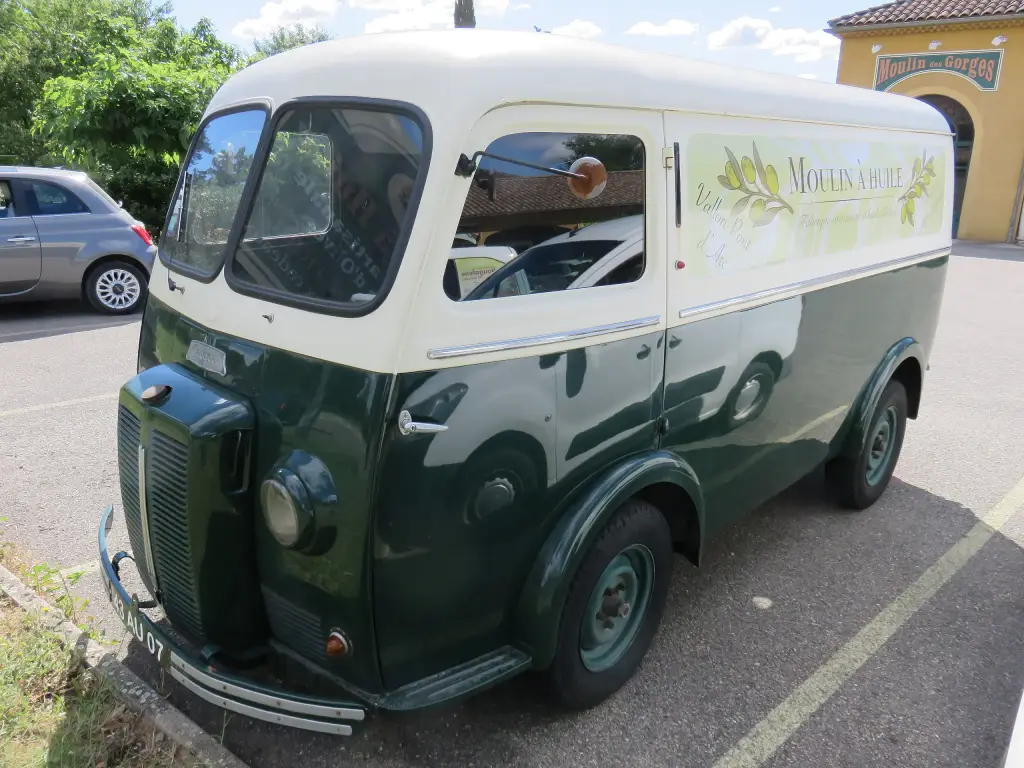
The Peugeot D3 and Peugeot D4 are vans of Chenard et Walcker design that were built for Peugeot from October 1950 to 1965, in 75,881 examples.
Peugeot D3 and D4 at a glance
| Production | October 1950 to 1965 |
|---|---|
| Origin | Chenard et Walcker CPV van of 1947 |
| Design | monocoque body, forward control cab, front-wheel drive |
| D3 engine | Peugeot 203, 32 then 40 hp |
| D4 engine | Peugeot 403, 45 hp, four-speed gearbox |
| Suspension | independent on all four wheels |
| Nickname | nez de cochon, pig nose |
| Bodies | panel van, minibus, ambulance, cattle truck, horse van |
| Total built | 75,881 |
| Replaced by | Peugeot J7 in 1965 |
based on one source (French Wikipedia); no free photographs of the model were found, the existing thumbnail stays
History of the Peugeot D3 and D4
From Chenard et Walcker
The van’s monocoque body with a forward control cab came from the Chenard et Walcker CPV, a front-wheel-drive van of 1947. In exchange for supplying the Peugeot 203 engine to the Chenard van, Peugeot sold it through its own network under the name D3. The engine sat longitudinally on a front overhang ahead of the gearbox, and the suspension was independent on all four wheels.
The range
In 1955 the D3 became the D4, with an engine from the Peugeot 403 and a four-speed gearbox. The D3 and D4 were sold as a panel van, a minibus, an ambulance, a cattle truck and a horse van, the last built among others by the firm Théault at Avranches. The French post office used the minibus to carry postmen, and the police used it as a mobile control vehicle.
The vans competed with the Renault 1,000 kg and the Citroën Type H and were often called “nez de cochon”, pig nose, because of the protruding grille needed to fit the Peugeot engine lengthways: it was longer than Chenard et Walcker’s original two-cylinder two-stroke. The D4B was replaced by the Peugeot J7 in 1965.
Model history
Chenard et Walcker’s own line ran from the CHV of June 1946, a 1,500 kg van with a flat-twin 1,021 cc two-stroke of 26 hp, through the CPV of April 1947 with a Peugeot 202 engine of 30 hp, to the CP3 of October 1950 with the 203 engine of 32 hp, which ended in January 1951. For Peugeot the sequence was: the D3A in October 1950 with the 203 engine, a different carburettor and a rev limiter; 40 hp in July 1952, recognisable by extra cooling vents at the front; a passenger seat from February 1953; the D4A in August 1955 with the 45 hp 403 engine and a four-speed gearbox; the D4AD in October 1959 with the Indenor TMD five-bearing diesel; the 1960 models with a new Peugeot badge at the front; the D4B and D4BD of January 1960 with 55 hp; indicators instead of trafficators from January 1961; new flat body mouldings for 1961; fewer grille vents in May 1963; the lion badge removed in June 1964; and the end of production in May and June 1965.
Design and features
- Forward control cab: the driver sat at the very front, over the axle.
- Monocoque body: taken from the Chenard et Walcker CPV.
- Independent suspension: all four wheels, unusual for a van of the period.
- Pig nose: the protruding grille that gave the van its nickname.
- Diesel option: the Indenor TMD from 1959 in the D4AD.
Peugeot D3 and D4 versions
- D3A (1950): Peugeot 203 engine of 32 hp, raised to 40 hp in 1952.
- D4A (1955): Peugeot 403 engine of 45 hp and four-speed gearbox.
- D4AD (1959): Indenor diesel with five main bearings.
- D4B and D4BD (1960): 55 hp and a diesel version.
- Bodies: panel van, minibus, ambulance, cattle truck, horse van.
The D3 and D4 were replaced by the Peugeot J7 in 1965 and used the engines of the 203 and the 403. More in the Peugeot collection.
Video: Premiers tours de roues du D3A Peugeot
Video by on YouTube.
Sources
- Peugeot D3 et D4, French Wikipedia: origins, engines, bodies, model history, total production