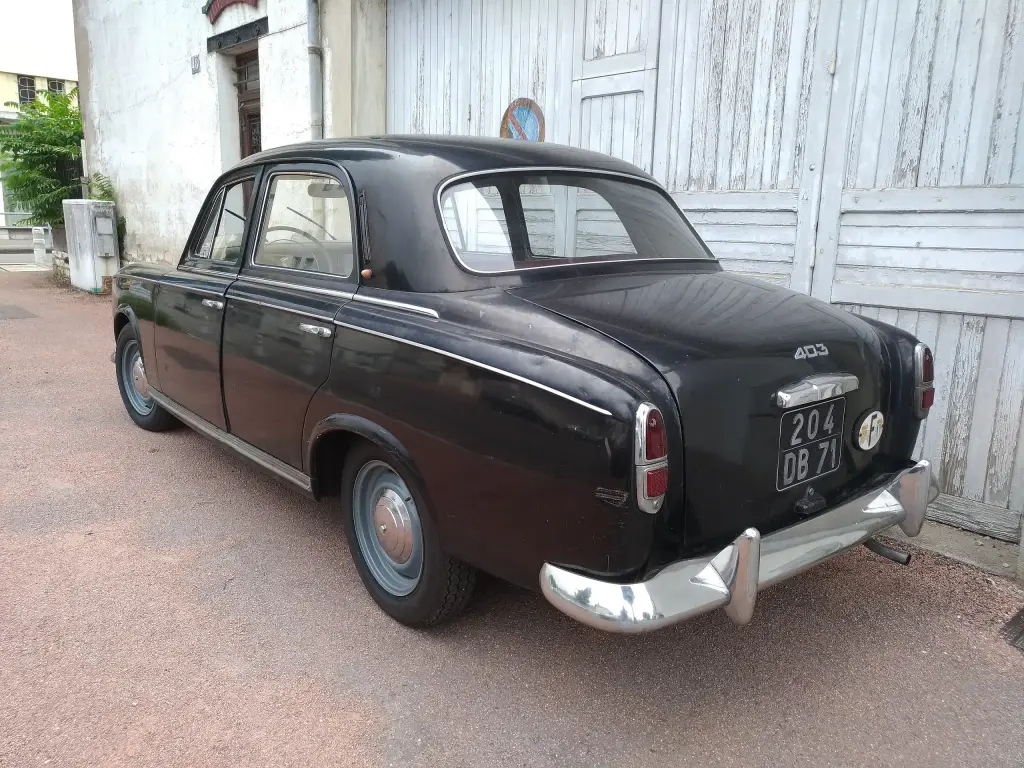
The Peugeot 403 is a mid-size car that Peugeot made between May 1955 and October 1966. Counting all types, including commercial models, 1,214,121 were built, making it the first Peugeot to pass a million sales.
Peugeot 403 at a glance
| Production | 1955–1966 |
|---|---|
| Launched | 20 April 1955, at the Trocadéro in Paris |
| Engine | 1,468 cc straight four, pushrods, hemispherical chambers |
| Power | 58 hp, raised to 65 hp in 1958 |
| Tax horsepower | 8 CV |
| Gearbox | four-speed, all-synchromesh, column change |
| Design | Pinin Farina, ponton three-box styling |
| Diesel | estate in autumn 1958, saloon a year later |
| Total built | 1,214,121 |
History of the Peugeot 403
Launch
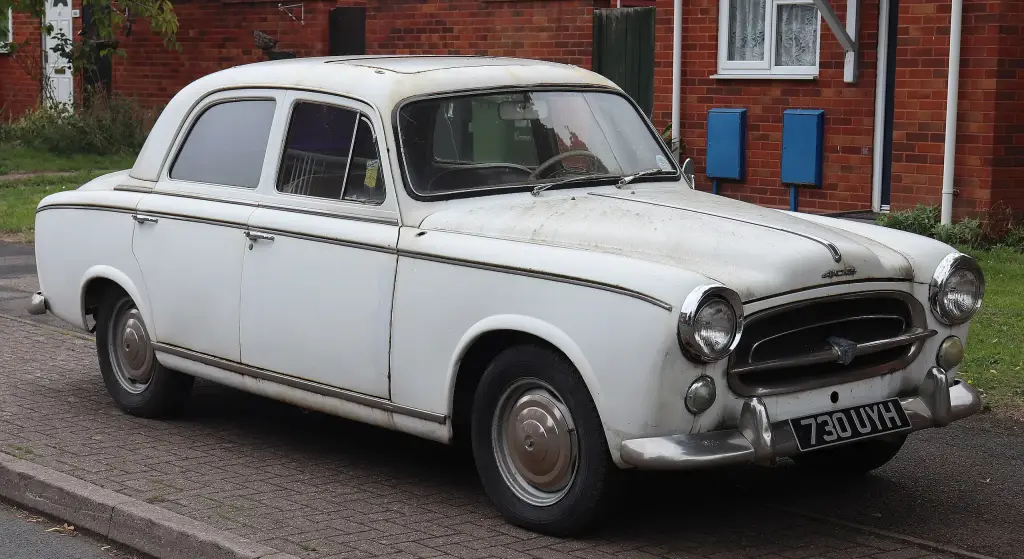
The 403 was shown as a saloon on 20 April 1955 at the Trocadéro Palace in Paris. For months before the launch, cars with their badges removed had been driven near the Sochaux factory; they became so familiar locally that they stopped attracting attention, but they drew the Paris motoring press to a town it usually ignored. The engine gave the car a tax horsepower of 8 CV, a class below the Citroën Traction that was about to be replaced and at least one above the small cars of its main rivals.
Until after 1958 the nose carried an angular, forward-leaning chrome lion, Peugeot’s trademark, which was removed for 1959 on safety grounds and replaced by a shield-shaped grille emblem. The semaphore trafficators on the C-pillars gave way to flashing indicators in the light clusters, the front lights were modified to new standards, and in 1957 parallel windscreen wipers replaced the original cross-hands design. Changes for 1959 moved the washer nozzles from the strip below the windscreen to the rear edge of the bonnet and replaced the half-ring horn with a full circular ring.
Design
Styled by Pinin Farina, the 403 had ponton three-box styling and, except on the most basic models, a metal sunroof. The collaboration began a partnership that lasted more than fifty years and produced many mainstream Peugeots. There were persistent rumours that the design had begun as a replacement for the Fiat 1900, rejected when Turin delayed the Fiat’s replacement. Unusual in Europe were the wide rear doors that opened to 90 degrees, and the rear door windows that lowered fully despite the wheel arch.
Engine and transmission
The 403 used an enlarged version of the 203’s 1,290 cc engine. The 1,468 cc straight four had pushrod valves, hemispherical combustion chambers and a crossflow head, producing 58 hp at about 4,900 rpm and 101 Nm at 2,500 rpm, raised to 65 hp in 1958. An unusual feature was the thermostatically controlled fan, which cut out below 75°C and came back at 84°C, saving 5 to 10% in fuel and a good deal of noise. A diesel estate appeared in the autumn of 1958, the first of a long line, followed by a diesel saloon a year later.
After the 203 was dropped in 1960, a 54 hp version of its 1,290 cc engine became an option on a reduced-specification 403, first called the 403 Sept and soon the 403 Berline Luxe; the smaller engine put the car in the 7CV tax class instead of 8CV. The gearbox was a four-speed all-synchromesh unit with the lever on the right of the steering column in left-hand-drive cars, and for the 1957 Paris show Peugeot offered a Jaeger electromagnetic automatic clutch at extra cost.
Bodies
The front seats reclined until their backs were flush with the rear cushions, making a couchette. The wheelbase grew by 240 mm for the five-door Familiale and Commerciale estates, the Familiale having a third row of seats and seating for seven or eight. The cabriolet had leather upholstery and in 1958 cost 80% more than the entry-level saloon, so it sold in modest numbers until production ended in the spring of 1961, ahead of the 404 Cabriolet. The 1960 cabriolet became famous as the car of the television detective Columbo. Two-door pickups and three-door vans were also built.
Design and features
- First million-seller: 1,214,121 cars of all types.
- Pinin Farina styling: the start of a fifty-year partnership.
- Thermostatic fan: cut out below 75°C to save fuel and noise.
- Diesel estate: the first of a long line of Peugeot diesels.
- Columbo cabriolet: the 1960 convertible made famous on television.
Peugeot 403 versions
- Saloon: the main body, with a metal sunroof on most cars.
- Familiale and Commerciale: long-wheelbase estates, the Familiale with seven or eight seats.
- Cabriolet: two-door with leather, built until 1961.
- 403 Sept and Berline Luxe: reduced specification with the 203’s 1,290 cc engine.
- Pickup and van: two-door and three-door commercial models.
The 403 followed the Peugeot 203 and was replaced by the 404, with the 403‘s 1,468 cc engine later used in the 404’s estates. More in the Peugeot collection.
Video: Peugeot 403 – Modelo 1964
Video by on YouTube.
Sources
- Peugeot 403, English Wikipedia: launch, design, engine, transmission, bodies, production