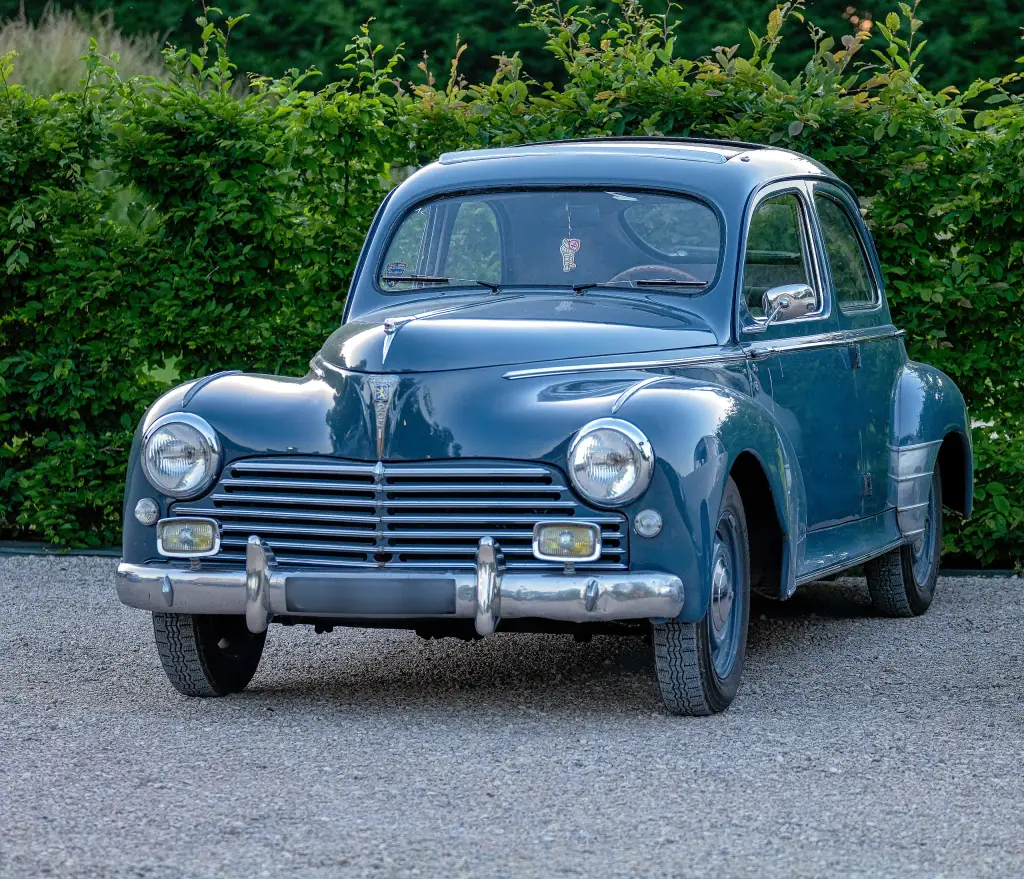
The Peugeot 203 is a small family car produced by Peugeot from 1948 to 1960. It was the company’s first new model after the Second World War and its first production car with a monocoque body, and almost 700,000 were assembled at Sochaux.
Peugeot 203 at a glance
| Production | 1948–1960 |
|---|---|
| Shown | Paris Motor Show, 1947 |
| Body | monocoque, the first on a production Peugeot |
| Engine | 1,290 cc four-cylinder TM, overhead valves, hemispherical chambers |
| Power | 42 PS at launch, 45 PS from 1952 |
| Top speed | 115 to 120 km/h |
| Gearbox | four-speed, column change; all-synchromesh from 1954 |
| Suspension | transverse leaf spring front, coil springs and Panhard rod rear |
| Wheelbase | saloon 258 cm; estate and Familiale 278 cm |
| Built at | Sochaux |
| Total built | nearly 700,000 |
History of the Peugeot 203
Launch after the war
The 203 was exhibited at the Paris Motor Show in 1947, by which time it had been under development for more than five years. Volume production was held up by strikes and material shortages, but it got under way late in 1948 and the first customers received their cars early in 1949. It was Peugeot’s first new model after the war, and between the end of the 202 in 1949 and the arrival of the 403 in 1955 it was the only model the company produced.
The body
The 203 was the first monocoque production Peugeot. Its fastback shape recalled the American Chevrolet Fleetline but also the streamlining of the 1930s, including Peugeot’s own 402. The four-door saloon was the main seller, and from 1950 Peugeot added the Commerciale estate and the six-seat Familiale with three rows of seats, both on a wheelbase lengthened by 20 cm to 278 cm. Extending the wheelbase for the estate versions set a pattern the company followed with the 404 and 504.
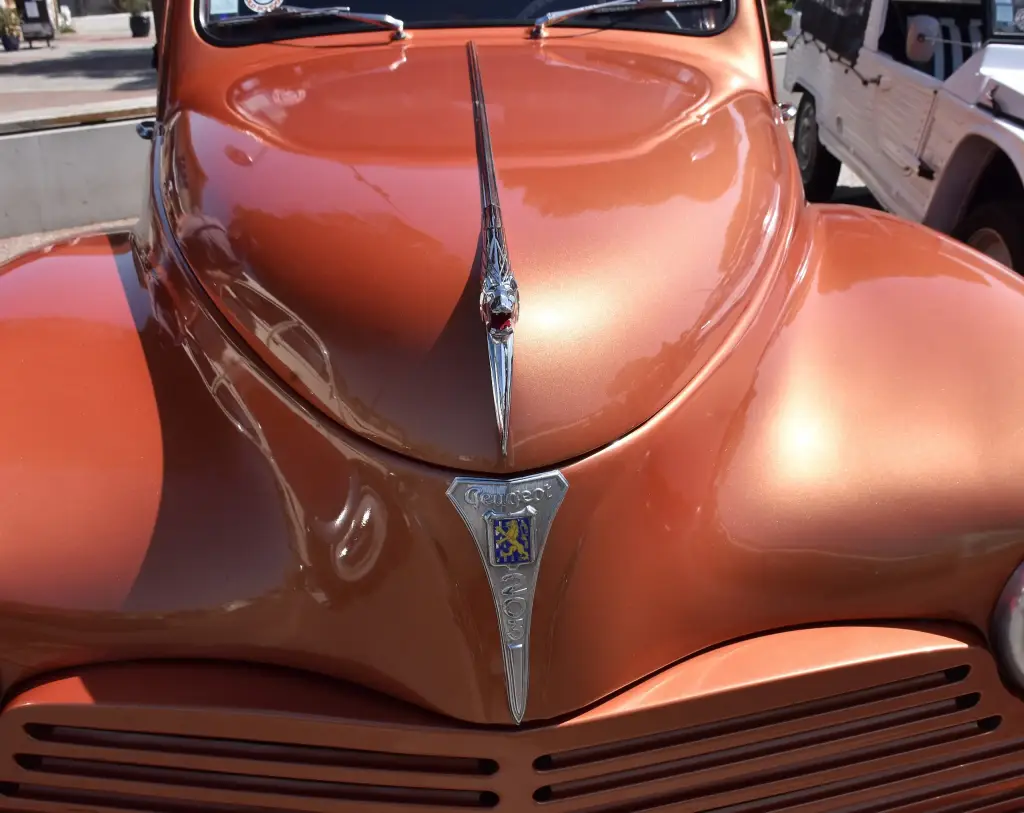
The October 1952 show brought hinged quarter lights at the front of the front doors, a larger rear window on the saloon and a speedometer moved from the centre of the dashboard to a position in front of the driver. From the 1953 show the fuel filler was sunk into the rear wing under a flush flap. A two-door coupé was added at the end of 1952 but sold poorly and left the brochures a year later. Specialists built a few cabriolets and coupés, although removing the roof from an early monocoque needed heavy strengthening. The chrome lion on the nose was dropped for 1959 on safety grounds and replaced by a flatter emblem.
Engine and chassis
Under the bonnet was the 1,290 cc four-cylinder TM engine, oversquare with hemispherical combustion chambers in a light alloy head. Power was 42 PS at launch and 45 PS from the October 1952 show, with no penalty in fuel consumption or car tax because the capacity was unchanged; the compression ratio stayed at 6.8:1. Top speed rose from 115 to 120 km/h, and the longer estates were significantly slower. Acceleration to 97 km/h took 20 seconds and consumption was 8.1 to 14.1 l/100 km.
The column-mounted change controlled a four-speed gearbox driving the rear wheels through a propeller shaft and a worm-and-wheel final drive. The most important upgrade came in March 1954 with synchromesh on all forward speeds; cars delivered between 1949 and 1954 had none on the bottom ratio. Suspension was independent at the front by transverse leaf spring, with coil springs and a Panhard rod at the rear.
Commercial success
The 203 was a hit in France. It was already advertised on the last page of the 202 brochure in October 1947, a year before it could be delivered, and there was plenty of pent-up demand when it arrived. By 1950 two hundred cars a day were leaving the line, and that year the 203 recorded 34,012 domestic sales, 19.5% of the French market and second only to the much smaller Renault 4CV. Exports followed, notably to West Germany. In early 1954 it was noted that in France the 203 lost value more slowly than any other French car on sale, thanks to a reliable and economical engine, good equipment including the sunroof and tight turning circle.
Design and features
- Monocoque body: the first on a production Peugeot.
- TM engine: 1,290 cc, hemispherical chambers, 42 then 45 PS.
- All-synchromesh (1954): a four-speed gearbox with synchromesh on every ratio.
- Long-wheelbase estate: the Commerciale and six-seat Familiale.
- Slow depreciation: the 203 held its value better than any other French car in 1954.
Peugeot 203 versions
- Saloon: the four-door berline, the main production version.
- Commerciale (1950): the estate on the lengthened wheelbase.
- Familiale (1950): six seats in three rows.
- Coupé (1952–1953): two-door version that sold badly.
- Cabriolet and coupé conversions: built in small numbers by outside specialists.
The 203 followed the Peugeot 202 and was joined by the 403 in 1955, then replaced in the range by the 404. More in the Peugeot collection.
Video: Peugeot 203
Video by on YouTube.
Sources
- Peugeot 203, English Wikipedia: production, body, engine, gearbox, sales