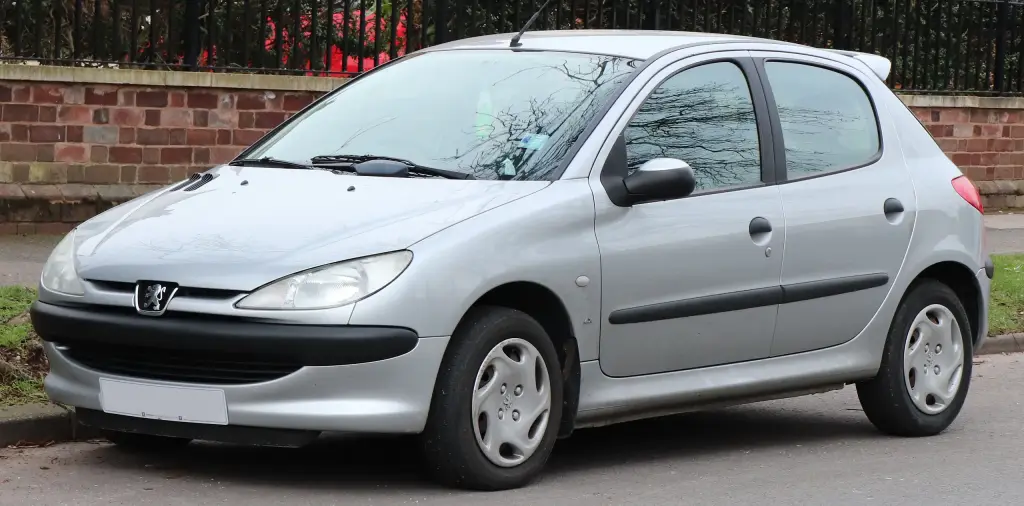
The Peugeot 206 is a supermini designed and produced by Peugeot from 1998, as the replacement for the 205. It was developed under the codename T1 and went on sale in September 1998.
Peugeot 206 at a glance
| Production | from September 1998; France until December 2012 |
|---|---|
| Project code | T1, approved 7 April 1994 |
| Design team | Murat Günak and Gérard Welter |
| Development cost | 6.3 billion francs |
| Bodies | hatchback, CC coupé cabriolet, SW estate, SD saloon |
| Launch engines | 1.1, 1.4 and 1.6 petrol, 1.9 diesel, HDi later |
| GTi (1999) | 2.0-litre, 210 km/h |
| RC (2003) | 177 PS, 220 km/h |
| Sold by 2012 | 8,358,217 |
| Plants | Poissy, Mulhouse, Ryton, and others outside Europe |
History of the Peugeot 206
Why a 206
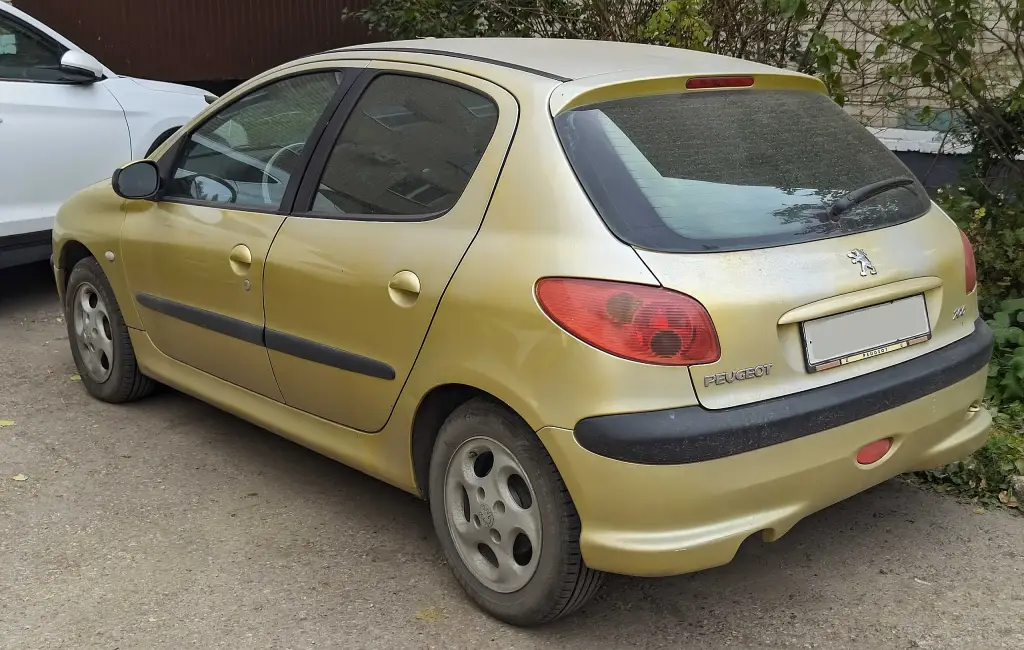
In the early 1990s Peugeot decided not to replace the 205 directly, judging that superminis were no longer profitable enough. The plan was for the smaller 106, launched in 1991, to take the bottom of the 205 range and the 306, launched in 1993, to take the top, so that the 205 could fade away. It did not work: with no direct rival to the Fiesta and Polo, Peugeot lost sales quickly, and the 206 arrived in September 1998 as a belated replacement.
On 7 April 1994 the president of Peugeot, Jacques Calvet, approved the T1 programme with a launch planned for 1997. The in-house design team was led by Murat Günak and Gérard Welter, the design was fixed six months after approval, and 34 months passed from design freeze to start of production. The programme cost 6.3 billion francs and was Peugeot’s first car designed with a digital mock-up and crash simulations; prototypes were tested at the Belchamp circuit in the Valentigney forest. With no suitable platform available inside PSA, Peugeot developed a new front-drive platform for the car.
Range and engines
The 206 was launched as a hatchback with 1.1, 1.4 and 1.6-litre petrol engines and a 1.9-litre diesel, a common-rail HDi following later. A 2.0-litre GTi capable of 210 km/h was added in 1999, and in 2003 a tuned GTi sold as the 206 RC, or GTi 180 in Britain, with 177 PS, 220 km/h and 0–100 km/h in 7.4 seconds. The 206 CC with a folding steel roof and the 206 SW estate arrived in 2001, and a four-door notchback saloon developed by Iran Khodro appeared at the end of 2005.
Production and sales
The car was built mainly at Poissy and Mulhouse until 18 December 2012, and at Ryton in Britain until that plant closed on 12 December 2006, with production moving to Slovakia. Outside Europe it was made in Iran, Chile, Argentina, Brazil, Uruguay, China, Indonesia and Malaysia. A minor facelift in 2003 brought clear headlights, different rear clusters, new side repeaters and chrome badges.
The 206 was a sales success across Europe, among the best-selling cars in Europe from 2001 to 2003 and the best-selling car in Britain for three years running between 1998 and 2001; the 1.4 XR was the most popular version. The five millionth car was built on 26 May 2005, and by 2012 sales had reached 8,358,217, the highest of any Peugeot. In 2020 Autocar listed it as the thirtieth most long-lived single-generation car.
Design and features
- New platform: an all-new PSA front-drive platform, the 106 having shared the Saxo’s.
- Digital development: the first Peugeot designed with a digital mock-up and crash simulation.
- CC roof: a folding steel roof on the coupé cabriolet from 2001.
- RC: 177 PS and 220 km/h from the tuned 2.0-litre in 2003.
- Global production: built in Europe, South America, China, Iran and elsewhere.
Peugeot 206 versions
- Hatchback (1998): three and five-door, the main body.
- 206 CC (2000): coupé cabriolet with a folding steel roof.
- 206 SW (2001): estate version.
- GTi (1999) and RC (2003): the performance models, 2.0 litres.
- 206 SD (2005): four-door saloon developed by Iran Khodro.
- 206+ (2009): the facelifted car sold in Europe as a cheaper model.
The 206 replaced the Peugeot 205 and was replaced by the 207 in 2006, which used a platform derived from the Citroën C3. More in the Peugeot collection.
Sources
- Peugeot 206, English Wikipedia: project, engines, bodies, production, sales