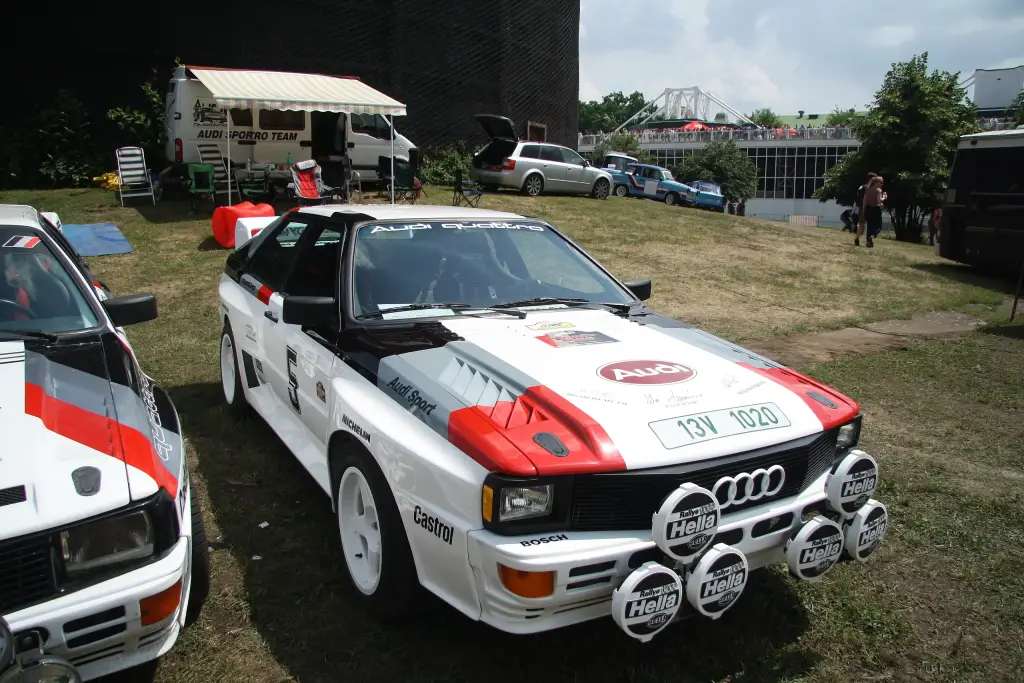
The Audi Quattro is a road and rally car that Audi presented at the Geneva Motor Show in March 1980 and built until 1991. It was the first Audi with permanent four-wheel drive and a turbocharged five-cylinder engine, and it made the quattro name famous in rallying.
Audi Quattro at a glance
| Sold | 1980 to 1991, 11,452 cars |
|---|---|
| First shown | Geneva Motor Show, 3 March 1980 |
| Also called | Ur-Quattro |
| Body | two-door coupé based on the Audi 80 Coupé |
| Engine | 2,144 cc five-cylinder turbo, 200 PS |
| 0–100 km/h | 7.1 seconds |
| Top speed | over 220 km/h |
| Later engines | 2,226 cc with 200 PS from 1987, 220 PS from 1989 |
| Rally version | 2,133 cc, 306 PS |
| Assembly | partly hand-built on a dedicated line |
| Production end | 17 May 1991 |
History of the Audi Quattro
From a military vehicle
The idea came from Audi chassis engineer Jörg Bensinger. In 1977, during winter testing in Scandinavia, he noticed that a four-wheel-drive Volkswagen Iltis military vehicle was faster than the Audi saloons he was testing. He persuaded Ferdinand Piëch to let a small team build a prototype based on the Audi 80 with a turbocharged five-cylinder engine. In 1978 this prototype, with 118 kW (160 PS), was shown to the Volkswagen board during tests in Austria, and it climbed a steep snow-covered slope on summer tyres. In February 1979 journalists including Paul Frère drove another prototype, disguised as an Audi 80, at Turrach in Austria.
1980: the launch
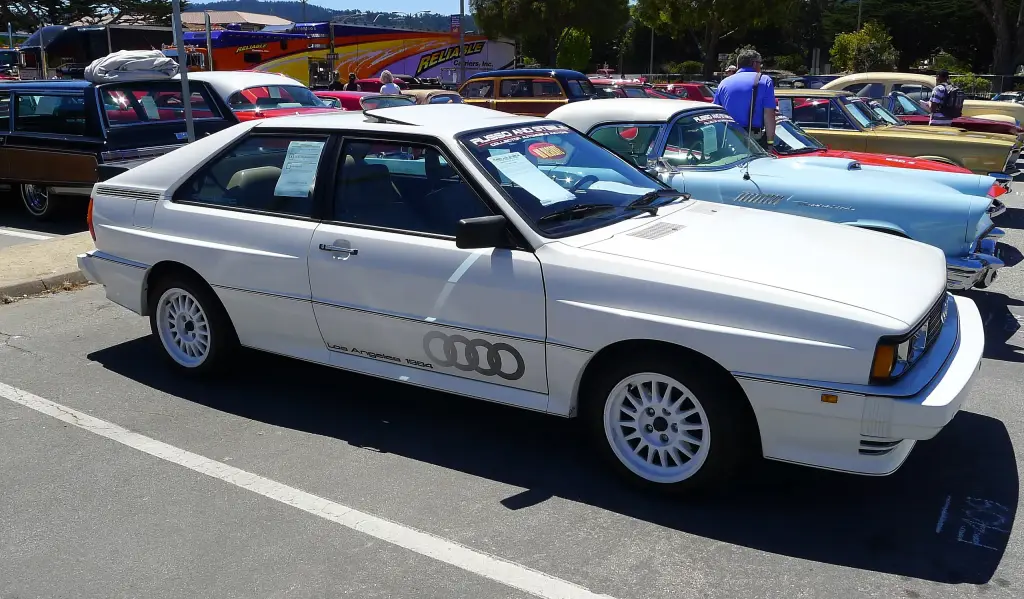
The Audi Quattro was presented at the Geneva Motor Show in March 1980 and went on sale in July. Its engine was a 2,144 cc inline five-cylinder with a single overhead camshaft, ten valves, a turbocharger and an intercooler, producing 200 PS and 285 Nm at 3,500 rpm. It reached 100 km/h in 7.1 seconds and more than 220 km/h. The permanent four-wheel-drive system used the five-speed gearbox of the Audi 100 with a hollow shaft and an additional centre differential, and it added about 75 kg. The body was based on the Audi 80 Coupé (Typ 85), with flared wheel arches styled by Martin Smith.
Changes from 1982 to 1989
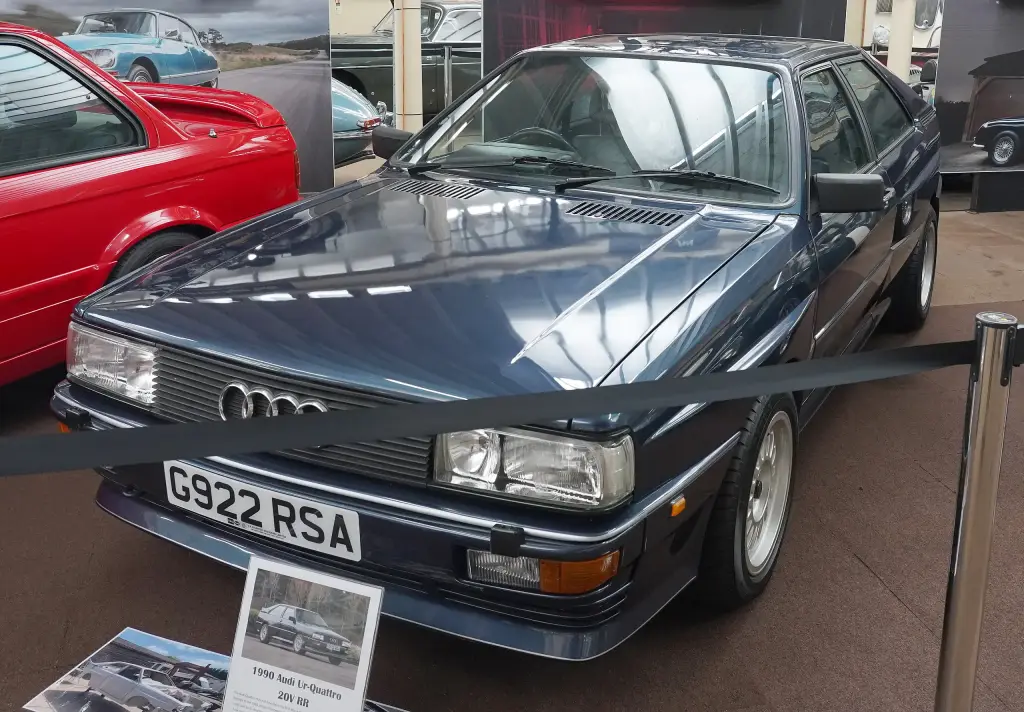
For the 1983 model year the car received wide twin headlights under glass and a digital LCD instrument cluster, which turned orange in 1988. The 1984 facelift brought a new dashboard and 8×15-inch wheels with 215/50 Pirelli P5 tyres, and the suspension was lowered by 20 mm. In 1985 the front grille became more sloping. A new 2,226 cc engine kept 200 PS in 1987, when a Torsen centre differential replaced the manual lock. In 1989 the engine gained a 20-valve cylinder head and 220 PS, raising the top speed to 230 km/h. The last original Quattro was built on 17 May 1991.
Rallying
The Quattro was the first rally car to take advantage of the new rules that allowed four-wheel drive in competition. It won events for the next two years and changed rallying for good. The competition car used a 2,133 cc engine with a 20-valve twin-cam head, a KKK K27 turbocharger at 1.03 bar and Bosch fuel injection, producing 306 PS. In September 1983 Audi presented the Sport quattro at the Frankfurt show, and in 2012 the company named the Audi Coupé S2 the official successor of the Ur-Quattro.
Design and features
- Permanent four-wheel drive: the system used a hollow shaft in the gearbox and a centre differential, and it added about 75 kg to the car.
- Turbo five-cylinder: the 2,144 cc engine with turbocharger and intercooler produced 200 PS, later 220 PS in 20-valve form.
- Digital instruments: from 1983 the Quattro had a green LCD dashboard, changed to orange in 1988.
- Torsen differential: from 1987 a Torsen centre differential replaced the manual lock and made the drive smoother.
Audi Quattro versions
- quattro 10V: the original model of 1980, 2,144 cc and later 2,226 cc, 200 PS.
- quattro 20V: the 1989 version with four valves per cylinder and 220 PS.
- Audi Sport quattro: presented at the 1983 Frankfurt show as the rally model.
- Rally car: the 2,133 cc competition version with 306 PS.
The Quattro was based on the Audi 80 Coupé and sat above the ordinary range; the four-wheel-drive idea later reached the Audi 100 and the Audi S4. More models are in our Audi collection.
Sources
- Audi Quattro, English Wikipedia: development, engines, facelifts, rally version
- Audi quattro, German Wikipedia: model history and technical details