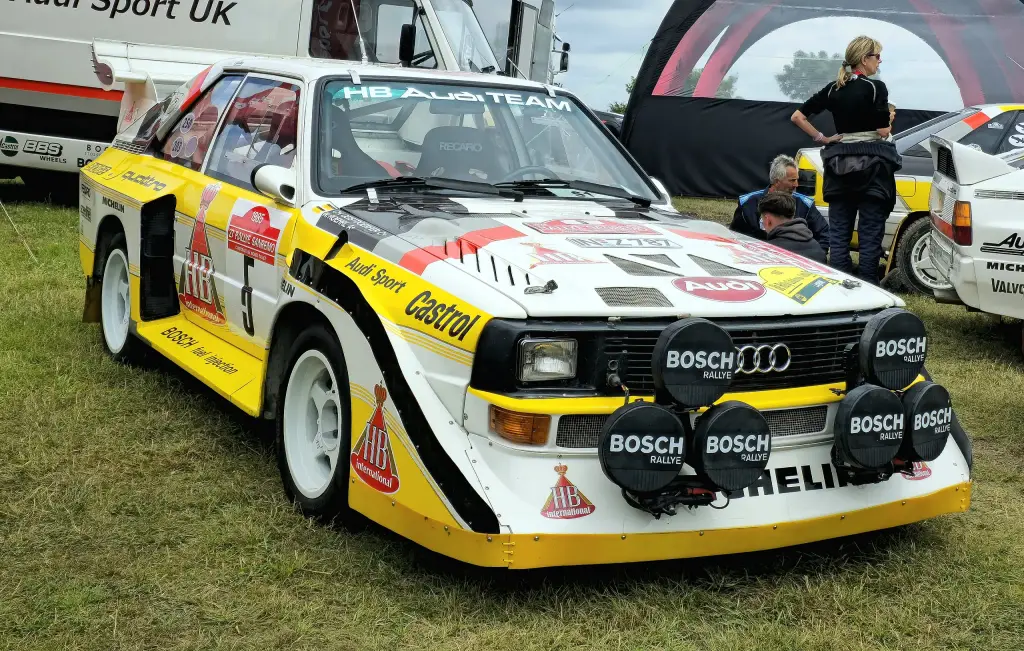
The Audi Sport quattro is the short-wheelbase version of the Audi quattro, built in 1984 and 1985 so that Audi could homologate a new rally car for Group B. It had a 306 PS turbocharged five-cylinder engine and a wheelbase 320 mm shorter than the standard quattro.
Audi Sport quattro at a glance
| Built | 1984–1985, for Group B homologation |
|---|---|
| Road cars | 220 (Italian Wikipedia gives 224) |
| Base | Audi quattro, wheelbase 320 mm shorter |
| Body | Audi 80 up to the B-pillar, Audi quattro behind it |
| Engine | 2,133 cc five-cylinder 20V turbo |
| Power | 306 PS at 6,700 rpm |
| Torque | 350 Nm at 3,700 rpm |
| 0–100 km/h | 4.8 seconds |
| Top speed | 250 km/h |
| Weight | 1,298 kg |
| Gearbox | five-speed manual |
| Price | about 180 million lire |
History of the Audi Sport quattro
Why Audi built it
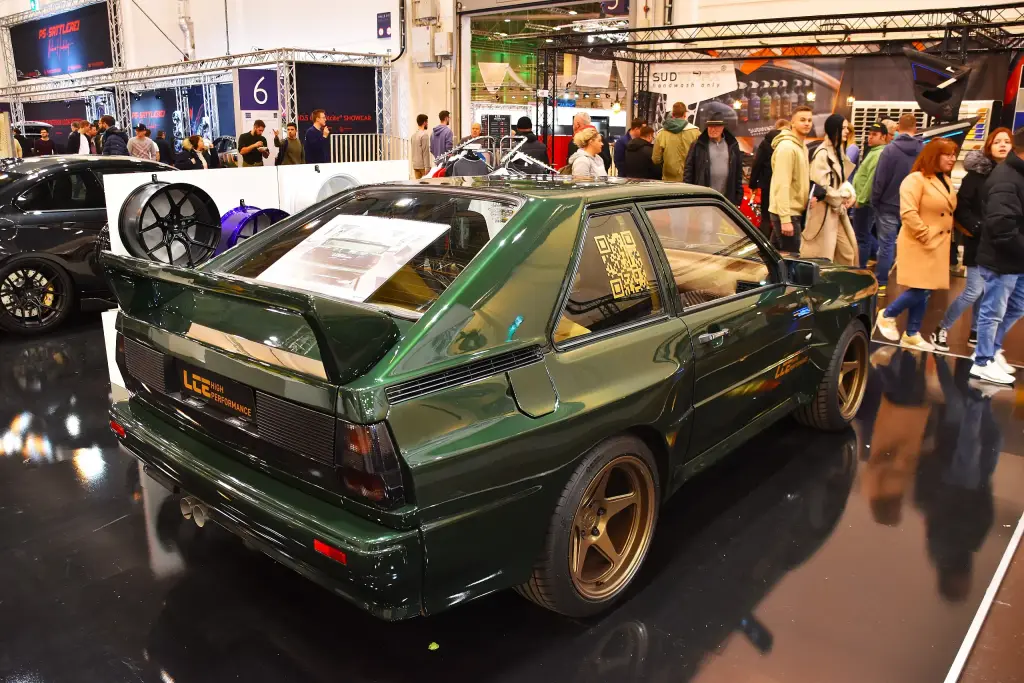
Audi entered the World Rally Championship in 1981 and won the manufacturers’ title with the quattro in 1982; in 1983 Hannu Mikkola took the drivers’ title. The competition then moved to purpose-built mid-engined cars such as the Peugeot 205 Turbo 16, which the road-based quattro could not match. Audi therefore designed a new car on a chassis cut between the B-pillar and the rear axle, 320 mm shorter than the quattro, to make it more agile on twisty stages. The Sport quattro was shown at the Frankfurt motor show in 1983, and deliveries began in December 1984.
The road car
Like the rally car it was based on the Audi 80 up to the B-pillar and on the Audi quattro behind it, with doors from the Audi 80. The front wings, roof, bonnet and bumpers were made of composite materials. The engine was the turbocharged five-cylinder reduced from 2,144 to 2,133 cc by using a smaller bore, so that with the 1.4 turbo factor of the rules it stayed under three litres; the aluminium block, the four-valve head and the fully electronic injection were new for an Audi turbo. It produced 306 PS at 6,700 rpm and 350 Nm at 3,700 rpm, with up to 2.04 bar of boost. The road car reached 100 km/h in 4.8 seconds and 250 km/h, weighed 1,298 kg, and had a five-speed manual gearbox and permanent four-wheel drive with three differentials, the centre and rear ones lockable. It cost about 180 million lire.
Rally versions
The competition Sport quattro weighed 1,090 kg and had 450 PS with a six-speed gearbox. It was followed by the Sport quattro S1 and the S1 E2, built for Group B, and a Sport quattro won the Pikes Peak hill climb in 1984 with Michèle Mouton. The rally cars competed from 1984 to 1986. Two concept cars carried the name later: a 408 PS study based on the RS5 in 2010, and the 2013 Sport quattro concept with a 700 PS hybrid powertrain.
Design and features
- Short wheelbase: 320 mm less than the Audi quattro, for agility on rally stages.
- Composite body: wings, roof, bonnet and bumpers in composite material, with steel doors from the Audi 80.
- 20-valve turbo five: 306 PS from 2,133 cc, with an aluminium block and fully electronic injection.
- Four-wheel drive: three differentials, the centre and rear ones lockable.
- Homologation special: only 220 road cars were built for Group B.
Audi Sport quattro versions
- Sport quattro road car: 306 PS, 1,298 kg.
- Sport quattro rally: 450 PS, 1,090 kg, six-speed gearbox.
- Sport quattro S1 and S1 E2: the later Group B evolutions.
- Sport quattro concept (2010): 408 PS, based on the RS5.
- Sport quattro concept (2013): 700 PS hybrid.
The Sport quattro is the short version of the Audi quattro, and its body used parts of the Audi 80. The later S2 is described in our Audi S2 article; more models are in the Audi collection.
Video: Audi Quattro S1 replica (2)
Video by Wobiste777 on YouTube.
Sources
- Audi Sport quattro, German Wikipedia: origins, body, engine, equipment and production
- Audi Sport quattro, Italian Wikipedia: road car, performance, rally versions and concepts