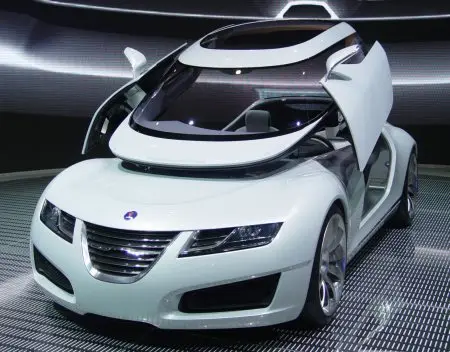
Saab Aero was the name Saab gave to the high-performance version of its models. It was introduced with the 1984 Saab 900 Aero, sold in the United States as the Special Performance Group, and the name referred to Saab’s history as an aircraft manufacturer.
Saab Aero at a glance
| Type | high-performance trim level |
|---|---|
| First model | Saab 900 Aero, 1984 model year |
| US name | Special Performance Group (SPG) |
| Usual equipment | body skirt, sport suspension, leather seats, premium stereo, air conditioning |
| Sport suspension | shorter, stiffer springs, stiffer shocks and anti-roll bars, from 1987 |
| Engines after 1985 | 16-valve units in the 900 S and 900 Turbo |
| Biggest jump | 9-7X Aero, 390 hp against 285 hp for the 4.2i |
| Smallest jump | 9-3 Aero, a slight increase in performance |
| Last Aero | 2014 Saab 9-3, built by NEVS |
Based on one source, the English Wikipedia article on Saab Aero, which covers the trim level rather than a single model. No free photographs of Aero-trim cars were available, so the previous thumbnail is kept.
History of the Saab Aero
The Aero name first appeared on the 1984 Saab 900 Aero, which was sold in the United States as the Special Performance Group, or SPG. Depending on the market and model year it brought a body skirt, a sport suspension with shorter and stiffer springs, stiffer shock absorbers and anti-roll bars from 1987, leather seats, a premium stereo and air conditioning. Most of these items could also be ordered separately from the Saab accessories catalogue, but the Aero package grouped them together.
Output varied by model year and market. After 1985 the 900 S and 900 Turbo Aero models used a 16-valve engine, while the basic 900 kept the earlier eight-valve unit. The sport suspension and the body kit gave the Aero a lower, more aggressive stance without changing the basic body shell.
Every model that Saab released after the 900 was offered with an optional Aero trim, and the amount of extra performance varied widely. Some modern Aero cars, such as the Saab 9-3, gained only a slight increase; others changed character completely, as with the Saab 9-7X Aero, whose 6.0-litre V8 produced 390 hp against 285 hp for the base 4.2i.
The last Aero was the 2014 Saab 9-3, built by the holding company NEVS after Saab Automobile itself had gone bankrupt. It was the last Saab-branded vehicle produced by that company, and it closed a line that had run for thirty years from the 900 Aero of 1984.
Design and features
- Aircraft heritage: the name refers to Saab’s history as an aircraft maker.
- Grouped equipment: body skirt, sport suspension, leather and a premium stereo in one package.
- 16 valves: after 1985 the Aero versions of the 900 S and 900 Turbo used a 16-valve engine.
- Wide range of performance: from a slight gain on the 9-3 to 390 hp in the 9-7X Aero.
Saab Aero versions
- 900 Aero / SPG (1984–): the first Aero, with a body skirt and sport suspension.
- Aero versions of later models: optional on every Saab released after the 900.
- 9-7X Aero: 6.0-litre V8 with 390 hp, the biggest jump over the standard car.
- 2014 9-3 Aero: the last Aero model, assembled by NEVS.
The first Aero was based on the Saab 900, and the name was later used on the Saab 9-3, Saab 9-5 and Saab 9-7X. More cars are in the Saab collection.
Video: Top Gear SAAB 9-5 Aero
Video by the uploader on YouTube.
Sources
- Saab Aero, English Wikipedia: history of the trim, equipment, examples