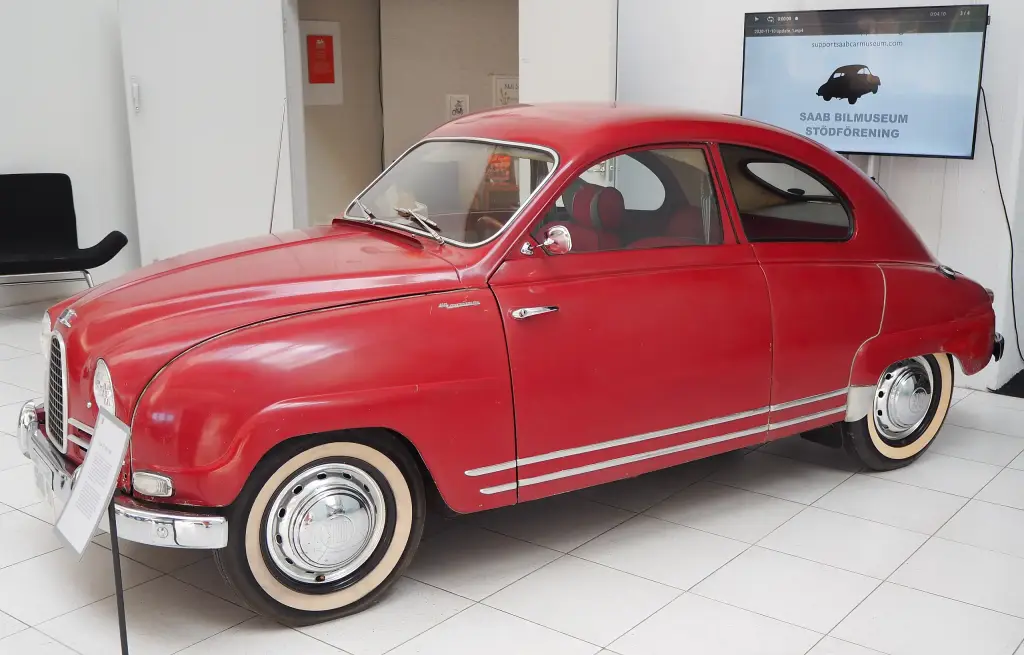
The Saab Granturismo was a series of more powerful versions of Saab’s small cars sold from 1958 to 1968. The name was used for the GT750 based on the Saab 93, then for the Sport and Monte Carlo models based on the Saab 96, and finally for a Monte Carlo with the Ford V4 engine.
Saab Granturismo at a glance
| Sold | 1958–1968 |
|---|---|
| Also called | Monte Carlo, Sport |
| First model | Granturismo 750, shown in New York in 1956 |
| Based on | Saab 93, then Saab 96 |
| GT750 engine | 748 cc two-stroke, 50 hp |
| Competition kit | 57 hp with twin carburettors |
| Sport engine (1962) | 841 cc, one Solex per cylinder, 57 hp |
| Monte Carlo 850 (1966) | 60 hp from 1965 |
| Monte Carlo V4 (1967) | Ford Taunus V4, 65 hp |
| GT750 built | 600 in 1958 and 1959 |
| Marking | twin metal stripes along the rocker panels |
Based on one source, the English Wikipedia article on the Granturismo.
History of the Saab Granturismo
The Granturismo 750 was a performance version of the Saab 93, introduced at the New York International Auto Show in 1956 and produced until 1960. It differed from the standard car by a wood-rim steering wheel, a Halda Speedpilot timing device for rallying, sport seats, driving lamps and metal trim along the rocker panels. Rear-hinged doors were offered for the 1958 model year only. Of the 600 Granturismo 750s built in 1958 and 1959, 546 were exported to the United States.
Its two-stroke engine had a compression ratio of 9:1, a two-barrel Solex carburettor, a tuned exhaust and twin fuel pumps, giving 50 hp, or 57 hp with the optional twin-carburettor Saab Competition kit. Power arrived high up the rev range, between 3400 and 5000 rpm, and lubrication came from oil mixed with the petrol at three percent. The gearbox had three speeds and a freewheel device protected the engine when it was running faster than the throttle demanded.
For 1960 and 1961 the Granturismo 750 was built on the Saab 96, the car with which Erik Carlsson won three RAC rallies in 1960. This version had a four-speed transmission with freewheeling, chrome wheel trim and venting rear quarter windows. In 1962 it was succeeded by the Saab Sport, also based on the 96, with an 841 cc three-cylinder engine using one Solex carburettor per cylinder for 57 hp. The Sport used oil injection from a separate tank instead of pre-mixed fuel, had front disc brakes at a time when these were rare, and used stronger four-stud wheels instead of the 96’s five-stud items.
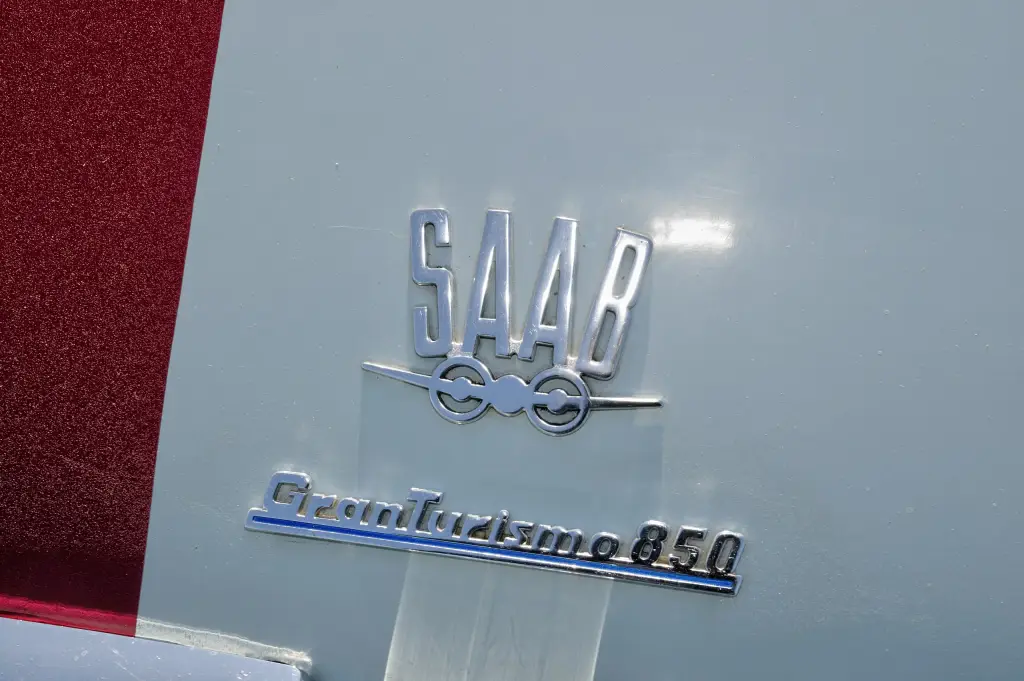
From 1963 the version sold in the United States was called the Granturismo 850. Power rose to 60 hp for the 1965 model year, and from 1966 every market used the name Monte Carlo 850, after Saab’s successes on the Monte Carlo Rally. During the 1967 model year the two-stroke cars were phased out and replaced by the Monte Carlo V4 with the 65 hp Ford Taunus V4 engine. Production ended in 1968.
Design and features
- Rocker-panel stripes: twin metal strips distinguished most Granturismo versions from standard cars.
- Rally equipment: a Halda Speedpilot, sport seats and driving lamps on the GT750.
- Two-stroke tuning: higher compression, twin carburettors and twin fuel pumps for up to 57 hp.
- Front disc brakes: fitted to the 1962 Sport, unusual for a small car of the time.
Saab Granturismo versions
- Granturismo 750 on the 93 (1958–1960): 50 hp, 600 built in 1958–59.
- Granturismo 750 on the 96 (1960–1961): four-speed gearbox with freewheeling.
- Sport (1962–1965): 841 cc engine with one carburettor per cylinder and oil injection.
- Granturismo 850 (1963–1965, US): the American name for the Sport.
- Monte Carlo 850 (1966) and Monte Carlo V4 (1967–1968): the final two-stroke and the Ford-engined version.
The Granturismo was based on the Saab 93 and the Saab 96, and its engine was shared with the Saab Sonett. More cars are in the Saab collection.
Video: Saab GT 750
Video by the uploader on YouTube.
Sources
- Saab Granturismo, English Wikipedia: versions, engines, equipment, production