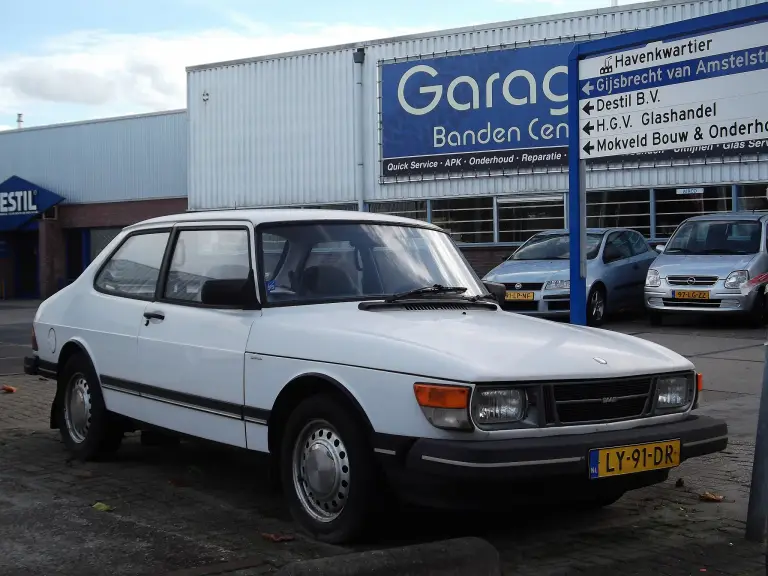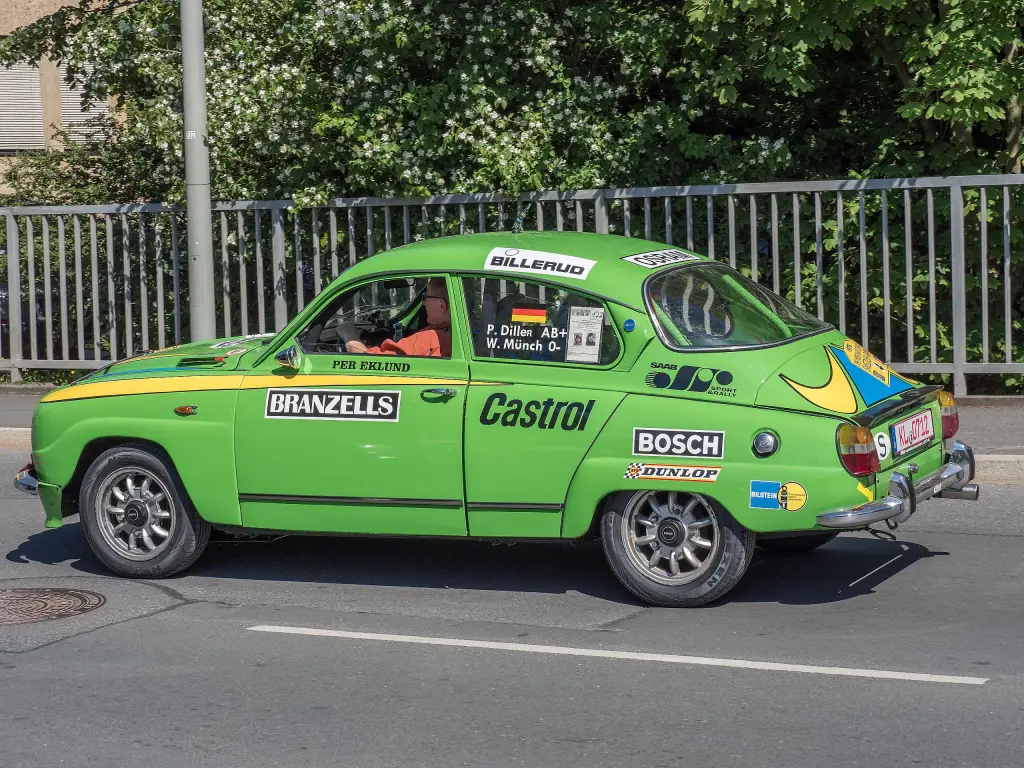
The Saab 96 was built from 1960 to January 1980 and replaced the Saab 93. It kept the aerodynamic two-door body and the three-cylinder two-stroke engine at first, then adopted a four-stroke Ford V4 in 1967 after a development programme carried out in secrecy.
Saab 96 at a glance
| Production | 1960–January 1980 |
|---|---|
| Replaced | Saab 93 |
| Body | two-door, four seats |
| Two-stroke engine | 841 cc three-cylinder, 38 PS, later 40 and 42 PS |
| Sport version | 52 PS with triple carburettors |
| V4 from 1967 | Ford Taunus 1498 cc, 65 PS |
| 96L (1976) | 62 PS for Swedish emissions rules |
| V4 super (1977–1980) | 68 PS |
| 0–100 km/h | 16 seconds with the V4 |
| Gearbox | three-speed at first, four-speed later |
| Code name | Operation Kajsa |
Based on one source, the English Wikipedia article on the 96.
History of the Saab 96
The 96 replaced the 93 in 1960 and kept its basic layout: an aerodynamic two-door body with four seats, a longitudinally mounted engine and front-wheel drive. Compared with the 93 it offered more storage space, a larger rear window and easier access to the boot. The front end was lengthened for the 1965 models in preparation for a new engine, and the radiator moved ahead of the engine; both windscreens grew slightly for 1968.
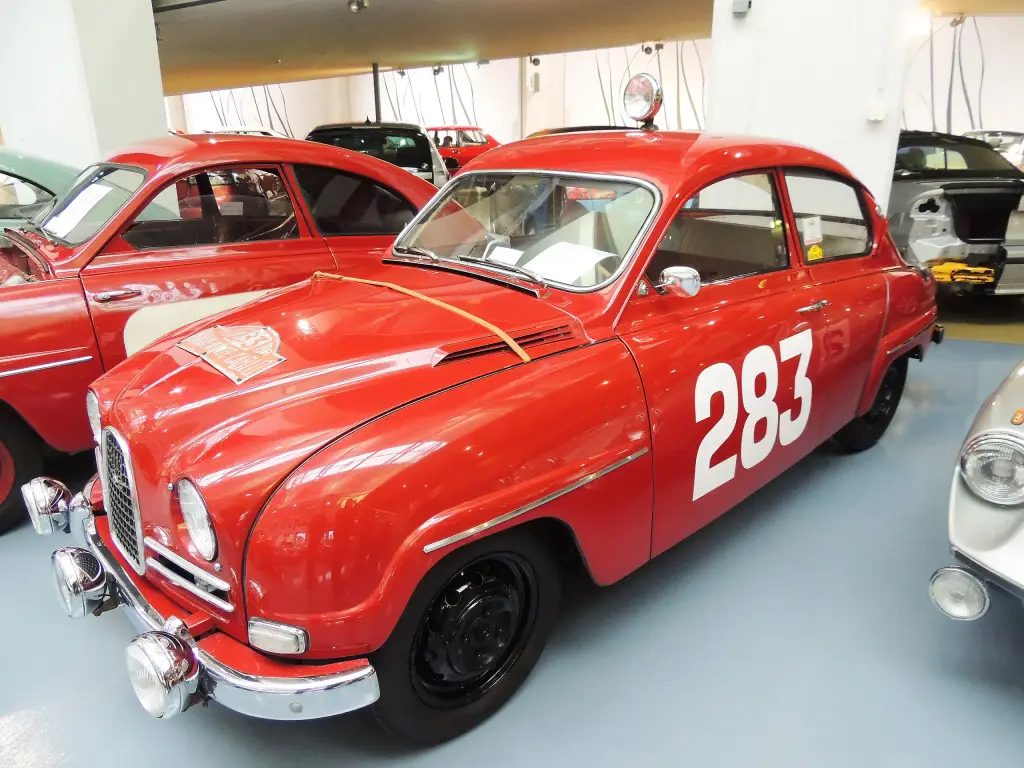
At first the car had an 841 cc three-cylinder two-stroke engine of 38 PS, raised to 40 PS by 1965. A 52 PS version with triple carburettors and oil injection was used in the Sport and Monte Carlo models, and for 1966 the standard engine received a three-throat Solex carburettor that raised output to 42 PS. Because a two-stroke needs oil mixed with its fuel and can starve on a closed throttle, the car had a freewheel device, and the gearbox was controlled by a column-mounted lever.
By the mid-1960s Saab had decided that a four-stroke engine was necessary. The project was called Operation Kajsa and was carried out in great secrecy: Rolf Mellde went around the chief executive to win backing from the Wallenberg family, engineers tested engines from Volvo, Ford, Triumph, Lancia, Opel, Volkswagen and Hillman, and the Ford V4 was chosen because it was almost as reliable as the Volvo B18 but far easier to fit. A front company called Maskinverktyg AB bought the V4-specific parts, and five months before production only seven people knew about the new engine.
The 96 V4 went on sale in 1967 with the 1498 cc Ford Taunus V4, originally developed for the Ford Taunus 15M, producing 65 PS. The two-stroke remained available until 1968. For the Swedish 1976 model year the car, now called the 96L, was reduced to 62 PS to meet new emission rules, but the 1977–1980 cars had 68 PS from a two-stage Solex carburettor and were badged V4 super. In the United States the two-stroke was marketed as the Shrike in 1967 and 1968, its capacity cut to 795 cc to stay under the emissions exemption limit, while American V4 cars used a 1500 cc high-compression engine of 73 hp, replaced in 1971 by a 1700 cc low-compression unit. The 96 and 95 left the American market after 1973.
Design and features
- Two-stroke to four-stroke: the switch to a Ford V4 in 1967, developed in secret as Operation Kajsa.
- Freewheel: protects the two-stroke engine when the throttle is closed.
- Aerodynamic body: a two-door shape carried over from the 93 and refined over two decades.
- V4 super: the final 68 PS version built from 1977 to 1980.
Saab 96 versions
- 96 two-stroke (1960–1968): 841 cc engine from 38 to 42 PS.
- 96 Sport / Monte Carlo: 52 PS with triple carburettors and oil injection.
- 96 V4 (1967–1976): 1498 cc Ford V4 with 65 PS.
- 96L (1976): 62 PS for Swedish emission regulations.
- 96 V4 super (1977–1980): 68 PS with a two-stage Solex carburettor.
The 96 replaced the Saab 93 and shared its engine and floorpan with the Saab 95 estate and the Saab Sonett. Its sporting version is covered by the Saab Granturismo article. More cars are in the Saab collection.
Video: Saab 96 1964 two stroke
Video by the uploader on YouTube.
Sources
- Saab 96, English Wikipedia: engines, Operation Kajsa, US market