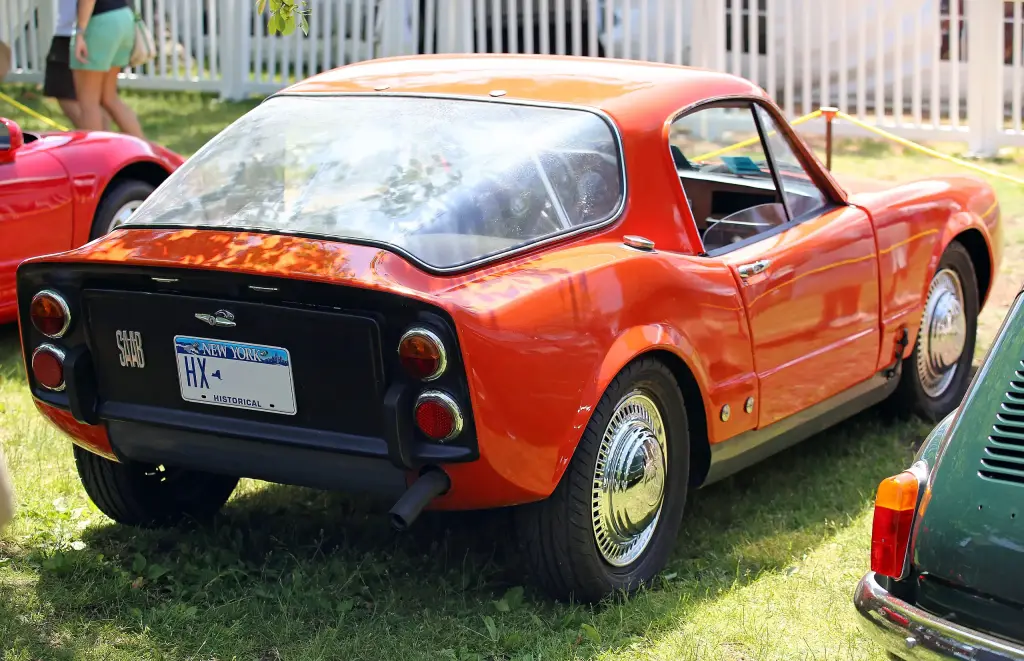
The Saab Sonett was a two-seat sports car made by Saab between 1955 and 1957 and again between 1966 and 1974. It shared its engines and mechanical parts with the Saab 93, 95 and 96, and it was aimed mainly at the American export market.
Saab Sonett at a glance
| Built | 1955–1957 and 1966–1974 |
|---|---|
| Type | two-seat sports car |
| Shared parts with | Saab 93, 95 and 96 |
| Main market | United States |
| Sonett I | roadster prototype, 1955–1957 |
| Sonett I engine | 748 cc two-stroke, 57.5 PS |
| Sonett I weight | 600 kg |
| Sonett I chassis | riveted aluminium stressed skin, under 70 kg |
| Sonett I built | six cars, all right-hand drive |
| Sonett II | shown in 1966, internal model 97 |
| Sonett V4 | Ford Taunus V4 from mid-1967 |
| Last version | Sonett III, produced until 1974 |
Based on one source, the English Wikipedia article on the Sonett; the article describes the first two generations in most detail.
History of the Saab Sonett
The first Sonett grew out of a private project. In the 1950s Rolf Mellde, a Saab engine developer and racing enthusiast, worked with Lars Olov Olsson, Olle Lindkvist and Gotta Svensson on a two-seat roadster prototype in a barn in Åsaka near Trollhättan. The project had a budget of only 75,000 Swedish kronor and was first known as the Saab 94; the designer Sixten Sason renamed it Sonett after the Swedish phrase “Så nätt den är”, meaning roughly “how neat it is”.
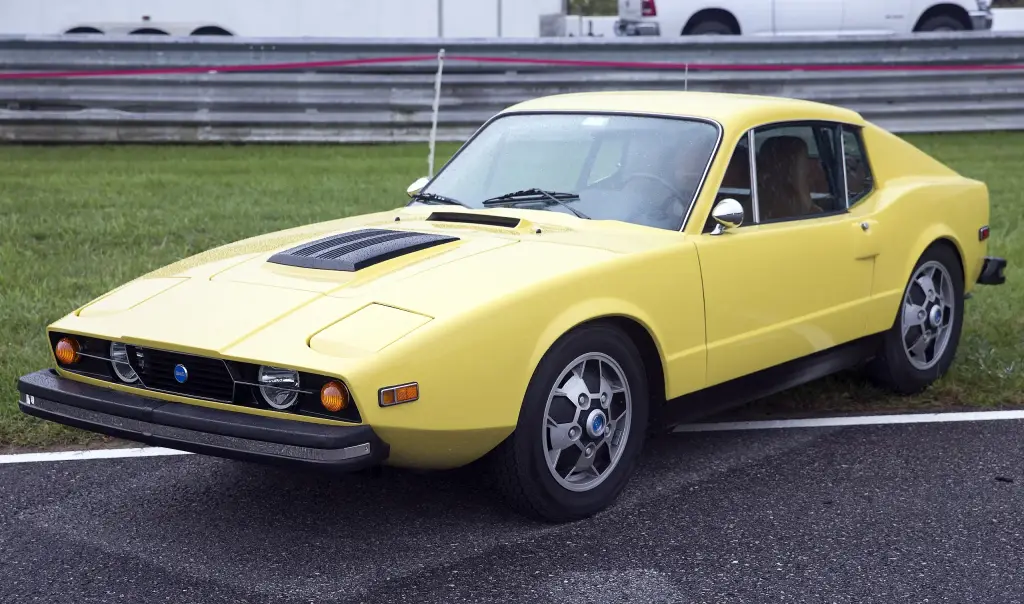
Instead of a tubular frame, Mellde chose a stressed-skin aluminium chassis weighing less than 70 kg, with the metal sections riveted together in the manner of aircraft construction, and a glass-reinforced plastic body made by a Gothenburg plastics company. The engine and gearbox came from the Saab 93 and were rotated 180 degrees to sit behind the front axle, which required reversing the engine’s rotation, something easily done with a two-stroke. The Sonett I was shown on 16 March 1956 at the Stockholm motor show with a 748 cc three-cylinder engine of 57.5 PS and a weight of 600 kg.
A production run of 2,000 cars was planned for 1957, and a top speed of 190 km/h was projected, but the competition rules changed to allow modified production cars into the classes Saab had aimed at, and the project lost its point. Only six cars were built between 1955 and early 1957, all right-hand drive, and Saab management cancelled the model in early 1958 in favour of the GT750 version of the Saab 93. In 1996 Erik Carlsson set a Swedish record for the under-750 cc class at 159.4 km/h in the restored first prototype.
The name returned in the 1960s, when Saab’s North American dealers persuaded the company that a sports car was needed to compete with MG and Triumph. Two proposals were built: the MFI13 by Malmö Flygindustri, designed by Björn Karlström with the engineer Walter Kern, and the Saab Catherina by Sixten Sason. Management chose the MFI13, which after modifications was shown at the 1966 New York and Geneva shows and put into limited production as the Sonett II, known internally as model 97 and built at Arlöv in Sweden.
The Sonett II used a two-stroke engine at first, but emissions rules made it uncompetitive in the United States, and in the middle of the 1967 production year Saab switched to the Ford Taunus V4 and renamed the car the Sonett V4. The two versions share most components; the V4 can be recognised by the bulge in its bonnet, needed to clear the taller engine, and it had a strengthened chassis, revised suspension and wheels half an inch wider. The final Sonett III remained in production until 1974.
Design and features
- Aircraft construction: the Sonett I used a riveted aluminium stressed-skin chassis weighing under 70 kg.
- Fibreglass body: a lightweight glass-reinforced plastic shell on the early car.
- Two-stroke engines: shared with the Saab 93 and 96, including the 57.5 PS unit of the Sonett I.
- Ford V4: from mid-1967 the Sonett V4 used the four-stroke Taunus engine, recognisable by its bonnet bulge.
Saab Sonett versions
- Sonett I (1955–1957): six lightweight roadsters, all right-hand drive.
- Sonett II (1966–1967): the production coupé with a two-stroke engine, model 97.
- Sonett V4 (1967–1970): Ford Taunus V4 engine and a modified bonnet.
- Sonett III (1970–1974): the final version, built until 1974.
The Sonett shared its engines with the Saab 93 and Saab 96, and its sporting engines with the Saab Granturismo. More cars are in the Saab collection.
Video: 1974 Saab Sonett 3 First Drive
Video by the uploader on YouTube.
Sources
- Saab Sonett, English Wikipedia: history of Sonett I and II, engines