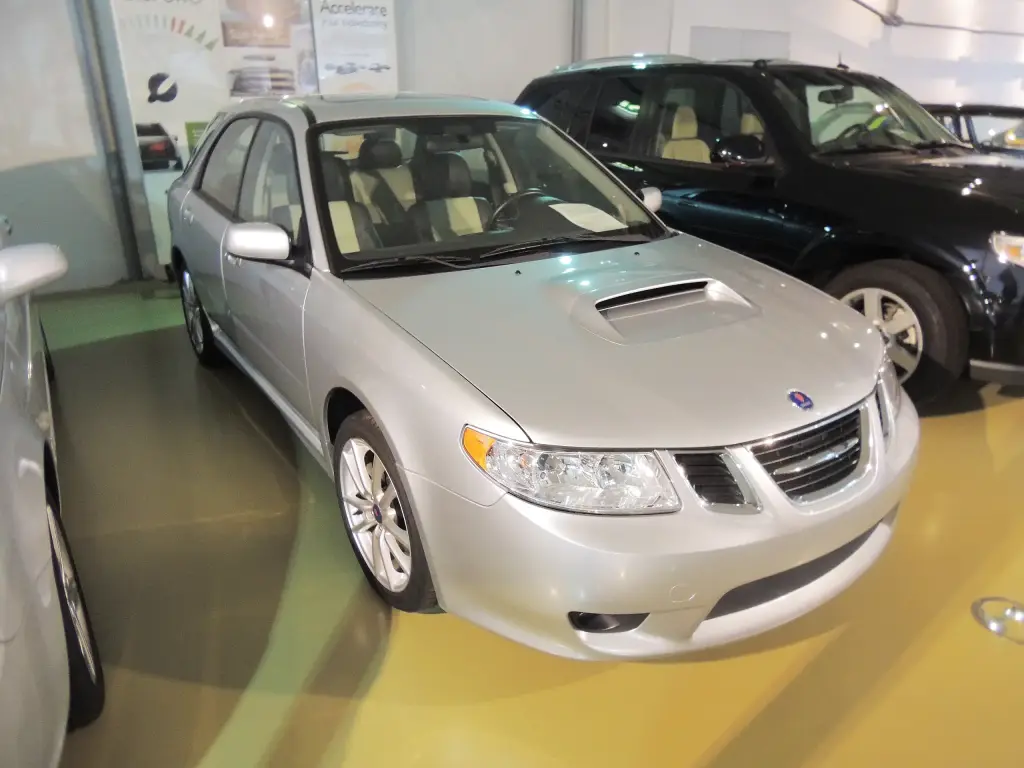
The Saab 9-2X was a compact estate car sold by Saab in North America from 2004 to 2006. It was based on the second-generation Subaru Impreza wagon, built alongside it by Fuji Heavy Industries in Japan, and became known as the “Saabaru” because so much of the Subaru remained underneath.
Saab 9-2X at a glance
| Maker | Saab Automobile, built by Fuji Heavy Industries |
|---|---|
| Production | 2004–2006 |
| Assembly | Ota, Gunma, Japan |
| Based on | Subaru Impreza station wagon, second generation |
| Market | United States and Canada only |
| Unveiled | Los Angeles Auto Show, December 2003 |
| On sale | 1 July 2004 |
| Drive | permanent all-wheel drive, standard |
| Engines | 2.5-litre flat four, 165 PS; 2.0-litre turbo, 227 PS |
| 2006 engines | 2.5i, 173 PS; 2.5 turbo, 230 PS |
| Gearbox | five-speed manual or four-speed automatic |
| Nickname | Saabaru |
The English Wikipedia article on the 9-2X redirects to the Subaru Impreza; this page is based on the German and Italian articles on the 9-2X.
History of the Saab 9-2X
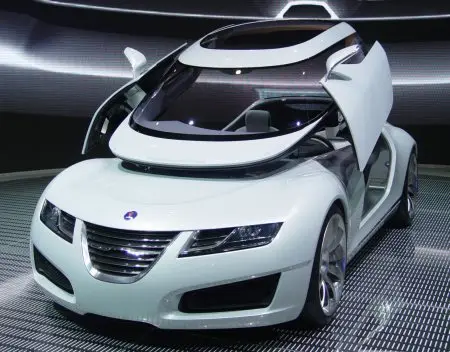
By the early 2000s General Motors owned a stake in Subaru, and Saab needed a smaller, cheaper model for the United States. The solution was to take the second-generation Subaru Impreza station wagon and give it a Saab face. The show car appeared at the Los Angeles Auto Show in December 2003, and the production car went on sale in the United States and Canada on 1 July 2004.
Only the passenger cell and the doors were carried over unchanged. The wings, bonnet, tailgate, lights and bumpers were restyled for Saab, and the work was done under the design director Michael Mauer by the Swedish designer Ola Granlund. The interior kept the Subaru layout but gained different materials, Saab’s active head restraints, thicker carpet and extra sound insulation. The car ended up 10 centimetres shorter than the Impreza wagon it was derived from.
The chassis was retuned as well: different front suspension settings and dampers, aluminium rear suspension arms, a new anti-roll bar and a quicker steering rack with a 15:1 ratio instead of Subaru’s 16.5:1. The 9-2X was the first Saab with permanent all-wheel drive and the first with a boxer engine. Two versions were offered at launch: the 2.5i with a naturally aspirated 2.5-litre flat four of 165 PS, and the Aero with a 2.0-litre turbocharged flat four of 227 PS, a limited-slip rear differential and a five-speed manual or four-speed automatic gearbox.
Sales never met expectations, and production ended with the 2006 model year, at the same time as the cooperation between General Motors and Subaru came to an end. The 9-2X was never officially sold in Europe, including Sweden.
Design and features
- Subaru underneath: the 9-2X shares its floorpan, engines and all-wheel-drive system with the Impreza wagon.
- Saab on top: new wings, bonnet, bumpers, lights and tailgate, plus a Saab grille and spoiler.
- Quieter cabin: extra sound insulation, thicker carpet and Saab active head restraints.
- Quicker steering: a 15:1 rack in place of the Impreza’s 16.5:1.
Saab 9-2X versions
- 2.5i: naturally aspirated 2.5-litre flat four, 165 PS and 225 Nm.
- Aero: 2.0-litre turbo flat four, 227 PS and 294 Nm, with a limited-slip rear differential.
- 2006 range: the 2.5i rose to 173 PS and a 2.5-litre turbo of 230 PS replaced the 2.0-litre unit.
The 9-2X sat below the Saab 9-3 in the American range, and it shared its showroom with the larger Saab 9-7X SUV. More cars are in the Saab collection.
Video: Jim’s Saab 92x Aero
Video by the uploader on YouTube.
Sources
- Saab 9-2X, German Wikipedia: production, engines, market
- Saab 9-2X, Italian Wikipedia: design, chassis changes, engines
- Subaru Impreza (second generation), English Wikipedia: platform and background