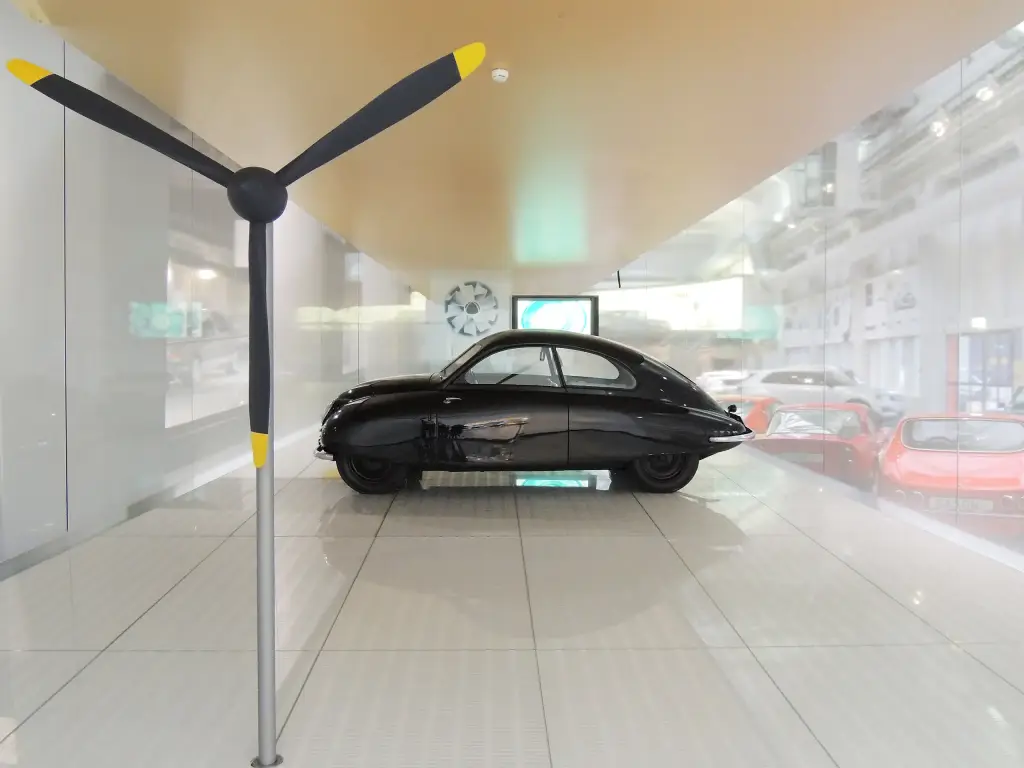
The Ursaab, also known as 92001, was the first of four prototype cars built by Saab, then an aircraft manufacturer. Developed from 1945 by a team led by Gunnar Ljungström and the designer Sixten Sason, it led directly to the Saab 92 of 1949 and is now in the Saab museum in Trollhättan.
Saab Ursaab at a glance
| Also known as | 92001, X9248 |
|---|---|
| Project started | 1945 |
| Internal name | X9248, then Project 92 |
| Team | 16 people, led by Gunnar Ljungström |
| Designer | Sixten Sason |
| Prototypes | 92001 to 92004, four cars |
| Wheelbase | 2.75 metres |
| Length | 4.5 metres |
| Target weight | 800 kg |
| Drag coefficient | 0.30 |
| Engine | transverse two-stroke, front-wheel drive |
| Target price | 3,200 Swedish kronor |
Based on one source, the English Wikipedia article on the Ursaab.
History of the Saab Ursaab
Saab began work on a car in 1945 under the internal name X9248. The project became formally known as Project 92, because 92 came next in the production sequence after the Saab 91 Safir, a single-engine trainer aircraft. The aim was a car that could compete with small German models such as the Opel Kadett, Volkswagen Beetle, DKW and Adler, at a target price of 3,200 Swedish kronor.
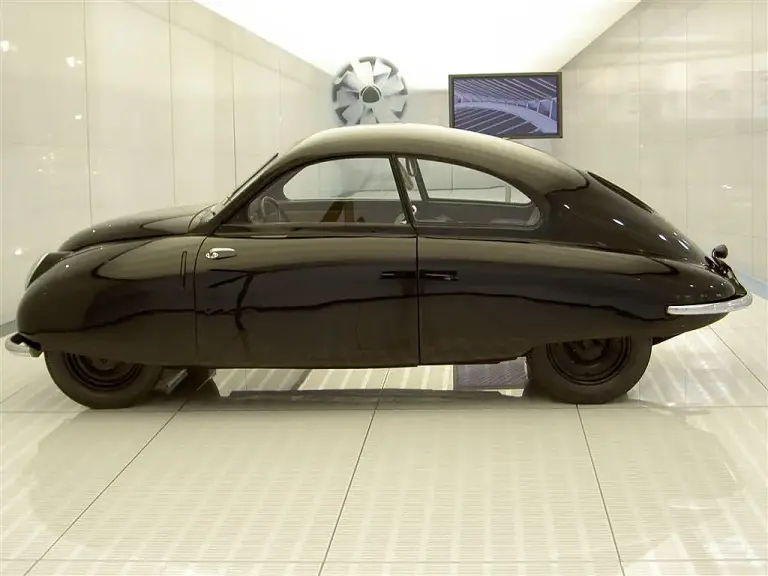
Bror Bjurströmer, head of the design department, produced a 1:25 scale sketch and the overall specification: a wheelbase of 2.75 metres, a total length of 4.5 metres, a monocoque body, 50 percent less drag than other cars, a maximum weight of 800 kg, a transverse two-stroke engine and front-wheel drive. Rear-hinged doors were chosen by Gunnar Ljungström to reduce the risk of damaging them while driving out of a garage.
The work was done in Linköping by a team of 16 under Ljungström and Sason. None of them had built a car before, and only two of the sixteen had a driving licence. They visited a Swedish body builder and bought cars to study, among them a DKW, a Hanomag, an Opel Kadett and a Volkswagen, and much of the manufacturing process had to be learned from scratch. Because they came from aircraft work, where every opening is covered by a load-bearing hatch, they kept the rear window as small as possible and left the body without a boot lid to preserve stiffness.
A full-size mock-up in alder wood was built in the spring of 1946 and coloured black with shoe polish. The steel body was hand-beaten on a wooden jig, and the first prototype body was ready by the summer of 1946; shaping was done in a secret factory 30 metres below ground. A row over the colour, black or blue, ended when it turned out the workshop had already bought black paint, and the painting was done by the Swedish railway works at Arlöv. The first engine was a borrowed 18 hp two-cylinder two-stroke from a DKW, later replaced by an engine and gearbox designed by Ljungström and cast by Albinmotor.
The Ursaab was driven more than 530,000 kilometres, usually in secrecy on narrow forest roads early in the morning or late at night. Four prototypes were built, 92001 to 92004, before the production Saab 92 was designed in 1949. The name Ursaab means “original Saab”.
Design and features
- First Saab car: built by a team with no car-making experience, only two of whom could drive.
- Aerodynamics: a target drag coefficient of 0.30, remarkable even today.
- Aircraft thinking: a monocoque body with a tiny split rear window and no boot lid to keep it stiff.
- Front-wheel drive: with wide wheel arches so snow would not block the wheels.
Saab Ursaab versions
- Ursaab / 92001: the first prototype, now in the Saab museum.
- 92002 to 92004: the three further prototypes built before the Saab 92.
The Ursaab led to the Saab 92, and its chassis ideas were tested again in the widened Saab Paddan before the Saab 99. More cars are in the Saab collection.
Video: Ursaab, the original Saab
Video by the uploader on YouTube.
Sources
- Saab Ursaab, English Wikipedia: project, specification, construction