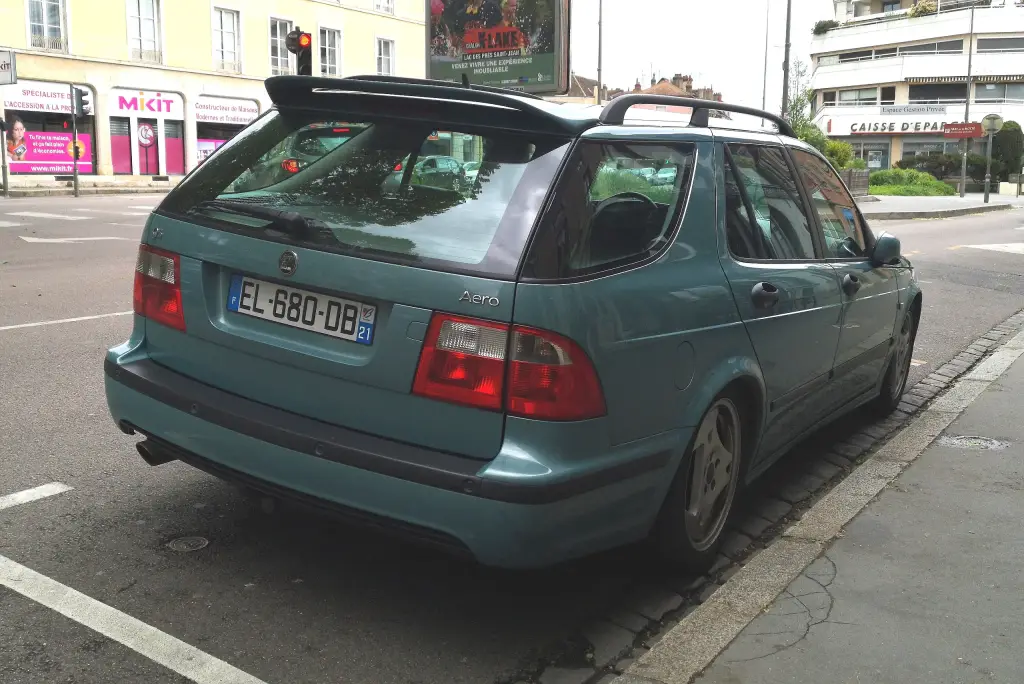
The Saab 9-5 was Saab’s executive car from 1997 to 2012. The first generation replaced the Saab 9000, was offered as a sedan and later as a wagon, and became the last big Saab developed under General Motors. The second generation lasted only two years before the company was liquidated.
Saab 9-5 at a glance
| Production | 1997–2012, two generations |
|---|---|
| First generation | 1997–2010, YS3E |
| Bodies | four-door sedan and station wagon |
| Wagon launched | 1999 |
| Drag coefficient | 0.29 sedan, 0.31 wagon |
| Engines | 2.0 and 2.3 turbo fours, 3.0 V6 turbo, diesels |
| V6 turbo | asymmetrical turbocharger, 1999–2003, automatic only |
| Gearbox | five-speed manual, four- then five-speed automatic |
| First-generation total | 483,593 cars |
| Second generation | presented 15 September 2009, built 2010–2012 |
Based on one source, the English Wikipedia article on the 9-5.
History of the Saab 9-5
The 9-5 arrived in 1997 for the 1998 model year and replaced the Saab 9000. Saab badged it as the 95 but always advertised it as the 9-5, pronounced “nine five”, to avoid confusion with the old two-stroke Saab 95. The car was a front-wheel-drive executive saloon with a drag coefficient of 0.29, and from 1999 it was also sold as a station wagon with floor tracks, a sliding load floor and a drag coefficient of 0.31. It was the first production car with ventilated seats.
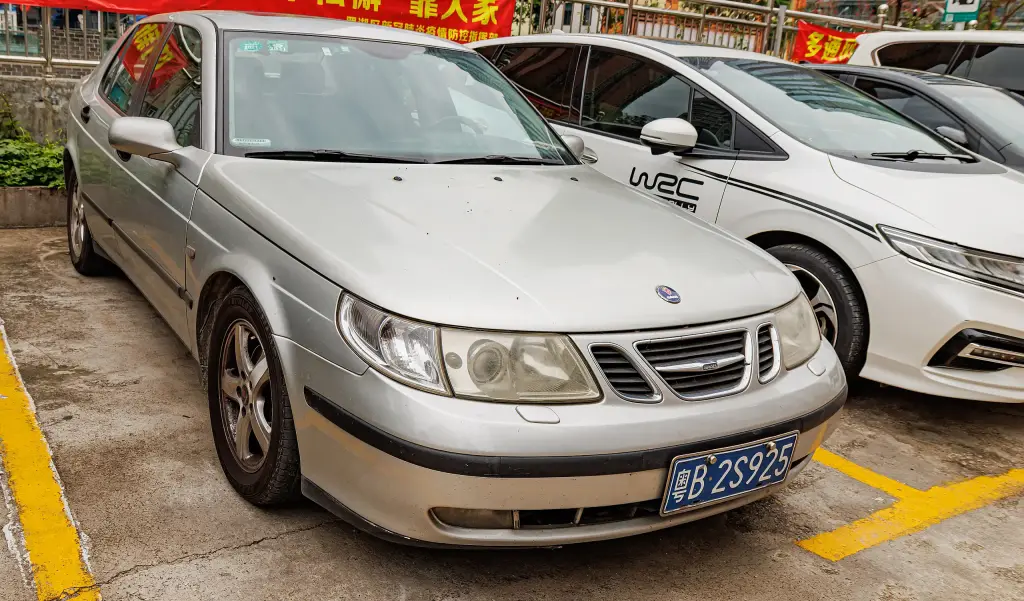
The engine range started with Saab’s own turbocharged four-cylinders, the B205 and B235, and from 1999 included a 3.0-litre V6 turbo with an unusual asymmetrical turbocharger, sold only with an automatic gearbox. Diesel versions followed in 2002, first an Opel 2.2-litre unit and from 2006 a 1.9-litre engine from Fiat. Some early B2x5 engines suffered from oil sludge, and Saab issued a workshop bulletin, revised the crankcase ventilation in 2004 and extended the engine warranty in 2005.
The 9-5 introduced Saab’s active head restraints, which move up and forward in a rear impact to reduce whiplash, and it was one of the first cars with extensive side-crash protection. The front seats had torso and head airbags even on the earliest cars, and electronic stability control became standard in 2002. In 2005 Saab added the 2.0t BioPower version for E85 fuel, followed by a 2.3 turbo BioPower in 2007; in the same year a 9-5 E100 concept with 300 PS was shown.
Production of the first generation ended in July 2009 for the sedan and on 1 February 2010 for the wagon, after 252,236 sedans and 231,357 wagons, a total of 483,593 cars. The second generation was presented at the Frankfurt Motor Show on 15 September 2009 and built from March 2010, the first Saab launched under Spyker ownership, although it had been developed under General Motors. Production stopped in 2012 during Saab’s liquidation.
Design and features
- Ventilated seats: the 9-5 was the first production car to offer them.
- Saab active head restraints: designed to reduce whiplash in a rear impact.
- Asymmetrical turbo V6: a 3.0-litre unit with a single turbocharger feeding both banks unequally.
- SportCombi wagon: floor tracks and a sliding load floor for easier loading.
- Night Panel: the instrument lighting can be reduced to the essentials at night.
Saab 9-5 versions
- Sedan (1997–2010): the original four-door body.
- SportCombi wagon (1999–2010): estate version with a sliding load floor.
- Aero: the performance version, with the most powerful turbo four.
- 2.0t and 2.3t BioPower: E85-capable versions from 2005 and 2007.
- Second generation (2010–2012): larger car on a General Motors platform, built in Trollhättan.
The 9-5 replaced the Saab 9000 and sat above the Saab 9-3. Its sports version is described in the article on the Saab Aero. More cars are in the Saab collection.
Video: Test: neuer Saab 9-5 2011
Video by the uploader on YouTube.
Sources
- Saab 9-5, English Wikipedia: history, engines, safety, production totals