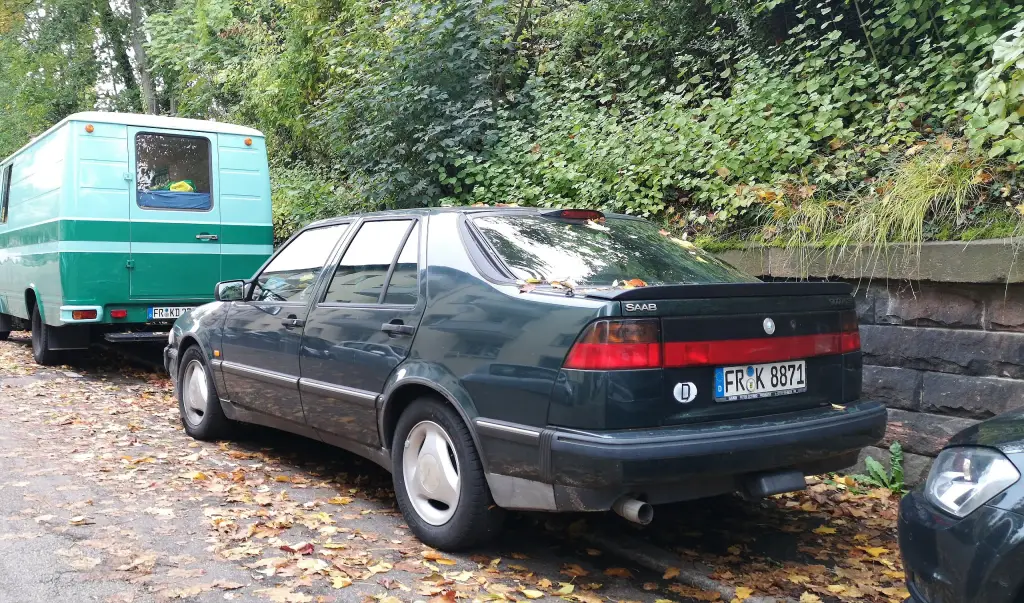
The Saab 9000 was Saab’s executive car from 1984 to 1998. It was developed on the Type Four platform shared with Fiat, Lancia and Alfa Romeo, and it was the model that took Saab into the large-car class with a transverse engine and a hatchback body. A total of 503,087 were built.
Saab 9000 at a glance
| Production | 1984–1998 |
|---|---|
| Presented | 24 May 1984, Kolmården |
| Platform | Type Four, shared with Fiat Croma, Lancia Thema, Alfa Romeo 164 |
| Designers | Giorgetto Giugiaro and Björn Envall |
| Bodies | five-door hatchback (CC and CS), four-door saloon (CD) |
| First engine | 2.0-litre turbo 16-valve, 175 hp |
| Drag coefficient | 0.34 |
| Engine layout | transverse, front-wheel drive |
| Rear suspension | beam axle, MacPherson struts at the front only |
| Built | 503,087 |
| Replaced by | Saab 9-5 |
Based on one source, the English Wikipedia article on the 9000.
History of the Saab 9000
The 9000 was designed as part of the Type Four programme, a joint development with Fiat. Fiat used the same platform for the Fiat Croma, Lancia Thema and Alfa Romeo 164, and the Croma and Thema looked outwardly similar to the Saab; the doors, for instance, appeared interchangeable. In practice Saab strengthened the body for American crash tests and fitted heavier side-impact protection, so only seven parts were actually shared, and the front of the Saab was completely different. Where the Italian cars had independent suspension all round, the 9000 used MacPherson struts only at the front and a beam axle at the rear.
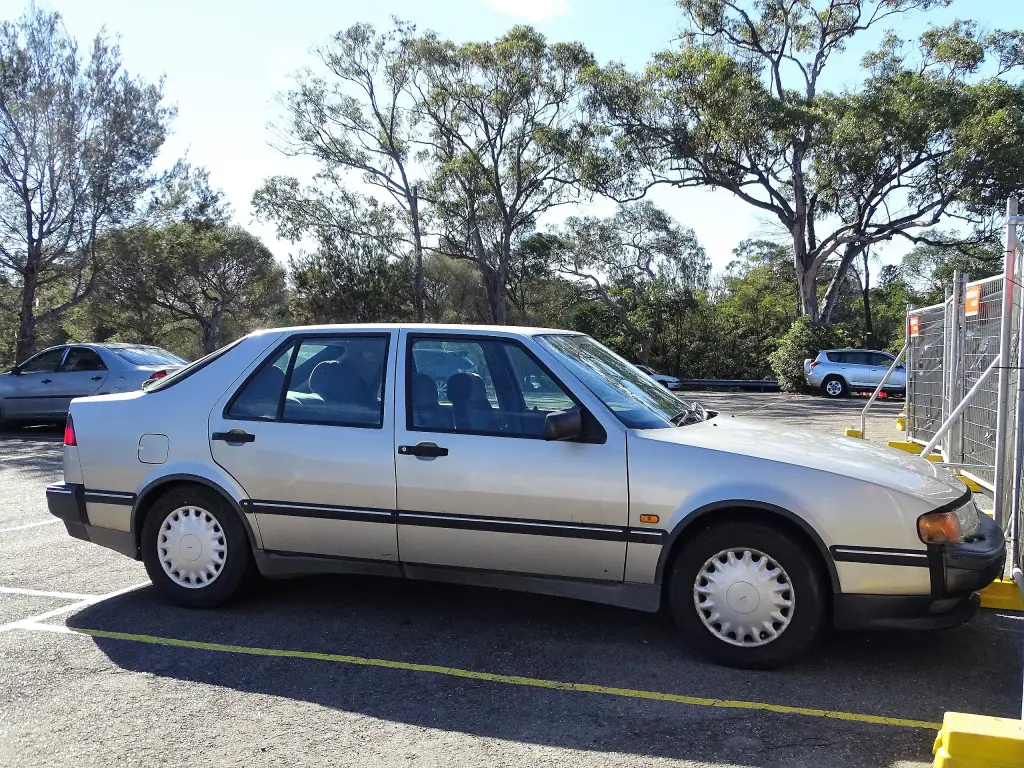
The car was styled by Giorgetto Giugiaro together with Saab’s own designer Björn Envall, and it was shown to the motoring press at Kolmården on 24 May 1984. The first version, the 9000 Turbo 16, was a five-door hatchback with a manual gearbox and the 2.0-litre turbocharged 16-valve engine already known from the 900, producing 175 hp without a catalytic converter. Its drag coefficient of 0.34 was competitive for the time. Although the 9000 was shorter overall than the 900, its longer wheelbase and transverse engine gave it far more interior space, and in America it qualified as a large car.
The first year’s cars suffered from weak structural rigidity and could crack if fitted with tow hooks or sunroofs, and early cars could not pass American crash tests; the body was reinforced continuously during production. For 1986 the 9000 reached the United States with a catalyst-equipped 160 hp turbo, and a naturally aspirated 125 hp engine joined the range. In the autumn of 1986 Saab ran three 9000 Turbos for 20 days and nights at Talladega, covering 100,000 kilometres in 21 days and setting 21 international and two world records; the event was commemorated with Talladega special editions.
A four-speed ZF automatic became available for 1987, and for 1988 Saab added the four-door CD saloon with a smoother, more streamlined front. Production ran until May 1998 and the car was replaced by the 9-5. Of the 503,087 cars built, 216,385 were the original CC hatchback, 174,525 the later CS and 112,177 the CD saloon.
Design and features
- Type Four platform: developed with Fiat and shared with the Croma, Thema and 164, but with Saab’s own front end and rear axle.
- Turbo 16: the 2.0-litre turbocharged 16-valve engine carried over from the 900.
- Space efficiency: a transverse engine and long wheelbase packed a large-car interior into a compact overall length.
- Talladega record: three cars covered 100,000 km in 21 days at the American speedway in 1986.
Saab 9000 versions
- CC hatchback (1985–1991): the original five-door, 216,385 built.
- CD saloon (1988–1997): four-door notchback with a smoother front, 112,177 built.
- CS hatchback (1992–1998): the facelifted five-door, 174,525 built.
- Talladega editions: special models marking the 1986 endurance run.
The 9000 replaced the Saab 99 at the top of the range and was itself replaced by the Saab 9-5. Its smaller stablemate was the Saab 900. More cars are in the Saab collection.
Video: Saab 9000 Turbo testdrive 618,7 bhp.
Video by the uploader on YouTube.
Sources
- Saab 9000, English Wikipedia: development, engines, production totals