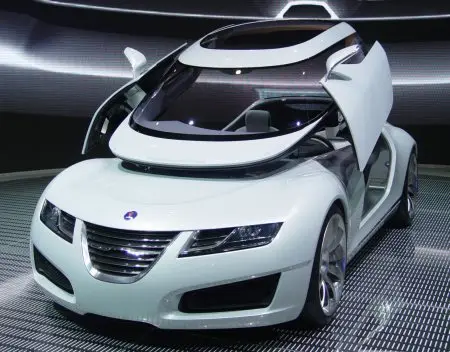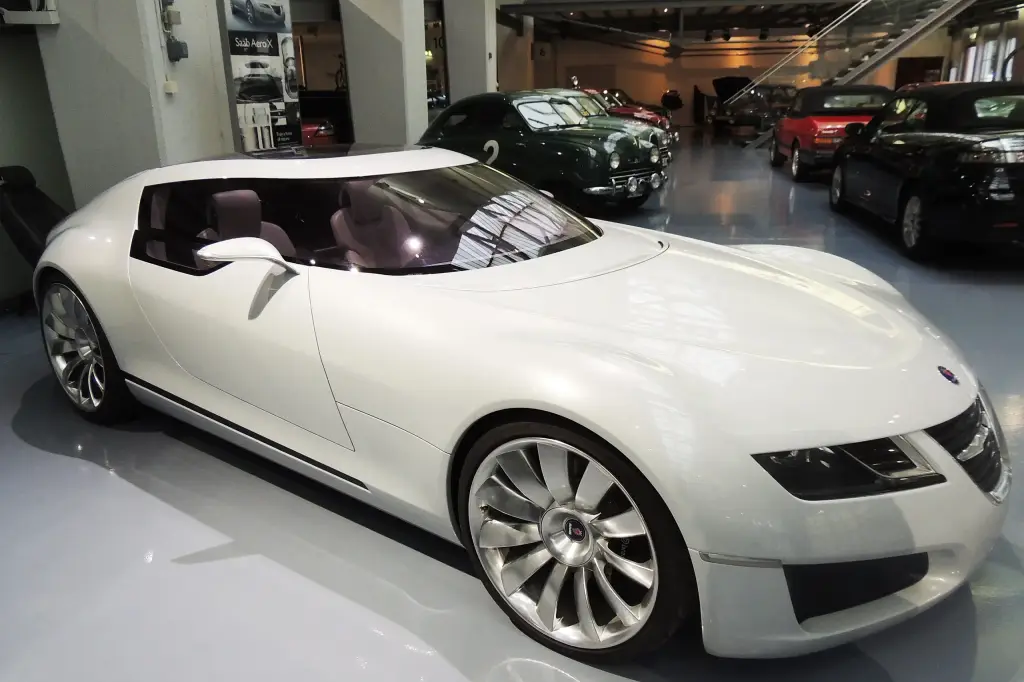
The Saab Aero-X was a concept car unveiled at the 2006 Geneva Motor Show. It had a carbon-fibre body, a 400 hp twin-turbocharged V6 running on pure ethanol and, instead of doors, a cockpit canopy that lifted the entire top section of the car.
Saab Aero-X at a glance
| Type | concept car |
|---|---|
| Unveiled | 2006 Geneva Motor Show |
| Engine | 2.8-litre twin-turbo V6, 400 hp |
| Fuel | pure ethanol |
| 0–100 km/h | 4.9 seconds, predicted |
| Top speed | 255 km/h |
| Gearbox | seven-speed manual with paddle shifters |
| Drive | four-wheel drive |
| Body | carbon fibre |
| Doors | cockpit canopy, no conventional doors |
| Seats | two |
| Suspension | electronically controlled |
Based on one source, the English Wikipedia article on the Aero-X.
History of the Saab Aero-X
The Aero-X was shown at the 2006 Salon International de l’Auto in Geneva. Its 2.8-litre twin-turbocharged V6 ran on pure ethanol and produced 298 kW, or 400 hp. Saab predicted a 0–100 km/h time of 4.9 seconds and a top speed of 255 km/h. Power went through a seven-speed manual gearbox operated by paddles on the steering wheel, and like the later Saab Turbo X the concept had four-wheel drive.
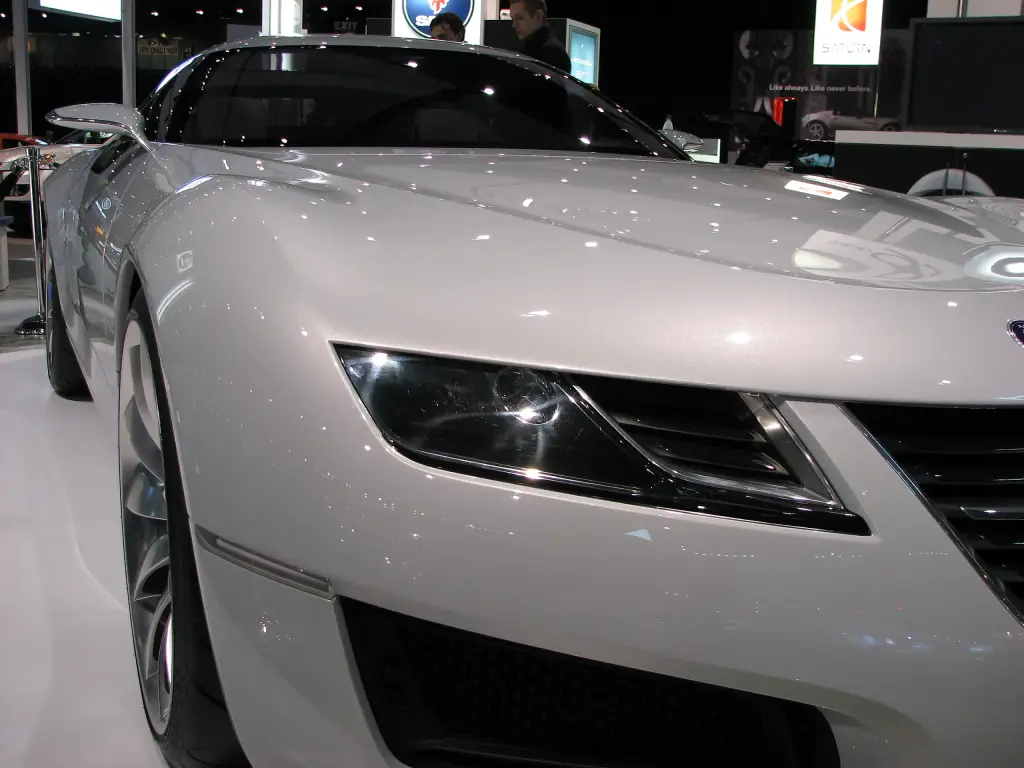
The most striking feature was the way the car opened. The doors and windscreen were connected, so rather than conventional doors or gullwing doors the Aero-X used a cockpit canopy: the entire top section lifted away. This gave the driver a full 180-degree view and made it easier to get in and out of the low cabin. The body was made of carbon fibre and the suspension was electronically controlled.
Although it was a two-seat sports car, the Aero-X had reasonable storage: two compartments at the rear, one reached through a conventional hatchback and one through a sliding drawer underneath. The interior was described as clean Scandinavian design, with no ordinary dials or buttons; data appeared on acrylic “clear zones” as graphic 3D images, and all interior and exterior lights used LEDs.
The concept was well received, and many enthusiasts called for it to be produced. Victor Muller of Spyker, later the owner of Saab, responded on the SaabsUnited website that it was not a priority for the company. General Motors executives described the car as a statement of Saab’s design direction, and elements of its frontal design later appeared on the facelifted Saab 9-3 Sports Sedan, the second-generation Saab 9-5 and the Saab 9-4X. The Aero-X was rumoured to appear in the film Transformers: Revenge of the Fallen, but it was not used.
Design and features
- Cockpit canopy: the whole top of the car lifts instead of opening doors, giving 180-degree vision.
- Ethanol V6: a 2.8-litre twin-turbo unit with 400 hp running on pure ethanol.
- Carbon-fibre body: with electronically controlled suspension and four-wheel drive.
- Digital cabin: acrylic clear zones with 3D graphics instead of dials, and LED lighting throughout.
Saab Aero-X versions
- Aero-X (2006): the single concept car shown in Geneva.
The Aero-X followed the Saab 9-X concept and influenced the design of the Saab 9-3, Saab 9-5 and Saab 9-4X. More cars are in the Saab collection.
Video: Saab Aero X Concept Car promotional video
Video by the uploader on YouTube.
Sources
- Saab Aero-X, English Wikipedia: engine, body, interior, reception